The Open Source Economy: from software to restaurants…

open source

open source

Pretty much everyone is familiar with open source software. However, the concept is transcending into other industries. Hence, we label this trend ‘The Open Source Economy’, an economy where organizations don’t design to protect (patent) but rather to spread (share). The idea behind open source is that someone can take an idea or design and develop it further – which in turn can lead to better solutions.

Roots: Open source software – Drupal

Drupal is the most widely used open source web content management system. It is used as a back-end system for 1% of all websites worldwide. Drupal is behind complex websites such as whitehouse.gov; data.gov.uk and even Ebay. In addition companies deploy it for knowledge management and/or business collaboration. Telenet for instance, the largest provider of broadband cable services in Belgium, used Drupal to develop their knowledge base.

Open source in other industries?

  • Publishing – Open Source Magazine: The July and November issue of a South-African magazine “hip2b2” only consisted out of open source content licensed under a Creative Commons.
  • Fashion – Open Source Fashion Label: A label for green and fair fashion items is open: other designers and artists are invited to enrich the label with their own creations. The label ensures that the product is high-quality and sustainable.
  • Automotive – Open Source Eco-car: An open source project that aims to design the car of the future. More than 800 people collaborated on the car’s blueprints. Those blueprints are publicly available under an open source license. The new car is open for modification by others as long as any derived works are shared with the public as well.
  • Food / Lifestyle / Leisure – Open Source Restaurant: At a restaurant in Amsterdam, everything starts with a web-based documentation platform. The web app allows people to share their with others and the restaurant deploys it for crowdsourcing basically for anything. What’s more, the instructions for creating a similar restaurant yourself are available online.

How to “open source” your business?

Open source seems a sustainable recipe for success. We’re not saying you have to comply with this trend but why not consider it at least? Is it also applicable to your activities? If you were to transform into an open source business, how would that affect your current workflow (a.k.a. cost structure)? What market advantages would you get from it? Would it result in a unique position that positively impacts your bottom line?

Need ideas? Generate them with us.

Just contact us, leave a comment, follow on twitter, etc.
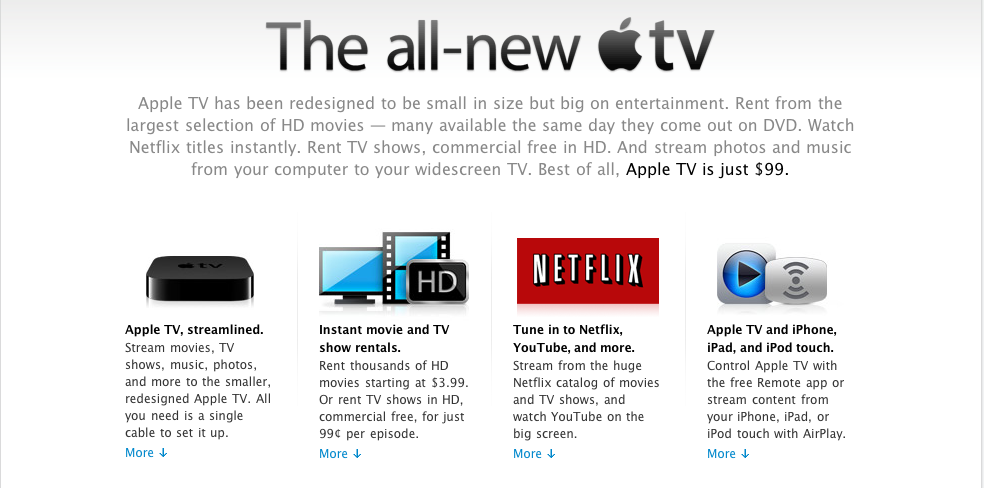
Apple, Microsoft and Google to battle for internet-tv. Sony for victory?

Apple TV

Apple TV

Apple, Microsoft and Google try to acquire a strong market position for the rising internet-tv industry. We feel that everybody is underestimating Sony. Sony takes a different approach compared to the “big 3”. The strategy could well result in Sony being definitely one of the players within the internet-tv market space. Here’s why.

Internet-tv, Apple, Microsoft and Google

Internet tv brings the experience and options of the web to your television set. In order to integrate both media, the big 3 are eager to set the standard. Microsoft for instance is talking to the big media concerns to offer a new television service over the Xbox 360. In this respect, it follows Google’s path. Google launched Google TV in cooperation with Sony and Logitech but the project is not loved by the big media concerns because of the “free specs” of Google TV. Apple in turn released a new version of Apple TV.

What about smaller players as Netflix and Hulu?

The “Big 3” are facing competition in the US by smaller companies like Netflix and Hulu. Over time these services already became an alternative to classic cable subscription. But how do the big ones react to their offerings? The way to handle the “small players” seems to integrate their services. We notice that Netflix can be accessed through Apple TV, PS3 and of course Google TV.

The Sony Strategy: frenemies

Sony is betting on two horses. On the one hand, they co-create with their “frenemy” Google to support Google TV on Sony hardware. On the other hand, Sony is strong in the console gaming market with its Playstation. Gamers can also use the Playstation to enjoy internet-tv services. In this manner, Sony is in the market from multiple perspectives: a strategy that almost guarantees success.

Internet-tv to enter mainstream via gaming consoles?

The above cases make clear that internet-tv might be a service that enters mainstream via gaming consoles. What other manufacturers within this industry could have an impact on internet-tv? Nintendo? How user-friendly is navigating the web with a “Wii”? The Netflix services can already be accessed through a Nintendo Wii, so it will be interesting to see what role they will play…

Or will traditional electronics manufacturer play an important role?

While working on this article, we ran up to an interesting article discussing the position of Samsung within the internet-tv market. We suggest to read it here: “5 social media Apps for your Internet tv”.

The app store economy: an innovative price model for publishers?

News behind a pay wall?

News behind a pay wall?

Newspaper publishers suffer for years now. The number of readers is going down – and as a result advertisers are less interested to put an advert in a newspaper. With the rise of the app store economy, publishers have the chance to come closer to a price model that works.

Strategy 1: news behind a pay wall?

In order to generate revenue there are plenty of newspapers who have turned news into paid content. The UK Times experiment with the paywall demonstrates that people say “No, thanks” and click away to another site when faced with a paywall at a news site. Source: The Times UK Lost 4 Million Readers To Its Paywall Experiment

Strategy 2: look at other industries (gaming industry) – The app store economy

The app store economy - innnovative pricing through inn-app purchase

The app store economy - innnovative pricing through inn-app purchase

Since there are loads of buzz within the publishing industry about publishing for the iPad, why not have a look at the opportunities of the app store economy? In the beginning of the Apple App Store, you had free apps and paid apps. After a while, they added a functionality called “in-app purchases”. In-app purchases mean that you can offer the apps for free and charge upgrades in the app – like e.g. in the gaming industry new levels.

Price model innovation newspapers: app store and in-app purchase

Consider this: a newspaper publisher creates an iPad edition. Would it make sense to offer the app for free, allowing everyone to read the entire newspaper on iPad? Would it make sense to limit the free articles to 3 and then offer “in-app purchase options” if one wants to read more? Would it make sense to show a summary of all articles and offer “in-app purchase options” to get the entire article?

We’d love to see publishers experiment with it and see whether the strategy from one industry can be applied to another one.