Music Maestro! Shantel & FIHP to spark off Whispering Web TV.

Closing Summer with a Big Party

At the end of this summer I decided to take some time off and just enjoy myself with some spare time. After all, it was summer and I didn’t take a break from work. What’s more, I still didn’t up until now. However, I’m quite convinced though that I’ll take my lazy ass to a beach in October. Plenty of places in the world still offering summer in October: Egypt, Thailand, Indonesia, …

FIHP & Shantel

One of the best experiences in my summer was the concert and performance from Shantel at FIHP.

Because I spend an excellent time and just like music really much, I want to share My experience with you. Hence I made a little video. And while producing that video, I came up with the idea to start my very own TV Channel.

Shantel to spark off Whispering Web TV! Yes, I might do videologs now to tell a story instead of writing it down. Yes, I might record cool keynotes on public events and share them on the Whispering Web TV Channel. Stay tuned!

Crises, Rebels, Journalists & Bloggers. On labels & labeling.

TV News

TV News

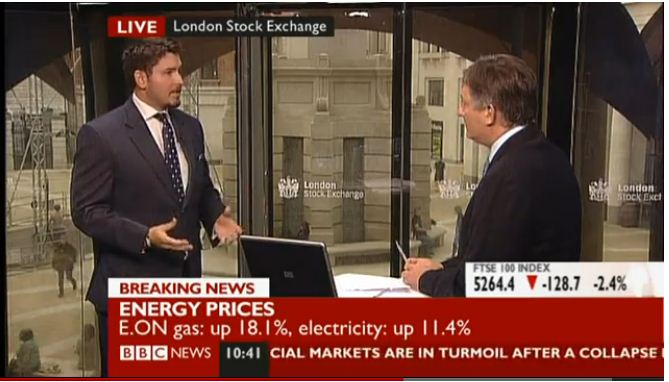
I’m not that different from any human being on this planet. I also watch TV news bulletins almost everyday. Yes, it offers me a window to the world. It shows me what’s going on. However, I came to realize the news is a heavy filter. Time to pull up the shutters, it’s noon.

On Labels & Labeling.

Labeling is describing someone or something in a word or phrase. That specific word or phrase is consequently a “label”. Without going into details of labeling theory, it’s important to realize that the very act of labelling is necessary for communication. You have to give something a “name” (aka label) so to communicate about it right?

It’s logic that journalists deploy labels and labeling techniques. After all, they are all human beings. However, they are human beings with a dramatic impact on society. Their act of labeling impacts how most people on the globe think about and frame certain events, evolutions, etc.

Let’s demonstrate “labels and labeling” with 3 real-life examples.

Example 1: multiple labels for 1 phenomenon

Mortgage crisis, credit crunch, debt crisis, economic crisis, etc.

I guess you’re quite familiar with the above “labels” today, as they have been largely present since a couple of years in the news. What’s remarkably striking however is that these terms have been deployed consecutively, one by one, the one after the other. In this manner it seems as if we’re hit by multiple different crises. I believe this is not the fact. All labels in fact point to one deeper phenomenon: rectification of global power values.

Global Power Value Rectification

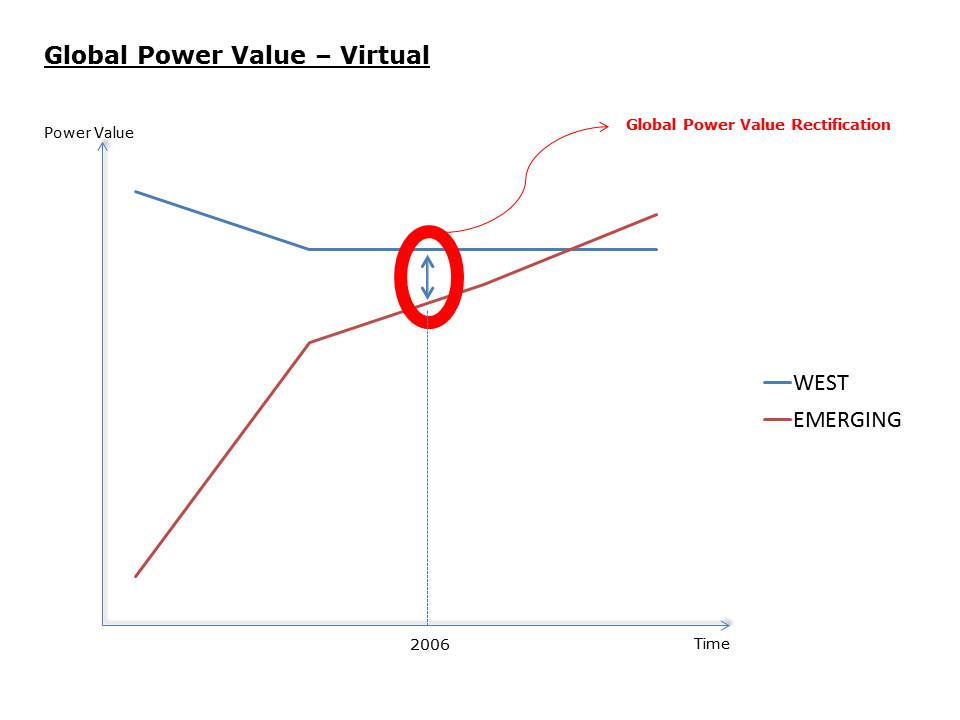
The concept of Global Power Value Rectification is not that easy to understand. Maybe that’s why journalists don’t use it to frame the crisis story. However, as a non-journalist, you have more time for interpretation and analysis. So why not try to explain this concept and consequently understand the framing of the different crises. I hope the below definition and graphics make clear what I label “Power Value Rectification”.

Global Power Value Rectification is:
a rectification process by which
a discrepancy between the Value in Reality and the Virtual Value
is manoeuvred away through crises.
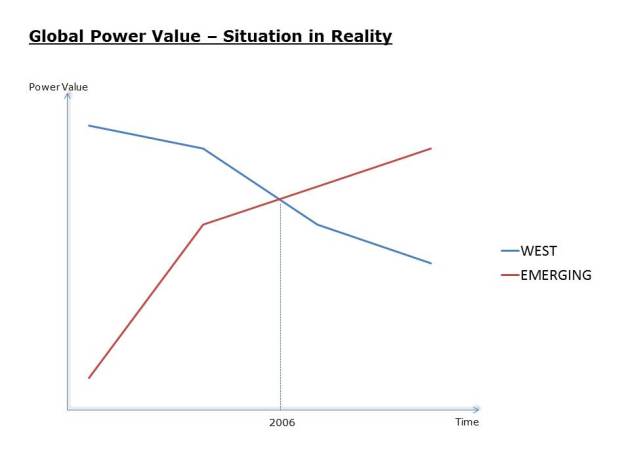
Global powers - a reality check?

Global powers - a reality check?

Global Power - the virtual situation not aligned to reality?
Global Power Value Rectification as underlying phenomenon to frame the crisises.

Global Power Value Rectification as underlying phenomenon to frame the crisises.

Well, that should be about it for the first example of “journalistic labeling”.

What I’m trying to prove here is that all crisises are related and have a deeper reason: the change in global power. The crises are the process that rectify the difference between real and virtual value. There’s only a new name (label) to it because it happens at different structural levels that construct society. Once all structures have gone through their crisis, the deeper reason – rectify global power – is gone and consequently all crises, up until a new rectification is required.

This was a rather difficult example of journalistic labels, I know. But it was the starting point in my thinking on labels, so it’s a well-deserved first place. The next case should be easier to understand: the labeling of freedom fighters as “rebels” during the Arab Revolution.

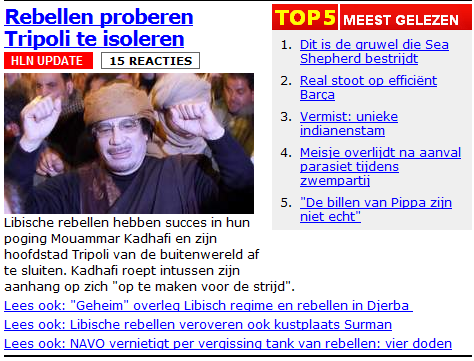
Rebels Journalistic Framing - HLN.be (rebellen = rebels in Dutch)

Rebels Journalistic Framing - HLN.be (rebellen = rebels in Dutch)

Example 2: The label “Rebels” in Arab Revolution

You often hear about the “Rebels” fighting the Arab Revolution. Quite frankly, this is a pretty strange label. After all, these people are actually fighting for freedom. Labelling them freedom-fighters would make a difference. Why do you call them rebels? I happen to associate the label rebel with negative and bad feelings, while freedom-fighter suggests they are “rebelling for a cause”. What about you?

Example 3: The label “Journalist” and the label “Blogger”

Overlooking what’s being said above, one can state that journalists are still important to provide us a window to the world but that we should always keep in mind that they are also humans who use labels so to interpret, understand and communicate about the world. I believe there might be a role for additional interpretation from bloggers around the globe.

It might be note-worthy in this respect to relate this to the “blogger vs journalist debate”. A journalist is formally employed at a professional media organization whereas a blogger is a more ad-hoc individual initiative. As a result the blogger has more freedom, time, less pressure and is able to frame stories more in-depth. Or am I just completely wrong on this whole labeling issue?
I’m sorry not to auto-follow back on Twitter. On Twitter goals.

Auto-Follow on Twitter

Auto-Follow on Twitter

Please follow me back. Erm, nope, sorry.

You probably noticed it: your Twitter follower counter goes nuts on a daily basis. It’s quite remarkable how this number fluctuates massively. I guess we should all be pretty glad that stock exchanges are more stable. But why is it then that this number is so damn fickle?

Twitter: getting followers

I know, you want followers. And that’s quite logic since it doesn’t make any sense to spread messages through-out the real-time web without any human being (nor animal I believe) ever noticing your efforts. I don’t want to provide tips or guidelines to get followers here. But I do want to break down at least one strategy.

Auto-follow people who follow you

I noticed some people just assume that you follow back when they follow you. I have some issues with this approach.
Yes, it’s friendly. Yes, it’s social. But does it add any value?

Alternatives to your Auto-Follow strategy

If you want to be followed I recommend deploying other strategies, like sharing and spreading compelling content. Use hashtags to broaden your range. Some people look for new Twitter accounts via keywords / hashtags. If you pop up there, you might get a chance of being noticed … and followed as a consequence.

Another approach could be to not just ask for “follow me back” but to surprise the account by mentioning him/her in a creative, funny or clever way. Tickle me through an @-mention and the odds of getting followed rise dramatically!

Why I don’t auto-follow back? My Twitter Goal

I look at Twitter as an infosphere that I put together myself. Twitter is as my home-cooked first-class private teacher in Business and Marketing. I put a lot of effort in finding the right people to educate me, to follow. What’s more, it took me about a year to create a satisfying infostream. Yes, Twitter is full of crap. Finding the right people isn’t easy.

Without being rude, just adding people as a friendly gesture because they follow me, would just break down all my previous efforts.

Am I just a bastard? Checking who follows you takes time

I might sound like a bastard to you now. You might think I don’t appreciate your following. But of course I do! And I don’t want to be a bastard. Sincerely, I’m not. I just have a Twitter goal.

From time to time, I go through my follower base and look for people to connect with. Speaks for itself that those people do make a chance to become an essential part of my “virtual MBA Professor”. However, this takes some time. So if you’re waiting for a follow-back, please note that this can take up to 2 or 3 months as from the day you connected with me.

Follow on Twitter

Follow on Twitter

How do you use Twitter? What’s your goal?

It’s completely legal to disagree on the above thoughts. But that’s just the way I use Twitter. If you want to label me as a selfish bastard for using Twitter in this manner, please do so. And if you want to hit the “unfollow button”, do as you please, that’s legal as well. What’s more, I once was the “King of follow and unfollowing”. After all, I had to cook that teacher I was envisioning.

So, that’s about it. Don’t hesitate to “Follow or UnFollow” me on Twitter.
But what would be more of my interest: What’s your Twitter goal?