The power of Twitter for websites: own test results.

Tweeting the day away via your smart phone?

If you’re a Twitter user, you know what it’s all about. For those who don’t: twitter is a micro-blogging platform that allows you to send out messages (limited to 140 characters) to the entire world.

Twitter - search for information

Twitter - search for information

Twitter for business purposes?

If you’re in business you might think of adding a “Twitter account” to your marcomm mix. After all, it might drive traffic to your website. Once you have those “Twitter-people” on your website, you can start to convince them. But not everything will turn into sales…

What else might happen?

  • A “tweet-reader” ends up on your webpage and decides to tweet about your webpage…your webpage has been broadcasted to people you never reached in the first place…
  • A tweeter retweets your statement and as a result your phrase is shared with people that didn’t initially follow you.
  • A tweeter might list you within a specific theme
  • A tweeter is by definition rather unpredictable, so almost everything might happen

My test results: this blog, the Bizz2Sozz twitter account

Based on the date of my first post, I started this blog at the end of February. While setting-up the blog, it came to me that to spread the ideas on this blog, another channel should come into play – as I can’t solely rely on my bloggin’ skills (if I have them, for you to decide). For this reason, I turned to Twitter.com and set-up an account.

Every time I posted a story on my blog, I tried to give it publicity by tweeting my views over the twitter platform. (I have to be honest: I forgot it a couple of times and backed this up by tweeting all articles at once. I know, not the perfect strategy). The workflow is rather easy: I write a blogpost, after which I summarize what’s in the article and add a link to the article (all in a 140 character phrase!).

Result today: a nice woman from Italy re-tweeted one of my stories, started to follow me and added me to a themed list. What will this bring along? New followers? We truly hope so, since the Italian woman is already followed by over 1 000 people, my article is now within the reach of more people than the 20 daily visitors on this blog and my 5 twitter-followers. If I have a closer look at this blog web stats … I can already see that the re-tweeted article is currently my “most read article”…

A re-tweet in Italy: no more words, just an image

Twitter, micro-blogging, sharing

Twitter, micro-blogging, sharing
Share

Vuvuzela: why to love it? Lessons from ethnomusicological classes

These days there’s a lot of “buzz” about the usage of vuvuzela instruments at the World Cup Football in South Africa. People seem to be annoyed by the “vuu-vuu” noize. Nevertheless, I want to make a case for the Vuvuzela.

vuvuzela

vuvuzela

Ethnomusicology.

A couple of years ago I was glad to take a class called “ethnomusicology”. Ethnomusicology is a branch within musicology. The first studies social and cultural aspects of music in local and global contexts as opposed to the latter which is more designed for and dedicated to Western art music (classical music). So to speak, ethnomusicology studies music as a human, social and cultural phenomenon.

Lesson from the classes about African music

One crucial aspect about the “music” (regardless of their diversity) in African societies is that it was (is) an inseparable part of societal live. This means e.g. that African music has to be understood within the realms of other structures that evolve around the “tones” and “noises”. Those structures are: events (religious or profane: a celebration), dance moves, costumes,  body paintings, …

Well, I guess you already start to see the link between the world cup and the vuvuzela. It’s just a habit, a ritual  – so don’t be annoyed by it.

The “vuu-vuu” noise as a means to a state of trance

Some traditional African music had the aim to get in some sort of “trance” in order to get closer to nature or God (for instance). I believe the monotone sound of the Vuvuzela is rather reverberating instead of annoying. I can imagine that the players on the pitch never really notice the “vuu-vuu” sound – but instead feel a certain “drive”, “tempo” that encourages their play.

Share

On the oil spill: BP to deploy SEM techniques for reputation management

BP deploys SEM techniques for reputation management

BP deploys SEM techniques for reputation management

BP: attack on nature and mankind?

You might have heard about it: there’s an oil leak in the Gulf of Mexico. BP – held responsible for this disaster – is doing everything within its reach to solve the issue as soon as possible. Instead of discussing the engineering operations by which the company is trying to stop the leak, I want to say a word or two about the marketing (public relations) aspects that come into play.

Reputation at risk.

Needless to say that a natural disaster can seriously harm the reputation of a company – resulting in fewer “likers” (cfr: the Facebook like hype on external websites…) or even less people willing to fill up their car at a BP service station. For BP this is as much a disaster as is the oil for the nature and our planet. BP can’t afford to have a decrease in revenue – the cost of the oil spill is already sufficiently high.

Reputation management: what is the reputation?

One could think of BP as a “money-making machine while destroying our planet”. One could think that is correct – but it’s not. In the past – as well as today – BP has been glorified for its environmentally responsible business model. Yes, BP is not just about oil. BP is about: oil, natural gas, wind, solar, biofuels, efficiency, energy security, energy diversity, …

SEM techniques as a means for reputation management

SEM stands for search engine marketing. It is the “art” of positioning website pages in the Google query result pages. One can pay Google to be on the result pages. You’ll end up in the “sponsored links” and pay each time somebody clicks your link. This type of search engine marketing  is called SEA: search engine advertising. An other approach is to build your website in such a way that it organically (without paying Google) lists well in the search results. This type of SEM is called SEO: search engine optimization. The latter is more sustainable than the first, but takes more time to prove its efficiency.

In order to understand the point, one needs to know a bit more about “the psychology of Google result pages”.

  • people usually look no further than the results displayed on page 1
  • people believe that they receive good information via this technology – and they actually do !
  • people believe the “best” companies are  at the top of the list
  • Google has become the number 1 source for people to obtain information.

Is SEM a powerful reputation management technique?

SEM, both SEA and SEO, are valid reputation management techniques. As a matter of fact, companies should consider thinking about this aspect not only when dealing with so-called crisis communication.
SEO: long-term reputation management?

What if the first Google result page of your company’s brand name is entirely filled with webpages that you own or that you have relations with? Well, then you would control your reputation when people search for you. How to handle that? Well, just think on the following set-up: index your company (product) specific website in Google, make a Facebook page as well, set up a blog, deploy a twitter account, etc. You’ll note that after a while when people browse your company or product they see pages in Google that are managed by yourself. The reputation that develops in people’s minds is completely under your control.

Why BP ran an SEA campaign

As stated above, SEA is a means to appear in the listing with a finger flick while SEO takes time to have impact. For this reason BP had to run an SEA campaign on the keywords ‘Oil Spill’. Is it wrong to do so? Actually no, it’s not because they paid for inclusion that it is immoral to do so. As a matter of fact, nobody would have questioned BP buying a newspaper page in order to put an ad for e.g. apologies about the oil spill (they might even have done so).

Finally, a word about BP.

Looking at the BP case, we have to admit that they are quite committed to the environment. We see that the engineering operations are doing everything to get the leak fixed as soon as possible. This is also what they want to make clear to the general public. However, if they had deployed a more extensive reputation management strategy before the disaster… it would have been more powerful and people wouldn’t have questioned the adwords campaign that much. Nevertheless: BP is environmentally responsible. They just had a little bad luck with their operations on the Gulf of Mexico…

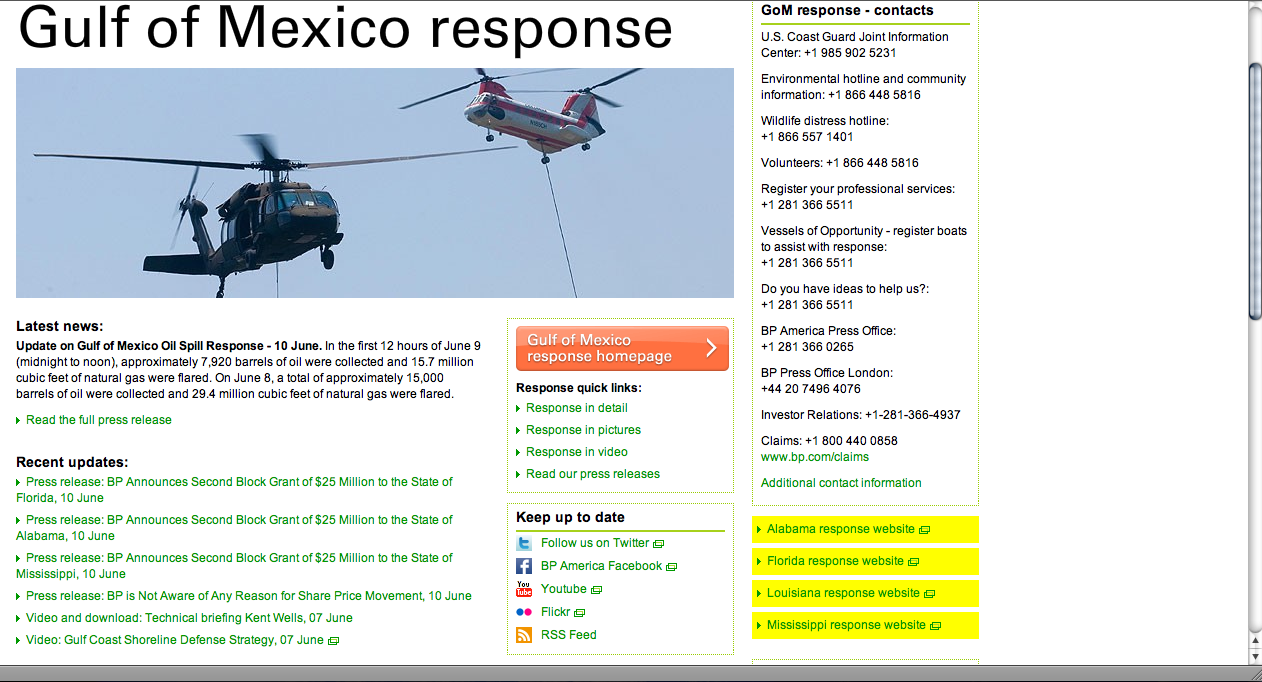
Special reputation management pages on BP.com

Special reputation management pages on BP.com

Live stream of operations at Gulf of Mexico

Live stream of operations at Gulf of Mexico

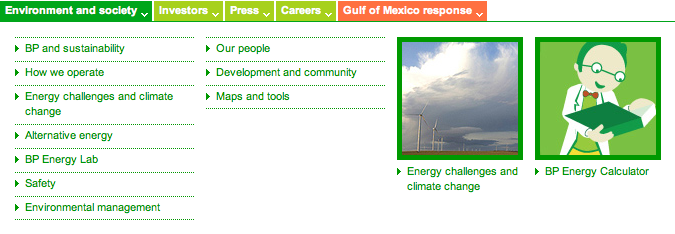
BP's environmentally responsible business program - not specifically related to the leak!

BP's environmentally responsible business program - not specifically related to the leak!

Share