How to make money with Social Media? A new business in "global village"?
October 20, 2010 2 Comments
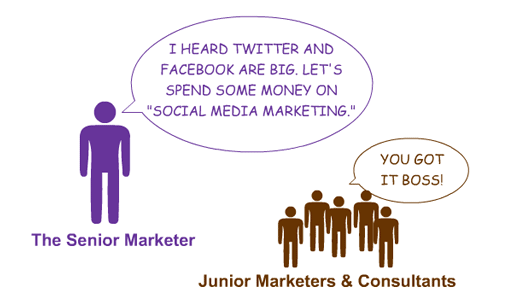
Every young marketer probably has met a C-level executive that made him end up in the same situation as depicted in the cartoons below. (Credits for the cartoons go to this linked website.)
Anyway, it was a starting point for me to come up with a concept of how you can generate revenue with Social Media. As far as my thinking is concerned I came to the conclusion that social media cannot make money for you if you consider, deploy and use it solely as a communication channel. To state it very simply: a Facebook fan page or a netlog advert probably won’t do the trick.
We see a remarkable resemblance with the “status” of marketing within an organization. To unleash the power of marketing you cannot reduce them to channel communication and sales support, just as you cannot simplify social media solely into a communication channel for your business.
To make money with social media stop considering it as a communication channel
Don’t consider social media solely as a marketing channel.
The opportunities of social media should be explored in a far more extensive way then as it being a highly targeted communication channel for marketing messages. The image below demonstrates why this approach won’t result in you generating money with social media.

Why only perceive social media as a marketing (communication) channel?
Create a new value on top of Social Media
If you create new value on top of social media networks, you might create a new market. If you are smart enough to keep your “new value” open for multiple social networks, you have a potential 700+ million euro business ahead of you.
Social Media Photo applications
I came to realize that one important aspect about the usage of social media is to share photographs with its friends, connections, peers, … (you name it). What if you could provide additional value to this “photo sharing experience” in such a way that people actually would want to pay for it? Wouldn’t it be better than “spending money on social media advertising”?
Connect the virtual photo sharing experience with the physical one
Social media profiles mostly contain a section where the user can upload images. In this manner users share their real-life experiences with their peers in the virtual domain. If there was an application that could gain access to all the images of the user and offer the user a user-friendly interface to create and consequently order photo books, postcards, calendars or slide show movies from their social media-assets, one could generate a business from selling those goods.
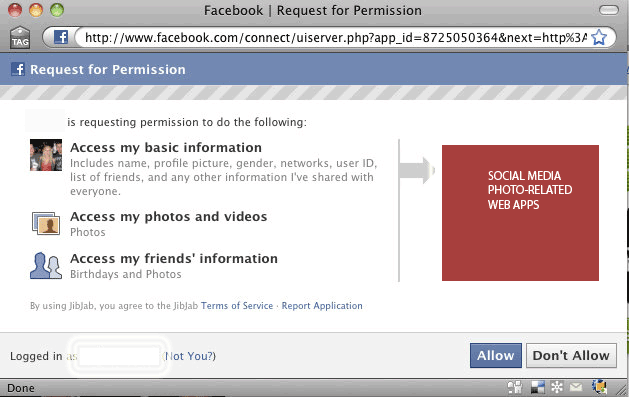
social media apps request for permission to access photo data
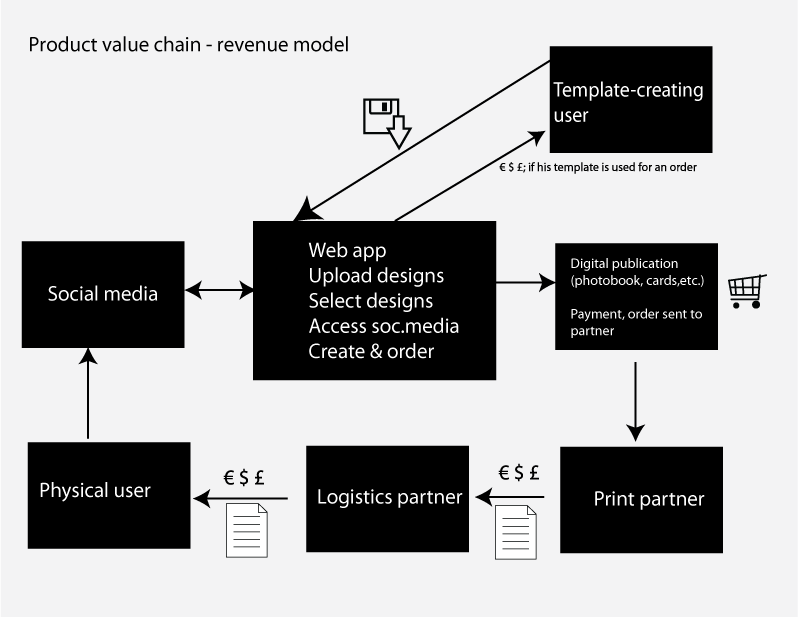
Dirty sketch of the value chain for a social media web app
Social Media Web app specs
- I would make the web app open enough. This means it should be able to access data from multiple platforms: facebook, netlog, hi5 and flickr seem quite appropriate platforms for the app I have in mind.
- The application presents multiple templates to the user: select a photo book template, select a card template, select a calendar template or select to generate a slide show movie. At the start templates and slide show movies are rather limited since they are created by the app developer. The goal is to come up with a business model that encourages people to supply templates to the platform. If another user selects the uploaded template in order to make and purchase a photo book, the creator of the template receives a margin on the order. Templates are created in such a way that there occurs no resolution problem (since the platforms mostly resize the uploaded images, I suppose).
- The user selects a template and consequently selects photos from his social media album.
- The user gets a preview of the template with his photos.
- The user sees a price for his creation and can order and pay it online.
- The user receives his physical good at home. He can now have a physical photo sharing experience as well. What’s more he can use the social media to “testify” about the usage of the photo book application. In fact, you can imagine that one takes a picture of its physical experience (receiving the photo book) and sharing this experience virtually again (indeed, upload a picture of the photo book to the social media platform!).
How could a business model look like for this type of product?
There is a lot to say about a business model and its components, difference with a business plan, etc. Instead of going into an academic discussion about that topic, I will make use of the Business Model Canvas as developed by Alex Osterwalder. I believe his canvas provides a valid framework to design “a business”. The business model canvas is defined by the following building blocks: partners, activities, resources, value proposition, customer relations, channels, customer segments, cost structure and revenue stream.
The image below depicts a thinking exercise on a possible business model of the Social Media Photo Application. It is based on Osterwalder’s business model canvas. It might prove fruitful for reading purposes to download the business model canvas for the social media photo book application as a PDF. (yes click here, this is a link!)

Business model generation by using the BM canvas
Just one more thing, how should one call this type of solution: Social-to-Print?


 Keen on C