Innovate your twitter reading experience: paper.li

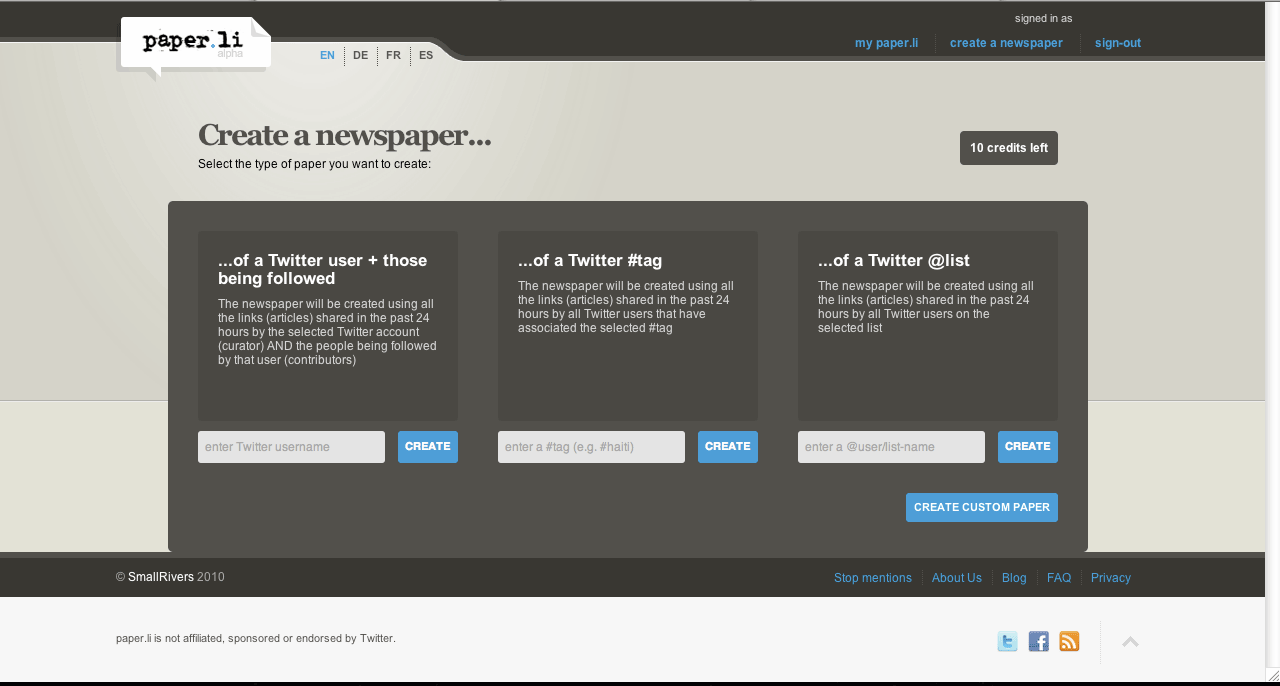
We stumbled upon a lovely and promising web app called “paper.li”. The app organizes twitter feeds into a newspaper-format. Shall publishers and marketing departments soon embrace this innovative technology? Or does the technology need to support multiple output formats before they do?

paper-li - create a newspaper of linked articles on Twitter feed

paper-li - create a newspaper of linked articles on Twitter feed

Your Twitter Feed as a Newspaper

The functionality and benefits of this web technology could not have been summarized better than by the organization that developed the tools. Here it is:

“paper.li organizes links shared on Twitter into an easy to read newspaper-style format. Newspapers can be created for any Twitter user, list or #tag. A great way to stay on top of all that is shared by the people you follow – even if you are not connected 24/7!” – source: paper.li

The Whispering_Web Daily

Of course we’ve been playing around with it and truly love it: great product.
Have a look at the Whispering Web Daily!

Output for other media?

How will the publishing industry and brands embrace this? Will it be a necessity for paper.li to generate an iPad compatible “website”? Will those groups ask for a different experience, such as presenting the stream in the format of a “leaf-through digital document”? Will traditional publishers feel the need to organize the stream in a printable document? Stated differently: is a truly personalized newspaper to become reality in this manner?

Just one more thing: developer of the app embraces Social CRM

As we are publishing this article, the application is being updated. We wonder what the new features will be. Looking forward to it.

But what’s at least equally important: SmallRivers – the app developer – not only builds innovative solutions. It also innovates its operations. In this respect, one could state that they strive to practice concepts as “Social CRM”, “BMI” and “enterprise 2.0”.

The update made clear that SmallRivers’ Customer Service deploys social media to inform their customers. In practice: twitter is used to inform them about the ongoing update. Just great!

Social CRM, one aspect for BMI and enterprise 2.0 (e2.0)?

Social CRM, one aspect for BMI and enterprise 2.0 (e2.0)?

Social CRM via Twitter - Enterprise 2.0

Social CRM via Twitter - Enterprise 2.0

Facebook's history of innovations. What's next?

Facebook - online social network

Facebook - online social network

Facebook is pushing its latest product innovations hard these days. Only within the last three months we have seen the launch of Facebook places, Facebook Groups and Facebook Messaging.

The history of the enterprise seems a history of innovations. What is the next innovation and where will this end?

Facebook: a history of innovations

  • Facebook as a platform is innovative by nature: it redefined our social experiences. Hence, this technology had a tremendous impact on how people construct their identity. From time to time we tend to note a “I publish, so I am-trend”, meaning that if it didn’t happen on Facebook (or there are no traces on Facebook) it didn’t happen.
  • Secondly, with their “connect to facebook” technology, the social sharing experience was opened up to third-party apps.
  • The third innovation that we wish to bring forward is the implementation of the like button across the web. This might seem an easy trick but has loads of consequences. And it’s extremely nice for a savvy marketer! Why? Guess this is food for another blog post…
  • Finally, the innovative new messaging system which is rumored for bringing together text messaging, instant messaging and e-mail messaging. It seems as the Facebook Messaging Innovation took a classic “melt-to-innovate” approach.

Will the next innovation be mobile?

The question for us is: what will be next? What could be Facebook’s next big innovation? Let’s have some ideas flow on that …

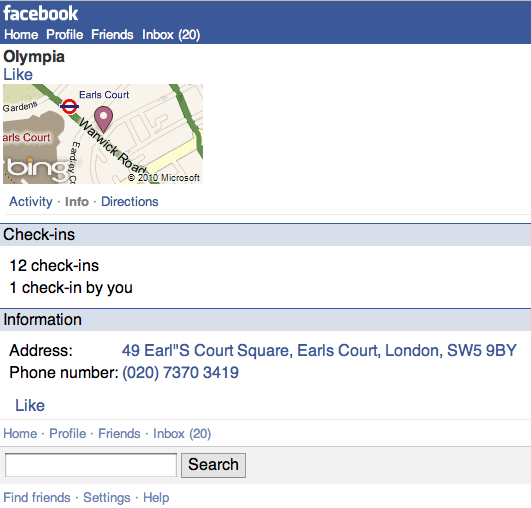
Facebook Places @ Olympia London

Facebook Places @ Olympia London

  • Would a photo book app on top of Facebook be innovative? And what if you could collaborate with your friends on the creation of that photo book?
  • Would an e-newspaper based on posted articles by friends be innovative? In this manner you can leaf through a digital newspaper that contains all news shared by your network.
  • What are the chances they further develop an “office suite” on top of it? Would that be innovative? Would that impact the way employees work? Would it mean the definitive break-through of enterprise 2.0? After all Facebook obtained Docs from Fuse Labs that will allow to co-create and share text documents, spreadsheets and PDF directly within Facebook with all friends, family and (especially) colleagues.
  • Is the next big thing in the mobile sphere with Facebook Places? Shall we get suggestions to drink a beer with a friend in the bar behind the corner? Will it embrace AR technology?
  • Or will Facebook evolve into the basis for artificial intelligence, as one of the main (Russian) investors believes?

Framing innovation

Innovation is about adaptation! We don’t want to bother you with theoretical facts about the adaption of technological innovations, but please realize that in the end, it are always the people who decide whether an innovation becomes a mainstream success or not. For those interested in the theory on innovation & adaptation: it follows the statistical distribution known as Gauss.

Gauss graph - diffusion of innovation

Gauss graph - diffusion of innovation

How to make money with Social Media? A new business in "global village"?

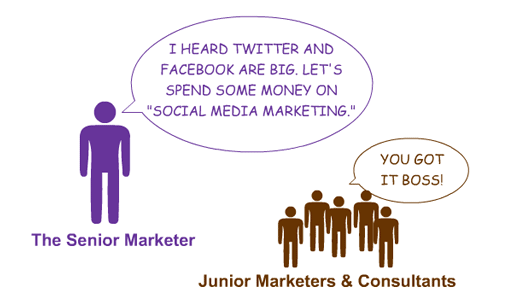
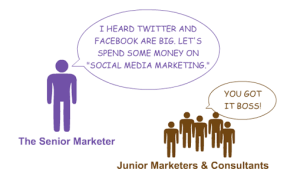
Every young marketer probably has met a C-level executive that made him end up in the same situation as depicted in the cartoons below. (Credits for the cartoons go to this linked website.)

Anyway, it was a starting point for me to come up with a concept of how you can generate revenue with Social Media. As far as my thinking is concerned I came to the conclusion that social media cannot make money for you if you consider, deploy and use it solely as a communication channel. To state it very simply: a Facebook fan page or a netlog advert probably won’t do the trick.

We see a remarkable resemblance with the “status” of marketing within an organization. To unleash the power of marketing you cannot reduce them to channel communication and sales support, just as you cannot simplify social media solely into a communication channel for your business.
To make money with social media stop considering it as a communication channel

To make money with social media stop considering it as a communication channel

Don’t consider social media solely as a marketing channel.

The opportunities of social media should be explored in a far more extensive way then as it being a highly targeted communication channel for marketing messages. The image below demonstrates why this approach won’t result in you generating money with social media.

Why only perceive social media as a marketing (communication) channel?

Why only perceive social media as a marketing (communication) channel?

Create a new value on top of Social Media

If you create new value on top of social media networks, you might create a new market. If you are smart enough to keep your “new value” open for multiple social networks, you have a potential 700+ million euro business ahead of you.

Social Media Photo applications

I came to realize that one important aspect about the usage of social media is to share photographs with its friends, connections, peers, … (you name it). What if you could provide additional value to this “photo sharing experience” in such a way that people actually would want to pay for it? Wouldn’t it be better than “spending money on social media advertising”?

Connect the virtual photo sharing experience with the physical one

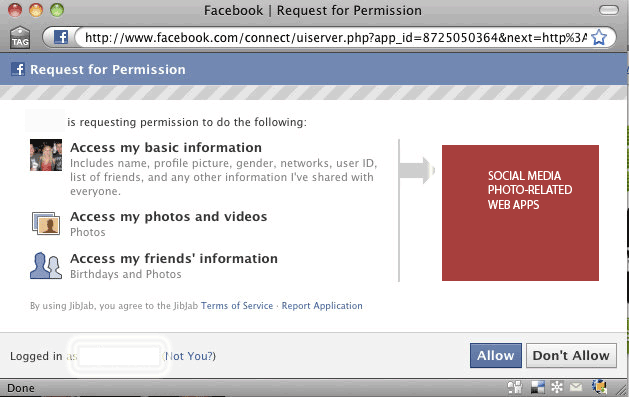
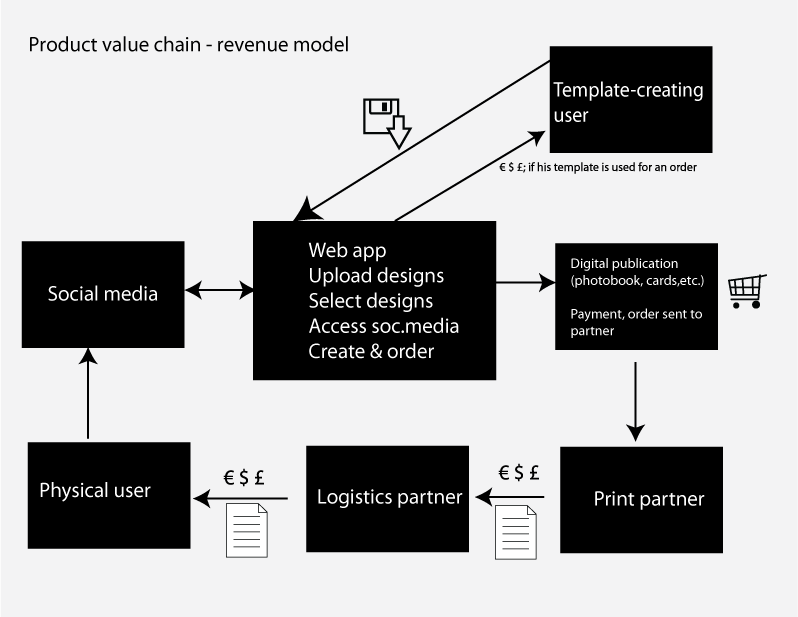
Social media profiles mostly contain a section where the user can upload images. In this manner users share their real-life experiences with their peers in the virtual domain. If there was an application that could gain access to all the images of the user and offer the user a user-friendly interface to create and consequently order photo books, postcards, calendars or slide show movies from their social media-assets, one could generate a business from selling those goods.

social media apps request for permission to access photo data
social media apps request for permission to access photo data

Dirty sketch of the value chain for a social media web app

Dirty sketch of the value chain for a social media web app

Social Media Web app specs

  • I would make the web app open enough. This means it should be able to access data from multiple platforms: facebook, netlog, hi5 and flickr seem quite appropriate platforms for the app I have in mind.
  • The application presents multiple templates to the user: select a photo book template, select a card template, select a calendar template or select to generate a slide show movie. At the start templates and slide show movies are rather limited since they are created by the app developer. The goal is to come up with a business model that encourages people to supply templates to the platform. If another user selects the uploaded template in order to make and purchase a photo book, the creator of the template receives a margin on the order. Templates are created in such a way that there occurs no resolution problem (since the platforms mostly resize the uploaded images, I suppose).
  • The user selects a template and consequently selects photos from his social media album.
  • The user gets a preview of the template with his photos.
  • The user sees a price for his creation and can order and pay it online.
  • The user receives his physical good at home. He can now have a physical photo sharing experience as well. What’s more he can use the social media to “testify” about the usage of the photo book application. In fact, you can imagine that one takes a picture of its physical experience (receiving the photo book) and sharing this experience virtually again (indeed, upload a picture of the photo book to the social media platform!).

How could a business model look like for this type of product?

There is a lot to say about a business model and its components, difference with a business plan, etc. Instead of going into an academic discussion about that topic, I will make use of the Business Model Canvas as developed by Alex Osterwalder. I believe his canvas provides a valid framework to design “a business”. The business model canvas is defined by the following building blocks: partners, activities, resources, value proposition, customer relations, channels, customer segments, cost structure and revenue stream.

The image below depicts a thinking exercise on a possible business model of the Social Media Photo Application. It is based on Osterwalder’s business model canvas. It might prove fruitful for reading purposes to download the business model canvas for the social media photo book application as a PDF. (yes click here, this is a link!)

Business model generation by using the BM canvas

Business model generation by using the BM canvas

Just one more thing, how should one call this type of solution: Social-to-Print?

Share