I like the latest adverts (see images below) of the saw manufacturer Stihl because they are based on strong copy. The importance of strong copy cannot be underestimated.
Importance of strong copy for adverts: I came, I sawed and I won (J.Caesar)
Importance of strong copy for adverts: No half work (with characters sawn in half))
We live in a country that isn’t governed for a period of about 4 months now. Why is that so difficult? Just watch the below instructional video from Marcel Sel…
Flanders: strong right-wing
In the northern part of the country (Flanders, where they speak Dutch) inhabitants tend to vote for conservatives. But what’s even more striking, is the huge support for an extreme right political party – known as Vlaams Belang (=”Flemish importance”).
Why does this political organization receives so much support from that many inhabitants? Is it that all Dutch-speaking Belgians are a bit “fascist”? It cannot be, I cannot believe.
Next to loads of other aspects, we want to point out that this political party sets itself apart from the other parties not only by leaving the democratic spectrum behind but also by deploying a different media buying strategy. With their media strategy, they tend to be visible in the streets the entire year – not only in the run-up to elections such as the other political parties. Added to that, the party empowers that visibility in the streets by offering gadgets via a webshop (e.g.: branded sweaters, caps, cycling outfits, mouse pads, flags, etc.).
New campaign: the Republic of Flanders.
Belgium has struggled to form a government for about 4 months now – one political crisis follows the other. Main reason is the inability to make an agreement between the Dutch-speaking community and the French-speaking community.
Ended up at this point, Vlaams Belang decided to launch a campaign to demonstrate that the country is doomed (this has been their main argument for years). The solution, according to them, is to form the Republic of Flanders.
To convince people that the republic of Flanders is the means to the end of wealth, Vlaams Belang launched a campaign that consists of 500 20 sq.m. outdoor ads, window posters and a brochure of which more than 1 million copies are printed (to compare: the biggest newspaper in Flanders is printed on about 100 000 copies).
You might disagree on Vlaams Belang’s opinions, but you’ve got to give them at least one thing: it is the only political party that tries to establish a continuous conversation with the inhabitants of Flanders. By this I mean, they are active even without upcoming elections.
Is it strange then that they get a lot of votes at elections? We believe it’s not that strange.
Given the fact that most of the people don’t really care about ideology, they might vote for “a brand” that they are most familiar with. The brand they’re most familiar with might just be the brand that chooses to have a continuous advertising frequency strategy.
Extreme right political party in Belgium goes for continuity media buying approach in street advertising. Great idea in Belgium, a country where you have to vote every other day. Picture taken from my car while driving with my mobile device - my apologies for the bad photograph. However, all stories on this blog appear just because I ran up to something that triggered me into a reflection exercise... For this reason we believe it is allowed to put this fuzzy picture on the web ;-)
Frequency-based theory high percentage extreme right voters derived from “advertising science”
Political advertising and commercial advertising serve pretty much the same goal. To convince people to believe information provided via a communication channel.
Within the communication science, there seems to be a general consensus on how to reflect about the impact of frequency of media exposures. Here’s sort of how it works:
The media objectives of a media plan often call for some combination of reach and frequency. Media planners want the highest reach possible because that means more people will be exposed to the campaign, which should lead to more brand awareness, customer loyalty, sales, and so on. Media planners also seek high frequency if they feel that consumers will only take action (that is, buy the product) after multiple exposures to the campaign.
Media planners can choose among three methods of scheduling: continuity, flight, and pulse. Continuity scheduling spreads media spending evenly across months. The flight scheduling approach alternates advertising across months, with heavy advertising in certain months and no advertising at all in other months. Pulse scheduling combines the first two scheduling methods, so that the brand maintains a low-level of advertising across all months but spends more in selected months.
Reading the above theory on scheduling methods, we have to say we’re not quite sure which one the political party is using. However, others are using none – except when running into campaigns. In this manner the political brand appeals to people in the streets because they meet it all the time…
Think about it? Should other parties counter-feight this dominance by also buying media space more frequently?
If I ask people to “just name a brand”, then I often get the answer “Google”. Yes, Google is a powerful brand these days. Nevertheless, people often know nothing more about Google then it being a search engine. Of course, Google is much more than a search engine. Just think about the apps “Google Earth”, “Google Maps”, “Google Video” “Google Docs”, “Google Calendar” and last but not least “Gmail”.
It’s clear that Google isn’t just a search engine. But how do they generate revenue then? Google introduced an innovative business model – AdWords – and the pay-per-click (SEA) concept. The new business model proved to work because today AdWords is still the main source of revenues of Google Inc.
Google and its highly targeted advertising options
The powerful element in the Google business model is the fact that advertisers are ensured their ad appears only when people are interested. A search engine ad only appears for relevant keywords (in the case of the pay-per-click model). People only enter keywords when they are explicitly interested in a subject. An Adsense ad only appears in between relevant content. This means the ad is advertising the same good or service as the page it is on. Bottom line: advertising via a Google platform is cost-effective since it only reaches people who are interested. Compared to “mass advertising media” such as television, this way is much more effective.
Example: Google Adsense on this blog
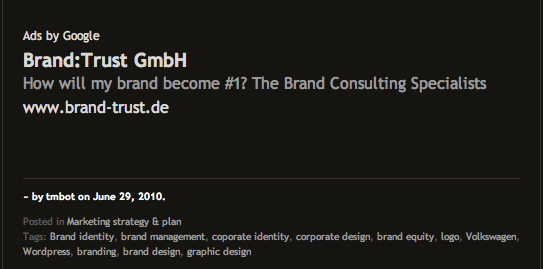
Have a look at the below screenshot of this website. It’s an Adsense ad that was placed next to an article on “brand management”. For a company specializing in brand management, appearing next to an article like that is very useful since the reader of the article is already interested in the advertiser’s core business.
Google Adsense for "brandtrust" on this blog
Benefits Google Adsense
The most robust targeting of any ad network
AdSense’s innovative targeting options allow advertisers to more precisely reach their desired audiences on a third-party website — resulting in more revenue for the third-party website owner as well as more sales for the advertiser.
Contextual targeting
AdSense ads are related to the content of the webpage. This is an advantage: your ad pops up there were it doesn’t interrupt. It fits in between the content on the website.
Placement targeting
An advertiser can target a site based on demographics, vertical, geographic location, or URL.
Interest–based advertising
An advertiser can show ads based on users’ interests and previous interactions with that advertiser.
New Media?
AdSense isn’t just for websites. Earn extra revenue by displaying ads on your:


 Keen on C