The Post Lancegate Era. Plea to allow doping in pro sports.

Doping in sports - © psmag.com

Doping in sports – © psmag.com

Lancegate

I guess anyone knows the story of Lance Armstrong by now. Just for the sake of ease I’ll refer to it as Lancegate and it points to “an all-American hero that fell to earth”.

Lance Armstrong’s recent doping confession to Oprah revamps an old discussion about doping (or the usage of banned performance-enhancing drugs) in professional sport(s).

What is the problem with doping?

The use of drugs to enhance performance is considered unethical by international sports organizations and especially the International Olympic Committee. The reasons why we ban those substances are related to health risks, the noble idea of equality for all sportsmen and the desire of the public to think of sportsmen as heroes – doing all these spectacular things in a “clean” fashion.

I believe exactly those same arguments can be used to state that doping shouldn’t be a problem. And why there shouldn’t have been a lancegate.

Why doping shouldn’t be a problem. A plea to allow doping in pro sports.

First of all the unethical aspect. Why is doping labeled as not ethical? Frankly I don’t know. And it doesn’t make sense. All things mankind has ever done in medics and pharmaceuticals are equally performance-enhancing drugs in the sense that they clearly enhanced our life time. Our timely performance of living is enhanced due to drugs. We didn’t label that as unethical. Additionally, we drink wine (alcohol is a hard drugs people, it’s just socially accepted!) to enhance our dining experience. There’s hardly anyone labeling that as unethical.

Second, the health thing. It just might be that doping isn’t healthy. True. Nor are alcohol, cigarettes and medicines. Can we allow people to decide individually what they take and for what reason? I guess most smokers do know they are having an unhealthy habit. I guess all sportsmen using performance-enhancing drugs equally know they are messing up their bodies. Additionally, one could state that doping are in this respect little different from the use of new materials in the construction of e.g. swimming suits or Formula 1 cars. Those things provide a similar unfair advantage over other competitors. What’s the difference between a substance and e.g. better equipment?

Further more, the way we feel about doping today reflects our culture of “equality”. Everybody is the same. We all have the same opportunities. That’s a great idea. However, we all know that’s not true. With regards to professional sports, it’s quite clear that someone born in the e.g. USA has a way better environment to grow up in to become a sports hero than e.g. somebody in Angola. Just think about sports education, sports infrastructures, etc.

Asterix potion made him heroic.

Asterix potion made him heroic.

Finally the argument that the public (“we”) has the desire to believe the sport is “clean”. More important however is that the public wants to look up to sportsmen. They are heroes. They inspire people. Do we really care that the hero plays according to the rules? I believe we don’t. Let’s go back to the origin of the word “hero”. A hero was originally a courageous figure in a legend or a myth that did spectacular things throughout the story. Not rarely those “heroes” had a (semi-)divine origin and their acts exceeded the human capabilities. Just think of the Greek Heroi or the modern Spider-man and Superman as an example. Or one of my favorites: Asterix & his potion!

If we want sport heroes we’d better frame “doping” differently. And that’s exactly what Lance did. He framed doping differently.

And that’s exactly why there shouldn’t have been a Lancegate. Your thoughts?
When Archives turn Newsworthy: Cyclo-cross’s disruptive innovation…

I’m a big fan of recycling. Unless when it’s about stuff one writes. This time however I’m glad to “promote” one from the archive:

Cyclo-cross’s disruptive innovation that made competition irrelevant – JANUARY 9, 2011.

I believe I have good reason for recycling this. The article – that uses concepts like “blue ocean strategies” and “business model innovation” – demonstrates a particular disruptive skill in CX cycling that allows to outperform competition. It’s the case of Sven Nys. One of his main advantages is that he leaps over obstacles by bike where other riders need to get of their bike. Exactly this benefit made him the 2013 CX World Champ last sunday!

Watch the video of the 2013 CX WC final lap below. If you don’t understand the Dutch comments, look as from the 4th minute. The obstacles that Nys tackles like nobody else can be seen at 5:30. As from then, it was straight to the World Title.

Special interest in stories linking Business & Sports? Check the sports button in the upper navigation menu!

Is “push to add drama” truly the best ad? Yes, for the agency.

Do you remember how TNT Benelux launched?
Odds are high you don’t even know what I’m talking about… (based on small-scale research, see below).

But if I’d ask you whether you recall a really cool video starring a big, red button in the middle of a town square – flanked with a sign that said “push to add drama”, chances are high you know what I’m talking about…
(based on small-scale research, see below).

The Best Ad in the World

Do I love the ad? Hell yeah!
Do I believe this is the best ad in the world? Hell no!

Why it isn’t the best advert in the world

To determine whether a specific ad is good or not, one has to look at the goals that were set before the advert was made. I have to be honest here, I don’t know the advertiser’s goals. But I believe they can be one or more of the following:

  • Awareness of the Brand TNT – it was a product launch after all
  • Drive ratings for the TV Channel – which impacts the bottom line of TNT
  • Brand building: make TNT’s identity
  • Other goals?

So in the last couple of weeks I ran an experiment to know whether this great concept also proved to be the best ad ever made (as I read somewhere). And once again, I need to be honest. The hypothesis I was looking to back up through research was:

“Push to add drama is the best ad for the agency that made it.”

Experiment Design

The experiment design consisted of two groups:

  • People within the Marketing, Communication, Ad industry
  • People outside of that industry

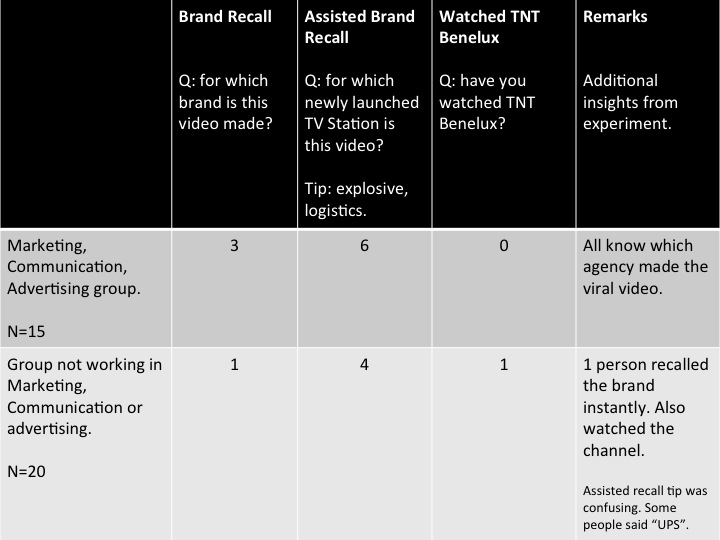
Next to that, the experiment asked whether they knew the brand for whom this video was made (in 2 distinctive manners) and whether they have been watching TNT Benelux so far. Hence the questions after viewing the movie:

  • For which brand is this video made?
  • For which newly launched TV station this video was aired? Tip: logistics, explosives.
  • Have you watched TNT Benelux?

Experiment Results

Experiment results

Experiment results


Experiment conclusion?

In general people don’t recall the brand promoted through the viral video. Even when I provided extra tips to them: “explosives (=TNT)” & “logistics (=TNT)”. Consequently it shouldn’t surprise that only 1 out of 35 respondents watched the channel. Within my respondents nobody went to see the website of TNT Benelux.

Well done Agency!

The most striking thing however is that the “Marketing, Communication, Advertising Group” of respondents basically all knew which agency made this ad / viral movie. And today, they’re all dreaming about a collaboration with that agency. It was the best ad in the world. For the agency that is.

What’s your view on viral advertising by the way?