Spatial planning strategies struggle to meet demands network society?

During one of our “search sessions” on random topics on google scholar, we stumbled upon an interesting article written by Healey, P.: “Network Complexity and the Imaginative Power of Strategic Spatial Planning.”

Not being an expert in both matters it was interesting to see how a discipline struggles to comply with knowledge from another science. As suggested by the article, spatial planning is still theoretically struggling to give answers to the characteristics of the network society.

Debate: the network society and implications for spatial planning?

The world has changed. Societies have changed. Concepts for spatial planning remained untouched. In order to know how planning could adapt to the challenges of the network society, one needs to define the specifics of this society. The article argues that a network society is fluid, open, complex and experiences multiple time-space relations.

How to answer the challenges?

Healey critiques the determinism resulting from the usage of architectural concepts for spatial organization. She suggests to find answers in sociological theory and/or geography studies. Once again a call for a multidisciplinary approach. Below is an attempt to translate the theoretical concepts into design strategies.

We apologize for this extremely theoretical post. Some like that however.
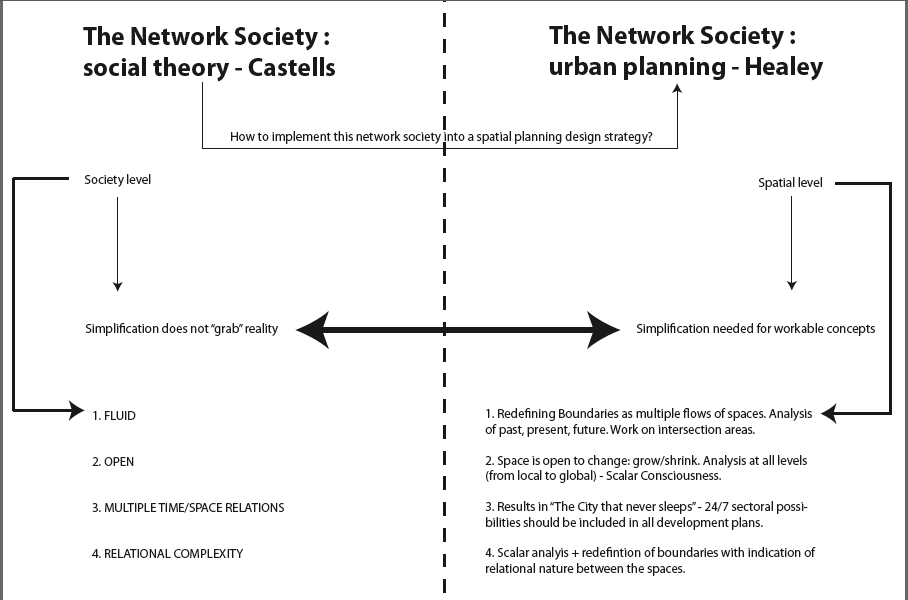
Spatial planning strategic challenges to comply with network society

Spatial planning strategic challenges to comply with network society - free, based on Healeys publication mentioned in the article

Facebook Questions to impact R&D? On Crowdsourcing.

Facebook Questions will be available to everyone in the US within the next few weeks. Shall this impact the way enterprises handle R&D? Will this mean a boost for crowdsourcing? Can Facebook Questions and Facebook Groups improve business operations? Shall knowledge-workers deploy it to collaborate in an enterprise 2.0-style?

Facebook Questions' impact on R&D: crowdsourcing over Facebook?

Facebook Questions' impact on R&D: crowdsourcing over Facebook?

Global resources – crowdsourcing on Facebook

Corporations can rely upon the knowledge available through every Facebook user. And that’s a lot: more than 500 million active users. Without a doubt, one can find creative solutions for any challenge by addressing this “melting pot of knowledge” named Facebook Questions.

Benefits for corporations

Enterprises can drastically cut their R&D expenses by using the “free knowledge base”. But what’s more, by developing products in co-operation with the external world, the success rate of bringing it to the market increases. The logic: co-creation results in a solution that better matches the problems.

Consequences for individuals

The consequences for individuals are both negative and positive. Individuals have the opportunity to present themselves to tackle global challenges. On the other hand, competition among individuals gets tougher because of the global scale of the resources. In the end this results in better products. After all, the fiercer competition the better the result.

Most influential brands 2010 index: where are the FMCG giants?

We often wonder what the most influential corporations or brands in the world are. To answer this, we need to pass two challenges: how does one define and measure “the most influential”? We searched for a list that could express “most influential”. We believe we found one that expresses this concept: the Thought Leadership index of TLG.

Defining influential as “Thought Leadership”

With the expression “most influential brand” we mean those brands and corporations that have impact on “opinion formers”. Opinion formers are human beings that, through their own actions and attitudes, shape those of others. They reside within several areas, such as business, politics, media, etc. Those opinion leaders often base their opinion upon the expertise available through organizations. Those companies are conceived and labeled “thought leaders” within a specific industry/sector/subject. “Thought leadership” is often cited as a strategy to build trust in your company and products – which in turn leads to growth.

Thought Leadership companies according to TLG

Thought Leadership companies according to TLG

“Most influential brands 2010 index” aka “TLG’s Thought Leadership index 2010”

The TLG index lists the “Thought Leadership” top companies aka “the top influential brands”. We believe that the TLG index is based upon a valid method: in-depth conversations with opinion leaders. We don’t have information on who exactly were the “opinion formers”, so one could question whether researcher selected “genuine opinion formers”. Let’s assume they did and analyze the list.

List trends: no FMCG concerns & dominance of web-based corporations

Have a look at the list again. There’s not a sign of FMCG concerns such as Unilever, P&G or Nestlé. On the other hand, relatively new corporations with web-focus seem to dominate the list (Facebook, Twitter, Google, Amazon).

Do these FMCG groups realize they are not conceived (“decoded”) as thought leaders/influential? Do they need to deploy another communications (pr) strategy? Are they not striving for thought leadership? The latter is hard to believe. Let’s see whether they’re in the 2011 top list!