Facebook Questions will be available to everyone in the US within the next few weeks. Shall this impact the way enterprises handle R&D? Will this mean a boost for crowdsourcing? Can Facebook Questions and Facebook Groups improve business operations? Shall knowledge-workers deploy it to collaborate in an enterprise 2.0-style?
Facebook Questions' impact on R&D: crowdsourcing over Facebook?
Global resources – crowdsourcing on Facebook
Corporations can rely upon the knowledge available through every Facebook user. And that’s a lot: more than 500 million active users. Without a doubt, one can find creative solutions for any challenge by addressing this “melting pot of knowledge” named Facebook Questions.
Benefits for corporations
Enterprises can drastically cut their R&D expenses by using the “free knowledge base”. But what’s more, by developing products in co-operation with the external world, the success rate of bringing it to the market increases. The logic: co-creation results in a solution that better matches the problems.
Consequences for individuals
The consequences for individuals are both negative and positive. Individuals have the opportunity to present themselves to tackle global challenges. On the other hand, competition among individuals gets tougher because of the global scale of the resources. In the end this results in better products. After all, the fiercer competition the better the result.
We live in a country that isn’t governed for a period of about 4 months now. Why is that so difficult? Just watch the below instructional video from Marcel Sel…
Flanders: strong right-wing
In the northern part of the country (Flanders, where they speak Dutch) inhabitants tend to vote for conservatives. But what’s even more striking, is the huge support for an extreme right political party – known as Vlaams Belang (=”Flemish importance”).
Why does this political organization receives so much support from that many inhabitants? Is it that all Dutch-speaking Belgians are a bit “fascist”? It cannot be, I cannot believe.
Next to loads of other aspects, we want to point out that this political party sets itself apart from the other parties not only by leaving the democratic spectrum behind but also by deploying a different media buying strategy. With their media strategy, they tend to be visible in the streets the entire year – not only in the run-up to elections such as the other political parties. Added to that, the party empowers that visibility in the streets by offering gadgets via a webshop (e.g.: branded sweaters, caps, cycling outfits, mouse pads, flags, etc.).
New campaign: the Republic of Flanders.
Belgium has struggled to form a government for about 4 months now – one political crisis follows the other. Main reason is the inability to make an agreement between the Dutch-speaking community and the French-speaking community.
Ended up at this point, Vlaams Belang decided to launch a campaign to demonstrate that the country is doomed (this has been their main argument for years). The solution, according to them, is to form the Republic of Flanders.
To convince people that the republic of Flanders is the means to the end of wealth, Vlaams Belang launched a campaign that consists of 500 20 sq.m. outdoor ads, window posters and a brochure of which more than 1 million copies are printed (to compare: the biggest newspaper in Flanders is printed on about 100 000 copies).
You might disagree on Vlaams Belang’s opinions, but you’ve got to give them at least one thing: it is the only political party that tries to establish a continuous conversation with the inhabitants of Flanders. By this I mean, they are active even without upcoming elections.
Is it strange then that they get a lot of votes at elections? We believe it’s not that strange.
Given the fact that most of the people don’t really care about ideology, they might vote for “a brand” that they are most familiar with. The brand they’re most familiar with might just be the brand that chooses to have a continuous advertising frequency strategy.
Extreme right political party in Belgium goes for continuity media buying approach in street advertising. Great idea in Belgium, a country where you have to vote every other day. Picture taken from my car while driving with my mobile device - my apologies for the bad photograph. However, all stories on this blog appear just because I ran up to something that triggered me into a reflection exercise... For this reason we believe it is allowed to put this fuzzy picture on the web ;-)
Frequency-based theory high percentage extreme right voters derived from “advertising science”
Political advertising and commercial advertising serve pretty much the same goal. To convince people to believe information provided via a communication channel.
Within the communication science, there seems to be a general consensus on how to reflect about the impact of frequency of media exposures. Here’s sort of how it works:
The media objectives of a media plan often call for some combination of reach and frequency. Media planners want the highest reach possible because that means more people will be exposed to the campaign, which should lead to more brand awareness, customer loyalty, sales, and so on. Media planners also seek high frequency if they feel that consumers will only take action (that is, buy the product) after multiple exposures to the campaign.
Media planners can choose among three methods of scheduling: continuity, flight, and pulse. Continuity scheduling spreads media spending evenly across months. The flight scheduling approach alternates advertising across months, with heavy advertising in certain months and no advertising at all in other months. Pulse scheduling combines the first two scheduling methods, so that the brand maintains a low-level of advertising across all months but spends more in selected months.
Reading the above theory on scheduling methods, we have to say we’re not quite sure which one the political party is using. However, others are using none – except when running into campaigns. In this manner the political brand appeals to people in the streets because they meet it all the time…
Think about it? Should other parties counter-feight this dominance by also buying media space more frequently?
Chinese characters appear in the fifa world cup stadium perimeter advertisements
Fifa world cup: global event, global brands
The world cup football is almost at its end. A European country is about to win the tournament – that’s for sure.
However, if one digs a little deeper into the entire phenomenon of the world cup – one could see that the “economic powers” from the past (let’s say USA, Western Europe) are loosing power.
I’ve been a dedicated world cup watcher since the ‘Mundiale’ in Italy, 1990. Since that day I mainly see “Western brands”: brands from manufacturers in the classic economic powerzones – they were the only ones who could afford the investment.
With today’s shift in economic and financial power, it should not be a surprise that we see non-western brands on the global advertising platform (which the world cup football definitely is)
Fifa partners and their core market
To demonstrate the reflection in powershift, one can start looking at the “general fifa sponsors”. These are well-known companies from the past with their headquarters in Western (industrial?) economies. Brands that match this example: adidas (Europe), coca-cola (US), visa (US), sony (Japan), hyundai(South Korea). One of the upcoming economic (financial) powers is the Middle-East. You shouldn’t be surprised then that the Dubai-based Emirates Group is an official sponsor nowadays…
Stadium perimeter advertisers
The driving factor in this analysis however came from looking at the stadium perimeter advertisements during the game. By seeing exotic alphabet (chinese) and an Indian inspired font next to the pitches, my attention was drawn.
Here’s a list of non-western brands that I’ve noticed to be advertising on football pitches during the world cup. In my opinion, they reflect the shift in economic and financial powers.
mahindra satyam > Mahindra Group; IndiaYingli Solar > ChinaSeara > Brasil
Proving the shift in powers
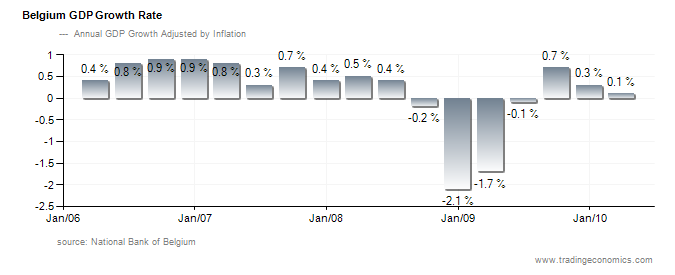
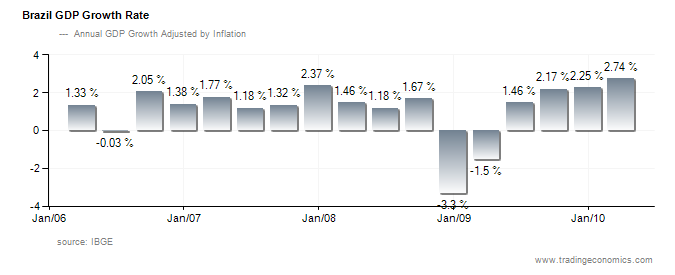
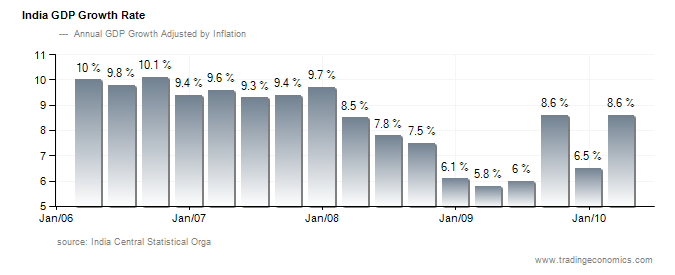
Credit crunch : US ; EuropeEconomic slowdown: US, EuropeNew regions (India, China, Brazil): economic growth in 2010?
Belgium - economic growth rate ; 2010 Trading Economics. All Rights Reserved.
United-States economic growth rate 2010; Trading Economics. All Rights Reserved.
Brazil economic growth rate; Trading Economics. All Rights Reserved.
Indian economic growth rate; Trading Economics. All Rights Reserved.
China economic growth rate; Trading Economics. All Rights Reserved.




 Keen on C