
BP deploys SEM techniques for reputation management
BP: attack on nature and mankind?
You might have heard about it: there’s an oil leak in the Gulf of Mexico. BP – held responsible for this disaster – is doing everything within its reach to solve the issue as soon as possible. Instead of discussing the engineering operations by which the company is trying to stop the leak, I want to say a word or two about the marketing (public relations) aspects that come into play.
Reputation at risk.
Needless to say that a natural disaster can seriously harm the reputation of a company – resulting in fewer “likers” (cfr: the Facebook like hype on external websites…) or even less people willing to fill up their car at a BP service station. For BP this is as much a disaster as is the oil for the nature and our planet. BP can’t afford to have a decrease in revenue – the cost of the oil spill is already sufficiently high.
Reputation management: what is the reputation?
One could think of BP as a “money-making machine while destroying our planet”. One could think that is correct – but it’s not. In the past – as well as today – BP has been glorified for its environmentally responsible business model. Yes, BP is not just about oil. BP is about: oil, natural gas, wind, solar, biofuels, efficiency, energy security, energy diversity, …
SEM techniques as a means for reputation management
SEM stands for search engine marketing. It is the “art” of positioning website pages in the Google query result pages. One can pay Google to be on the result pages. You’ll end up in the “sponsored links” and pay each time somebody clicks your link. This type of search engine marketing is called SEA: search engine advertising. An other approach is to build your website in such a way that it organically (without paying Google) lists well in the search results. This type of SEM is called SEO: search engine optimization. The latter is more sustainable than the first, but takes more time to prove its efficiency.
In order to understand the point, one needs to know a bit more about “the psychology of Google result pages”.
- people usually look no further than the results displayed on page 1
- people believe that they receive good information via this technology – and they actually do !
- people believe the “best” companies are at the top of the list
- Google has become the number 1 source for people to obtain information.
Is SEM a powerful reputation management technique?
SEM, both SEA and SEO, are valid reputation management techniques. As a matter of fact, companies should consider thinking about this aspect not only when dealing with so-called crisis communication.
SEO: long-term reputation management?
What if the first Google result page of your company’s brand name is entirely filled with webpages that you own or that you have relations with? Well, then you would control your reputation when people search for you. How to handle that? Well, just think on the following set-up: index your company (product) specific website in Google, make a Facebook page as well, set up a blog, deploy a twitter account, etc. You’ll note that after a while when people browse your company or product they see pages in Google that are managed by yourself. The reputation that develops in people’s minds is completely under your control.
Why BP ran an SEA campaign
As stated above, SEA is a means to appear in the listing with a finger flick while SEO takes time to have impact. For this reason BP had to run an SEA campaign on the keywords ‘Oil Spill’. Is it wrong to do so? Actually no, it’s not because they paid for inclusion that it is immoral to do so. As a matter of fact, nobody would have questioned BP buying a newspaper page in order to put an ad for e.g. apologies about the oil spill (they might even have done so).
Finally, a word about BP.
Looking at the BP case, we have to admit that they are quite committed to the environment. We see that the engineering operations are doing everything to get the leak fixed as soon as possible. This is also what they want to make clear to the general public. However, if they had deployed a more extensive reputation management strategy before the disaster… it would have been more powerful and people wouldn’t have questioned the adwords campaign that much. Nevertheless: BP is environmentally responsible. They just had a little bad luck with their operations on the Gulf of Mexico…

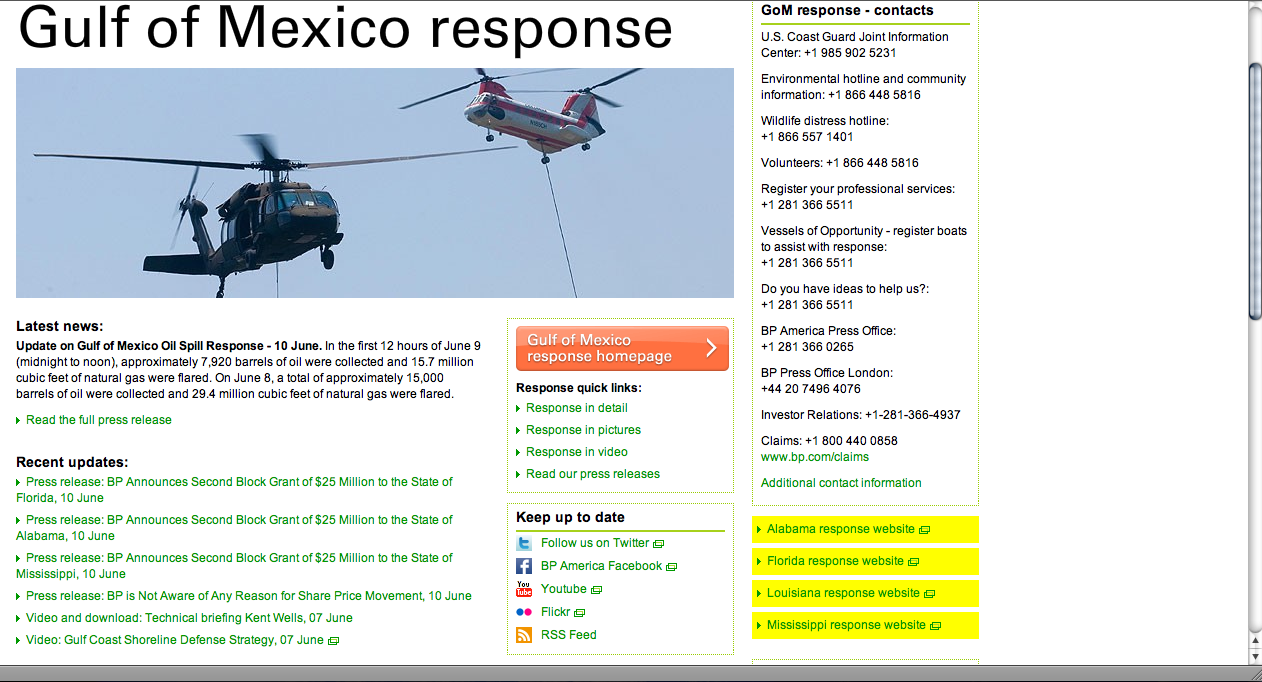
Special reputation management pages on BP.com

Live stream of operations at Gulf of Mexico

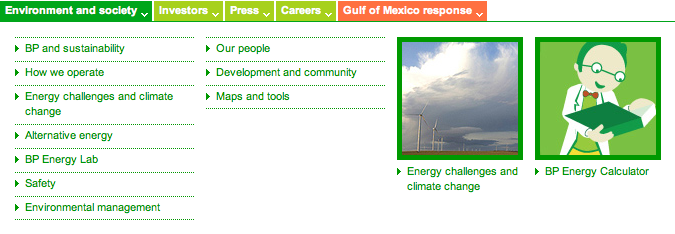
BP's environmentally responsible business program - not specifically related to the leak!





 Keen on C