Pretty much everyone is familiar with open source software. However, the concept is transcending into other industries. Hence, we label this trend ‘The Open Source Economy’, an economy where organizations don’t design to protect (patent) but rather to spread (share). The idea behind open source is that someone can take an idea or design and develop it further – which in turn can lead to better solutions.
Roots: Open source software – Drupal
Drupal is the most widely used open source web content management system. It is used as a back-end system for 1% of all websites worldwide. Drupal is behind complex websites such as whitehouse.gov; data.gov.uk and even Ebay. In addition companies deploy it for knowledge management and/or business collaboration. Telenet for instance, the largest provider of broadband cable services in Belgium, used Drupal to develop their knowledge base.
Open source in other industries?
Publishing – Open Source Magazine: The July and November issue of a South-African magazine “hip2b2” only consisted out of open source content licensed under a Creative Commons.
Fashion – Open Source Fashion Label: A label for green and fair fashion items is open: other designers and artists are invited to enrich the label with their own creations. The label ensures that the product is high-quality and sustainable.
Automotive – Open Source Eco-car: An open source project that aims to design the car of the future. More than 800 people collaborated on the car’s blueprints. Those blueprints are publicly available under an open source license. The new car is open for modification by others as long as any derived works are shared with the public as well.
Food / Lifestyle / Leisure – Open Source Restaurant: At a restaurant in Amsterdam, everything starts with a web-based documentation platform. The web app allows people to share their with others and the restaurant deploys it for crowdsourcing basically for anything. What’s more, the instructions for creating a similar restaurant yourself are available online.
How to “open source” your business?
Open source seems a sustainable recipe for success. We’re not saying you have to comply with this trend but why not consider it at least? Is it also applicable to your activities? If you were to transform into an open source business, how would that affect your current workflow (a.k.a. cost structure)? What market advantages would you get from it? Would it result in a unique position that positively impacts your bottom line?
Need ideas? Generate them with us.
Just contact us, leave a comment, follow on twitter, etc.
Newspaper publishers suffer for years now. The number of readers is going down – and as a result advertisers are less interested to put an advert in a newspaper. With the rise of the app store economy, publishers have the chance to come closer to a price model that works.
Strategy 1: news behind a pay wall?
In order to generate revenue there are plenty of newspapers who have turned news into paid content. The UK Times experiment with the paywall demonstrates that people say “No, thanks” and click away to another site when faced with a paywall at a news site. Source: The Times UK Lost 4 Million Readers To Its Paywall Experiment
Strategy 2: look at other industries (gaming industry) – The app store economy
The app store economy - innnovative pricing through inn-app purchase
Since there are loads of buzz within the publishing industry about publishing for the iPad, why not have a look at the opportunities of the app store economy? In the beginning of the Apple App Store, you had free apps and paid apps. After a while, they added a functionality called “in-app purchases”. In-app purchases mean that you can offer the apps for free and charge upgrades in the app – like e.g. in the gaming industry new levels.
Price model innovation newspapers: app store and in-app purchase
Consider this: a newspaper publisher creates an iPad edition. Would it make sense to offer the app for free, allowing everyone to read the entire newspaper on iPad? Would it make sense to limit the free articles to 3 and then offer “in-app purchase options” if one wants to read more? Would it make sense to show a summary of all articles and offer “in-app purchase options” to get the entire article?
We’d love to see publishers experiment with it and see whether the strategy from one industry can be applied to another one.
I often encounter the phrase “Print is dead”. Of course, print is not dead. First of all, it’s not a living organism – so technically unable to die because it never actually lived. Second, I still meet printed collateral on a daily basis. Third: history demonstrates that some people always tend to state that new emerging media “kill” existing ones. Concerning this third issue, allow me to have a small digression by referring to the panic for the medium radio with the rise of commercial television.
Commercial television would kill “the radio”. In fact, radio still exists. What happened is a re-allocation of the time spent for a specific medium. People tend to watch more tv and listen to the radio less. But radio is still alive and kicking. People just use it in a different way. The radio went from a “primetime” medium to a “drive time” medium – which means that people mainly use radio while driving a car. So: did video kill the radio star? No, it did not. It just resulted in a new way of allocating resources for specific media.
How to understand the phrase “print is dead”?
So one needs to pay attention what exactly is meant and how the above phrase should be understood. First of all, we have explained in the above paragraphs that media do not die. However, having a look at the phrase “print is dead”, there seems to occur another problem. What is the “printing industry”?
The printing industry is a rather general description of business activities related to printing. The argument that print is dead doesn’t hold much water past books, newspapers and magazine – which aren’t even dead also by the way. The printing industry has multiple subsections, so one cannot simplify that easily.
To start with: every single item made and sold in this world comes with packaging, even if ordered over the internet. So package printing won’t die. However, in times of economic downfall people consume less, which results in less shipments of goods (with printed packages). This also counts for commercial printing – which most of the time people denote when saying the phrase “print is dead”.
Is commercial printing dead?
Commercial printing is about the creation of leaflets, brochures, catalogues, etc. Yes, it still exists and it’s often quite important to have those “sales support documents” next to a powerful website. What is a fact is that more and more corporations are re-allocating their budgets from print to other media (internet, mobile, tv, …). But it is not dead. Nevertheless, the decrease in volume of printed marketing collateral has been an undeniable trend for years now.
Companies that have been in the industry for years are increasingly looking to survive. What business strategies have proven to be effective in surviving this turmoil?
Sustainable business strategies for commercial printers?
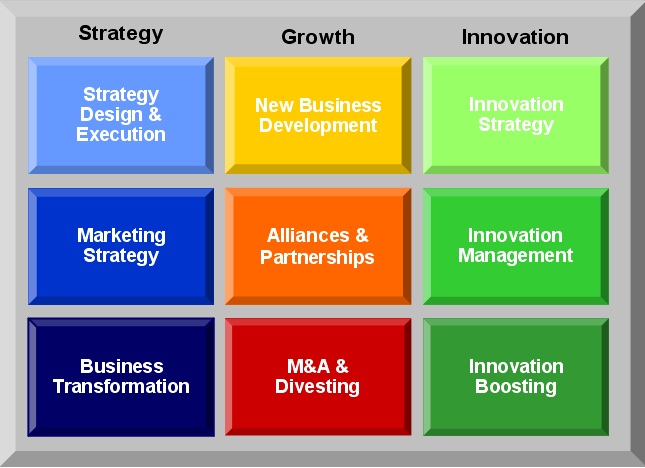
Business strategies and innovation are closely linked together
We don’t want to put an in-depth (theoretical) analysis here about business strategies for growth and innovation. But apparently they are closely linked to one another. The image on the left should do the trick for now. We believe it’s more fruitful to draw a real-life business case.
Sustainable business strategies for SMEs in commercial printing?
The graphics / printing industry has been going down for years now. The economic slowdown and the credit crunch only empower the trend. Loads of SME printers went bankrupt or at least had to shrink down the number of employees.
As a reaction, the industry’s major players reached out to a well-known strategy for growth: “M&A” (mergers and acquisitions). A financially strong company within the sector buys out less powerful players and consequently integrates them into the new structure. The sustainability and growth of the business is hence secured (it might be a short-term…).
As a result of the concentration process, the number of printers within the industry decreased. SMEs reacted by expanding into multi-media production services or by integrating into larger corporations. However more creative initiatives have seen the light as well. And those initiatives don’t even mean the loss of SME commercial printers. The initiative “Pinca” of the Pica Media Partners Group is one of those creative initiatives to counter-fight the negative spiral of the industry.
The Pica Media Partners case
Pica Media Partners is an independent network that contains more than 30 graphic communication corporations within it. The network covers the entire area of The Netherlands. By gathering the strengths of each entity in a network, the group has additional forces for marketing, sales and purchase. By uniting forces, the SME companies within the network can benefit from the state-of-the-art tools as if they were a big player.
In today’s printing industry it’s important to make the transition from a “printer” who sells products into a “media service provider” who sells services. An important element to successfully realize this transition is technology. Specific technologies support printers’ transformation into a service provider.
The network equally saw the importance of technology and jointly invested in an “online collaboration platform”. We are very keen to see how this technology will further prove how business model innovation can act as a strategy for growth. And I have to say: it looks quite promising. The deployment of the technology resulted in an innovative business model within the graphic production industry. In fact, BMI or business model innovation could well be the theme for my next blog post since I started to feel a particular interest in related subjects.





 Keen on C