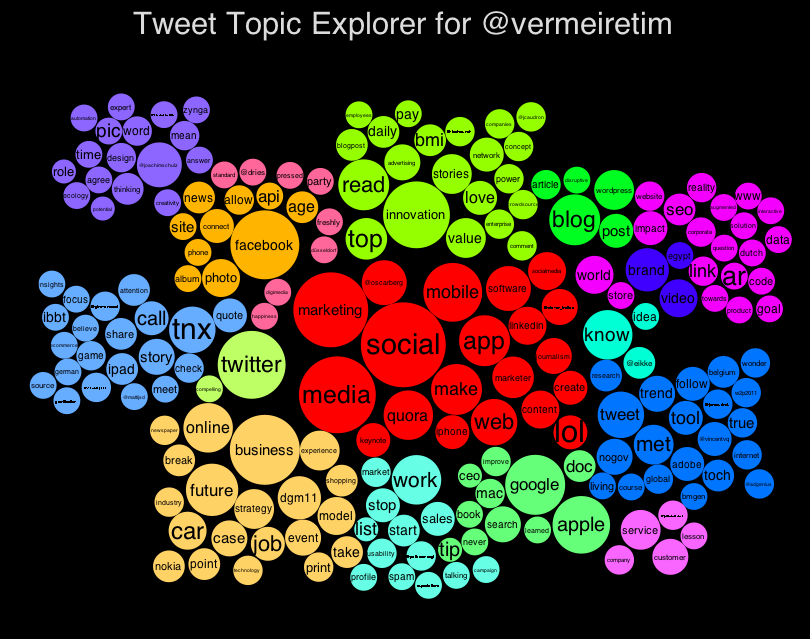
Tweet Topic Explorer – infographic generator.

I recently came across a nice tool to generate infographics based on the topics you tweet about. Below is an infographic of what I tweet about. If you like the topics, why not connect with me on Twitter?

Tweet topic explorer - infographic

Tweet topic explorer - infographic

Citizen journalism & Citizen service: Twitter-interview Belgian Minister.

A couple of days ago, a Minister from the Kingdom of Belgium organized a Twitter-interview. The “event” was organized in cooperation with a newspaper. As a result, a lot of Q-A occurred between the Minister and officially registered journalists of a publishing group. We do understand this of course. However, the “Twitter-interview-experiment” could have meant the start of “Citizen Journalism” and “Citizen Service”. The first being a form of journalism that enables anyone to take part in the news-making process. The latter being an informative, collaborative and conversation platform for governmental organizations.

Citizen journalism: Twitter-interview with Minister of Belgium

Citizen journalism: Twitter-interview with Minister of Belgium

The rise of the internet and the advent of Citizen journalism

With the rise of the internet, journalism gradually changed. Anyone could create articles through blogs. Everybody could be a journalist. They just had to start a blog and write articles. Today, there’s something even more interesting: Twitter.

Twitter-interview Belgian Minister

The interview on December 9 demonstrated that in fact anyone with a Twitter-account could have interviewed the Minister. Anyone was able to ask questions. Everybody was an interviewer.

Citizen service: Twitter as a tool for governments?

The event did not guarantee your question to be answered. Should there be a dedicated governmental service to make sure all citizen questions are answered?

Can Twitter be a useful medium for this? Can governments deploy it to further bridge the gap with their citizens? Is it useful to inform citizens about new laws via a twitter feed? Would it be beneficial to build up conversations about essential social themes over Twitter? Could Twitter bring the government closer to the people? Could this result in happier citizens and an improved quality of life?

Understanding Dutch? Read the Twitter-interview here.

Most influential brands 2010 index: where are the FMCG giants?

We often wonder what the most influential corporations or brands in the world are. To answer this, we need to pass two challenges: how does one define and measure “the most influential”? We searched for a list that could express “most influential”. We believe we found one that expresses this concept: the Thought Leadership index of TLG.

Defining influential as “Thought Leadership”

With the expression “most influential brand” we mean those brands and corporations that have impact on “opinion formers”. Opinion formers are human beings that, through their own actions and attitudes, shape those of others. They reside within several areas, such as business, politics, media, etc. Those opinion leaders often base their opinion upon the expertise available through organizations. Those companies are conceived and labeled “thought leaders” within a specific industry/sector/subject. “Thought leadership” is often cited as a strategy to build trust in your company and products – which in turn leads to growth.

Thought Leadership companies according to TLG

Thought Leadership companies according to TLG

“Most influential brands 2010 index” aka “TLG’s Thought Leadership index 2010”

The TLG index lists the “Thought Leadership” top companies aka “the top influential brands”. We believe that the TLG index is based upon a valid method: in-depth conversations with opinion leaders. We don’t have information on who exactly were the “opinion formers”, so one could question whether researcher selected “genuine opinion formers”. Let’s assume they did and analyze the list.

List trends: no FMCG concerns & dominance of web-based corporations

Have a look at the list again. There’s not a sign of FMCG concerns such as Unilever, P&G or Nestlé. On the other hand, relatively new corporations with web-focus seem to dominate the list (Facebook, Twitter, Google, Amazon).

Do these FMCG groups realize they are not conceived (“decoded”) as thought leaders/influential? Do they need to deploy another communications (pr) strategy? Are they not striving for thought leadership? The latter is hard to believe. Let’s see whether they’re in the 2011 top list!