Google: a new phase in brand management techniques?

Google is without a doubt one of today’s global brands. What’s remarkable, it gained that position without deploying branding techniques previously known as effective. If one compares the manner by which the Google brand grew to the strategy used by brand institutes like P&G or Unilever, one might believe a new phase arrived.

1. Google & adverts

Marketing used to follow this logic: manufacture with the lowest cost and spend money on adverts. This will do the trick. Google (almost) used no adverts (as far as we know). They relied on “viral” and pr to build the brand. Funny aspect: ads are Google’s main source of revenue.

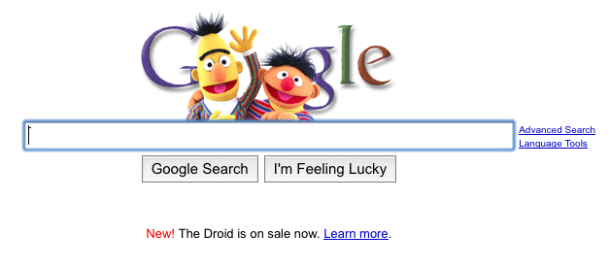
Google logo - bert&ernie style

Google logo - bert&ernie style

2. Branding: corporate design, corporate identity

It used to be important to have a consistent display of the corporate design / identity. To simplify: the logo has to look always and everywhere the same. Google plays with its logo – expressing change and hence its identity (?). Equally striking are the options to customize your homepage (e.g. by modifying the background). What’s more the corporation itself encourages users to personalize their homepage: have a look at the movie below.

3. Product extensions and sub-branding

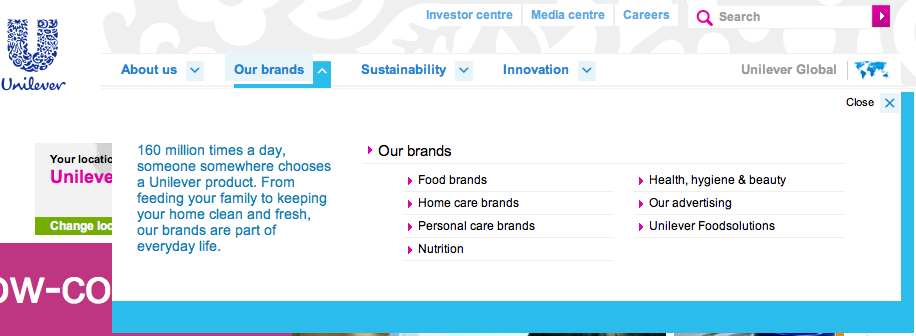
Strategy deployed by the big brand institutes was in fact one of “sub-branding”. Every product was conceived as a separate brand. An element that could explain the power of the brand Google is the fact that nothing is in fact sub-branded. Google is actively creating product extensions that all become an part of the brand google (e.g.: Google Mail to Google Maps) to ensure that it can grow beyond search. Other corporations such as Unilever choose to build a brand for each product, ending up with a big portfolio of different brand names.

Unilever branding techniques: sub-branding

Unilever branding techniques: sub-branding

Does this introduce a new stage in brand building?

Does this make the profession of brand management totally different?

Google Adsense: why should you consider it?

Google Inc.

If I ask people to “just name a brand”, then I often get the answer “Google”. Yes, Google is a powerful brand these days. Nevertheless, people often know nothing more about Google then it being a search engine. Of course, Google is much more than a search engine. Just think about the apps “Google Earth”, “Google Maps”, “Google Video” “Google Docs”, “Google Calendar” and last but not least “Gmail”.

It’s clear that Google isn’t just a search engine. But how do they generate revenue then? Google introduced an innovative business model – AdWords – and the pay-per-click (SEA) concept. The new business model proved to work because today AdWords is still the main source of revenues of Google Inc.

Google and its highly targeted advertising options

The powerful element in the Google business model is the fact that advertisers are ensured their ad appears only when people are interested. A search engine ad only appears for relevant keywords (in the case of the pay-per-click model). People only enter keywords when they are explicitly interested in a subject. An Adsense ad only appears in between relevant content. This means the ad is advertising the same good or service as the page it is on. Bottom line: advertising via a Google platform is cost-effective since it only reaches people who are interested. Compared to “mass advertising media” such as television, this way is much more effective.

Example: Google Adsense on this blog

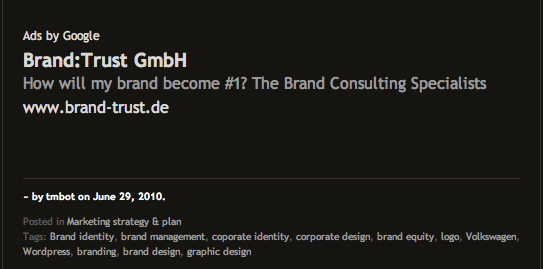
Have a look at the below screenshot of this website. It’s an Adsense ad that was placed next to an article on “brand management”. For a company specializing in brand management, appearing next to an article like that is very useful since the reader of the article is already interested in the advertiser’s core business.

Google Adsense for "brandtrust" on this blog

Google Adsense for "brandtrust" on this blog

Benefits Google Adsense

  • The most robust targeting of any ad network
  • AdSense’s innovative targeting options allow advertisers to more precisely reach their desired audiences on a third-party website — resulting in more revenue for the third-party website owner as well as more sales for the advertiser.

  • Contextual targeting
  • AdSense ads are related to the content of the webpage. This is an advantage: your ad pops up there were it doesn’t interrupt. It fits in between the content on the website.

  • Placement targeting
  • An advertiser can target a site based on demographics, vertical, geographic location, or URL.

  • Interest–based advertising
  • An advertiser can show ads based on users’ interests and previous interactions with that advertiser.

  • New Media?
  • AdSense isn’t just for websites. Earn extra revenue by displaying ads on your:

  • Site search results
  • Mobile webpages
  • Feeds
  • Parked domains
  • Mobile applications
  • Videos
  • Online game
  • Share

    On the oil spill: BP to deploy SEM techniques for reputation management

    BP deploys SEM techniques for reputation management

    BP deploys SEM techniques for reputation management

    BP: attack on nature and mankind?

    You might have heard about it: there’s an oil leak in the Gulf of Mexico. BP – held responsible for this disaster – is doing everything within its reach to solve the issue as soon as possible. Instead of discussing the engineering operations by which the company is trying to stop the leak, I want to say a word or two about the marketing (public relations) aspects that come into play.

    Reputation at risk.

    Needless to say that a natural disaster can seriously harm the reputation of a company – resulting in fewer “likers” (cfr: the Facebook like hype on external websites…) or even less people willing to fill up their car at a BP service station. For BP this is as much a disaster as is the oil for the nature and our planet. BP can’t afford to have a decrease in revenue – the cost of the oil spill is already sufficiently high.

    Reputation management: what is the reputation?

    One could think of BP as a “money-making machine while destroying our planet”. One could think that is correct – but it’s not. In the past – as well as today – BP has been glorified for its environmentally responsible business model. Yes, BP is not just about oil. BP is about: oil, natural gas, wind, solar, biofuels, efficiency, energy security, energy diversity, …

    SEM techniques as a means for reputation management

    SEM stands for search engine marketing. It is the “art” of positioning website pages in the Google query result pages. One can pay Google to be on the result pages. You’ll end up in the “sponsored links” and pay each time somebody clicks your link. This type of search engine marketing  is called SEA: search engine advertising. An other approach is to build your website in such a way that it organically (without paying Google) lists well in the search results. This type of SEM is called SEO: search engine optimization. The latter is more sustainable than the first, but takes more time to prove its efficiency.

    In order to understand the point, one needs to know a bit more about “the psychology of Google result pages”.

    • people usually look no further than the results displayed on page 1
    • people believe that they receive good information via this technology – and they actually do !
    • people believe the “best” companies are  at the top of the list
    • Google has become the number 1 source for people to obtain information.

    Is SEM a powerful reputation management technique?

    SEM, both SEA and SEO, are valid reputation management techniques. As a matter of fact, companies should consider thinking about this aspect not only when dealing with so-called crisis communication.
    SEO: long-term reputation management?

    What if the first Google result page of your company’s brand name is entirely filled with webpages that you own or that you have relations with? Well, then you would control your reputation when people search for you. How to handle that? Well, just think on the following set-up: index your company (product) specific website in Google, make a Facebook page as well, set up a blog, deploy a twitter account, etc. You’ll note that after a while when people browse your company or product they see pages in Google that are managed by yourself. The reputation that develops in people’s minds is completely under your control.

    Why BP ran an SEA campaign

    As stated above, SEA is a means to appear in the listing with a finger flick while SEO takes time to have impact. For this reason BP had to run an SEA campaign on the keywords ‘Oil Spill’. Is it wrong to do so? Actually no, it’s not because they paid for inclusion that it is immoral to do so. As a matter of fact, nobody would have questioned BP buying a newspaper page in order to put an ad for e.g. apologies about the oil spill (they might even have done so).

    Finally, a word about BP.

    Looking at the BP case, we have to admit that they are quite committed to the environment. We see that the engineering operations are doing everything to get the leak fixed as soon as possible. This is also what they want to make clear to the general public. However, if they had deployed a more extensive reputation management strategy before the disaster… it would have been more powerful and people wouldn’t have questioned the adwords campaign that much. Nevertheless: BP is environmentally responsible. They just had a little bad luck with their operations on the Gulf of Mexico…

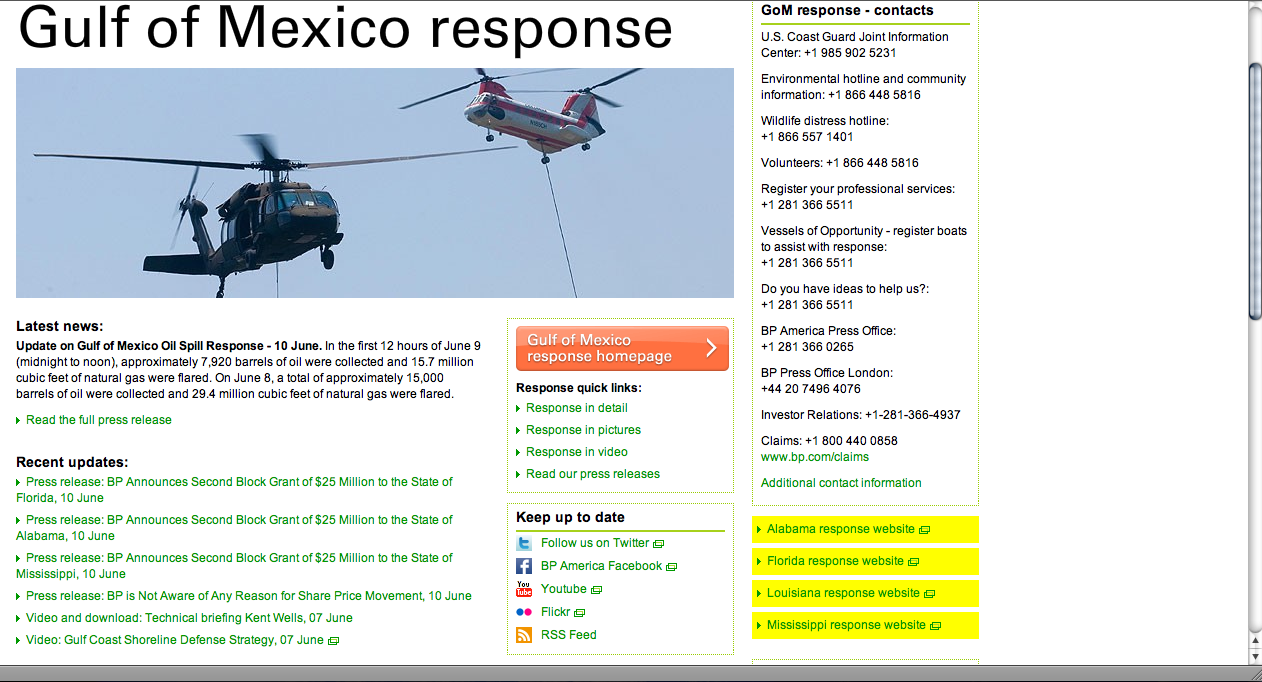
    Special reputation management pages on BP.com
    Special reputation management pages on BP.com

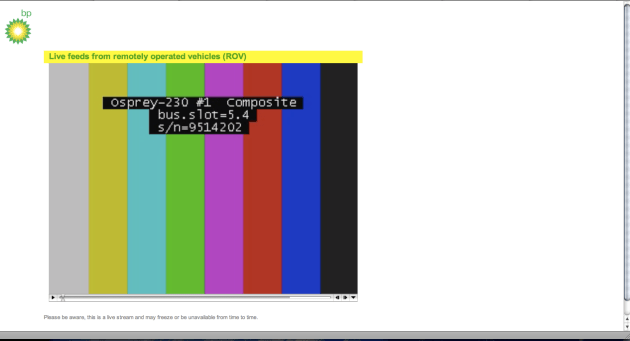
    Live stream of operations at Gulf of Mexico

    Live stream of operations at Gulf of Mexico

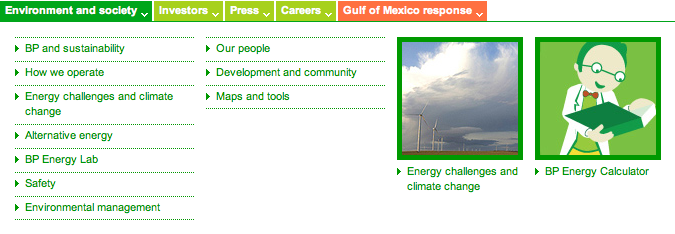
    BP's environmentally responsible business program - not specifically related to the leak!

    BP's environmentally responsible business program - not specifically related to the leak!
    Share