I tend to test chinese smart phones as a hobby. Back in the days I was testing the ZTE Blade, a phone running on Android. Money well spend? Well, yes and no.
The phone did things. But he was quite frustrating as well: its inability to install those apps you truly wanted. Right, seems there’s no such thing as a default Android OS.
I couldn’t have been more wrong. To start with, it was wrong to compare both “apps” as they are in fact not to be compared. But if we ignore the above, here’s why Instagram is great.
Huawei Ascend P1
In my struggle testing chinese smart phones I’m currently dealing with the Huawei Ascend P1. It’s not really a struggle this time. It’s a fast machine (it beats my friend’s iPhone5 in browser start-up etcetera), running every app I tried so far. And it also runs Instagram. So now that I’m on Instragram for Android, I realize Little Photo is -sorry- crap. What is it then that makes Instagram a “waw” and little photo a “boo”?
Instagram: it’s all about the User Experience. UX.
UX – user experience – is all about how a person feels about using a product, system or service. User experience reflects on the experiential, affective, meaningful and valuable aspects of human-computer interaction. As a result, one could state that user experience is in fact subjective in nature because it’s about an individual’s feelings and thoughts about a technology.
Next to that, UX is dynamic, in a way that it may change over time.
Finally, user experience and usability are closely linked but are not the same. In my view, usability does not define the overall user experience but it has a powerful contribution to that overall experience.
Today I have to say: it’s a pleasure to work with Instragram while it’s frustrating to handle apps like “little photo”. The experience is just great. And it’s very easy to use.
Little Photo failed on UX & Usability
And that was the entire issue with “Little Photo”. In the end, you could get nice results. But until you got there… you probably cursed numerous times at your phone. The user experience was crap. And deploying the filters onto photos wasn’t very “userfriendly”. The product failed on UX and Usability. It results in not using the product any more.
Guess it’s time to take UX seriously
User Experience, UX and Usability matter. No doubt. Or do you have a different view?
It’s that time of the year again. The end is near. But since the end is not as near as the Maya’s predicted, it still makes sense to step back and take some time to look ahead.
Resolutions are bullshit
I’ve always believed making up resolutions was a completely pointless activity.
After all, stating some good intentions without really living according to those doesn’t get you that far. The former is exactly the reason most people repeat the same resolutions annually. They didn’t live up to them so they restate them – not rarely emphasizing that this year they are very serious about it.
I used to have the same issue, so I stopped making resolutions after a while. Until last year. Last year I believed that it might be a good idea to lower the expectations of these resolutions. I ran a small test: the milk case.
A resolution about milk
The pilot I set up was simple and straight-forward:
Drink more milk in 2012.
It strikes me – until today – how many times I lived up to this resolution: while I passed milk in the supermarket, when I opened the fridge, when I got in the basement, … every time the resolution popped up again. Speaks for itself that I drank more milk this year. Hooray! Mission accomplished. Things like this make people happy.
Resolution tips – learned from the milk case
Thanks to the milk experiment, I’m a resolution believer again. I learned a few things about resolution-setting from my milk experiment. I will definitely use them to define my resolution(s) for 2013 later today.
Simple resolutions are easy to remind.
Measurable resolutions help to check whether you actually behave accordingly.
Adjustable resolutions help the realization.
Realistic resolutions are an absolute must to stay happy.
Time-pin the execution of your resolutions so to adjust them through-out the year
Funny resolutions stick in your mind. Give your goal a small funny and funky twist.
What’s your view on resolutions? What are your 2013 resolutions?
I recently came across the below YouTube video. It mixes two of the most popular Flemish TV shows ever – F.C. De Kampioenen and Samson & Gert – into a video clip for the latter show. It got me thinking.
Could it be that there’s something like a narrative format that pleases Flemish brains? What constitutes those success factors? And did Bart De Wever – a nationalist populist politician – crack that same code to win elections?
So to answer the questions from the introduction, I strongly recommend to have a look at the above video after which we present some background on Belgium and the TV shows in particular.
Background: Belgium & Broadcasters
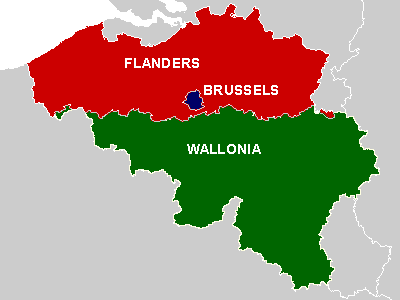
Belgium at a glance.
Belgium. One of the planet’s most difficult, absurd and surreal countries. Yes, we excel in chocolate, beers and waffles. And that’s a good thing. But apart from that we organized our country into distinct regions like a French-speaking part called Wallonia, a Dutch-speaking part known as Flanders and a mixed region known as Brussels.
There’s something remarkable about Flanders and its most popular TV shows.
Successful TV Shows on Public Broadcasting TV
The Belgian broadcasting landscape is organized along the same lines of the country. That is to say, TV is organized and managed by the regional governments. In case of Flanders, the Flemish government takes care of the media landscape. That landscape is a mixture of public broadcasters and commercial broadcasters. It’s important to realize that the public broadcasting service is quite popular up until recent changes in the media landscape.
What’s striking however is that this public broadcaster often airs the same shows. This allows them to recycle content without investing in the production of new shows. Equally important is to point out the fact that the ratings for these shows remain impressively high.
Over the last 20 years there have been two remarkable TV Shows. Those were so brilliant that they were aired year after year.
Flemish TV Shows as a cultural meme?
During my entire lifetime there seem to be two extremely successful TV-shows, one for ‘adults’ and one for ‘kids’. I’m respectively talking about ‘F.C. De Kampioenen’ and ‘Samson & Gert’. Both have been aired and recycled year after year that an entire generation of Flemish people actually knows these stories as if they were a cultural meme. Hey, I believe today they actually are one.
But why exactly are these shows that popular? I believe one needs to find the answer by looking at both shows. For me, it’s quite clear that both shows draw upon the same principle. The way the narrative is structured and told is the same. The only thing that differs between both shows is in fact that the one is for adults and the other one is for kids. In practice, it comes down to a family wide social TV watching experience.
The Flemish brain?
Why do these stories appeal the Flemish people that much? And why don’t these stories appeal to the Dutch-speaking neighbouring country ‘The Netherlands’? Yes, we tried to export both shows. The one for kids worked fine but wasn’t as big in the Netherlands as it was in Flanders. The TV show for adults was a complete disaster: Dutch people did not like it at all. Was it our humor? Or is there something more at stake here?
I believe that the TV shows are popular just because of the way the story is told. The stories are wired for a Flemish brain. The only thing I need to find is a method to analyze stories so to check whether this hypothesis is valid anyway.
How to analyze TV Shows as a story?
In order to find the “success narrative elements for Flemish brains” I’d like to analyze loads of the shows of both series and consequently compare both series to one another. The final goal is to demonstrate that both shows act on the same storytelling principles. Principles that are particularly appealing to Flemish people.
Until today however, I’m having some issues developing the right analytical frame to execute a proper content analysis. I would truly appreciate your help. Do you know any studies that have analyzed the narrative as such?
Content Analysis Framework to discover the narrative
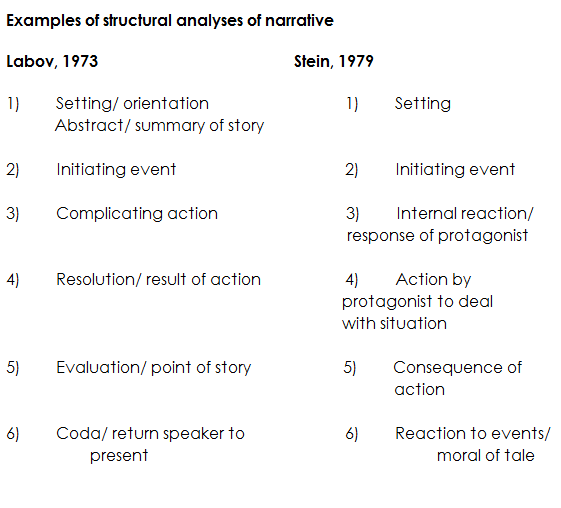
In order to demonstrate that both shows rely on the same narrative principles, I’m looking to develop a framework for content analysis so to test my gut feeling. The below information from Dr. Chris Griffin seems a good starting point.
narrative analysis
Has Bart De Wever cracked the code?
We recently held local elections, as my earlier article demonstrates. And regardless of the fact that they were on regional level, Bart De Wever was able to take it to higher levels. He had to anyway, otherwise his “story” wouldn’t have made any sense.
Bart De Wever, N-VA
But now that we touch upon the story-aspect. Is the political success of Bart De Wever related to his storytelling tactics? Does he deploy the same techniques that F.C. De Kampioenen and Samson & Gert stories do? I believe he might have. What he certainly does is simplifying reality. This has been proven in a Ph.D. “N-VA. Analysis of an ideology.” that states “the party reduces democracy to a temporary dictatorship – meaning: the ones who won the elections are the only ones that can actually reign. In their story they are the only valid voice of Flanders. And this story is often repeated in media outlets: N-VA and especially Bart De Wever are the personification of the moral community of the “Flemish people”.
What else could explain “Flanders Only” popularity?



 Keen on C