RE: ROI of Business Storytelling: Story of Horse Bust.

Have you ever experienced the web as a powerful tool for connecting people?

  • Yes: continue reading.
  • No, but I like the sound of that: continue reading.
  • Not at all and I believe it’s bullshit: stop reading and go back to google.

Do you want to read a story about the web connecting people?

The New Trade - Book on Business Storytelling

The New Trade - Book on Business Storytelling

I have experienced the power of the web. I felt how it can connect and engage people. And I want to share this story with you. Yes, I really want you to have a similar experience. Simply because it rocks!

linkedstories – connected people?

Below is the story of @vermeiretim connecting with @rafstevens with regards to his book project “The New Trade”.

If you like what’s being discussed in the below e-mail conversation, I suggest you read the book at some point. Highly recommended!

E-mail in: ROI of Business Storytelling: Story of Horse Bust.

Hi Tim, here it comes…

I would be honored to give you “a voice” in the book I am writing. The concept of the [book will be a mix of bizz-book-wrting, storytelling and blog-writing (with links to video, blogs, etc). I am in the final phase of finishing it. A draft should be ready within 4 weeks or so.

Here is my question to you: what is the ROI of storytelling to you?

To get you started on the topic I want to share this with you:
http://significantobjects.com/2010/10/08/horse-bust-beth-lisick-story/

Significantobjects is a project where a creative writer invents a story about an cheap second object to increase its value. In the test, invested with new significance by this fiction, the object is sold via eBay. It was a test of a group of people trying to prove that a good story sells, even if this story is false.

You can read more about the project/test here:
http://www.iddictive.com/2010/02/15/how-to-stand-out-by-telling-stories/
and here:
http://significantobjects.com/about/

This got me thinking about what Shawn Callahan of Anecdote calls “big S and small S storytelling:
The Uncanny Valley of Business Storytelling (http://www.anecdote.com.au/archives/2011/01/the_uncanny_val.html)

I quote him here: Big ‘S’ Storytellers understand plot structures, character development, scene design and a myriad of other storytelling principles and practices. At the other end of the spectrum is Small ‘s’ Storytelling where we find the stories we tell on a daily basis in conversations, anecdotes, recounts and examples.

Okay, here I go:
A part of my book is dedicated to storytelling as a “tool” to reveal what is happening in an organization. Here I’ll also be exploring how stories can drive internal communication to another level.

But another part of the book is dedicated to “how to use big ‘S’ stories to better connect to an audience.

So I repeat my question here:
What is the ROI of storytelling?
What is your view on what is going here with the test of significantobject? Does a good story always sell, no matter true or false.
The auction for this Significant Object, with story by Beth Lisick, has ended. Original price: 99 cents. Final price: $62.95.

Like to hear your view. And if it is okay with you I will curate your answer in the book. Ofcourse you can read the draft of the book and still than decide if you are okay with publishing it in it.

Thanks for considering this.

Best regards,
Raf Stevens

__________________________________
CORPORATE STORYTELLER
Vroonbaan 67 I 1880 Nieuwenrode I Belgium
M: +32 486 85 15 81
E: rafstevens@me.com
I: www.corporatestoryteller.be

E-mail out: RE: ROI of Business Storytelling: Story of Horse Bust.

Dear Raf,

as a result of your request to reflect on the “ROI of Business Storytelling”, I’m honored to bring you my story.

“What is the ROI of Business Storytelling?”

When I first read this question, I was puzzled. What at first sight seemed a simple question proved to be a genuine brain teaser.

In order to even boost that thinking, I figured it might prove beneficial to pose this question to my follower base on Twitter. After all, the real-time message service, had already proven to spark conversations. What’s even more, on top of those conversations, one can build true stories.

In what follows I will try to explain how my “Big Story about Storytelling” stems from “Little Stories Conversations” on Twitter.

Conversation: monetary value of Business Storytelling?

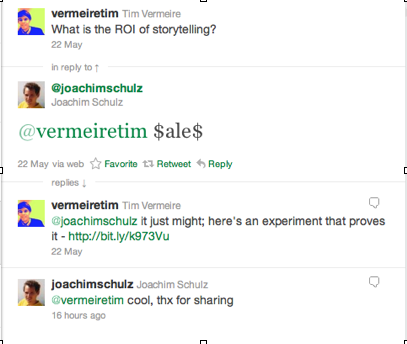
To reach beyond my grey brain cells, I fired “What is the ROI of Business Storytelling” at the crowd. And yes, there it was: @joachimschulz noticed the question and replied – quite convinced – $ale$.

Twitter conversation with @joachimschulz about ROI of Storytelling

Twitter conversation with @joachimschulz about ROI of Storytelling

Now, that reply immediately related to an experiment Raf referred me to earlier: Significant Objects.

Significant Objects Experiment: story brings economic value

The Significant Objects experiment seems to prove that a good story behind an object (product) increases the value. The emotional value (story) can be monetized (economic value).

According to @joachimschulz and the Significant Object experiment that’s truly the case. A good story sells, always. I believe this isn’t 100% true.

Storytelling brings value, but not per se economic value.

Stories have business value. No doubt. For most businesses however they won’t bring immediate revenue or a higher margin. At least they won’t in the short run. They definitely will in the long run.

In the long run, all businesses need to evolve into a social, human business to stay in business. Stories support the transformation into a social business. Because social is human. And humans like stories – just as candy and sex. We simply can’t help it – it’s hard-wired into our brain.

That’s right, we still have that cavemen brain. And back in the cave days, stories were the manner to transmit information and knowledge in such a way that it was easy to notice, to remember and to share. The explanation speaks for itself: in an oral culture – where content is transmitted via speech – one needs a certain “angle” to find something compelling in order to receive attention, to be remembered and – especially – to be shared. And that’s where stories come into play.

Conversation: non-monetary values of storytelling?

Stories bring value. Period. But which values?

To tackle this question, I turned to my socially constructed professor again: Twitter. I teased the crowd with an – at first sight – simple question:

“Is it storytelling or storybuilding?”

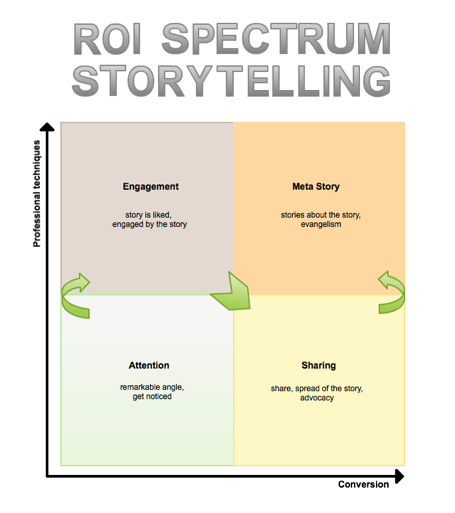
And hooray, scored again. The conversations lead to the ROI spectrum of storytelling.

Twitter conversation with @jukkaam about Business Storytelling

Twitter conversation with @jukkaam about Business Storytelling

The ROI Spectrum of Business Storytelling

I’d love to thank @jukkaam for jumping into the question. He simply added “or storysharing or storyexperiencing #leadership” to the “Is it storytelling or storybuilding #justaksing” tweet – and by doing so co-created the ROI spectrum of Business Storytelling.

Yes, a spectrum. Because we later on realized we were actually having a wrong debate. We were not supposed to think in “or”. It was an “and” story.

We agreed to favor the Genius of the ‘and’ over the Tyranny of the ‘or’ (and we gave credits to @digitaltonto for this splendid quote). But in the meantime, we were talking about the ROI Spectrum of Storytelling.

The Return on Story Investment for Business is:

  • Stories create attention – because of their angle, their framing, their intriguing aspect.
  • Stories create engagement – because of the manner they grab the spectator.
  • Stories are made for sharing – because of the experience the spectator had. He wants to share it with his peers.
  • Stories are made to act on – people act on stories and even create stories about the stories.

ROI of Business Storytelling Spectrum

ROI of Business Storytelling Spectrum


Business Storytelling is in conversion, not in conversation.

I tend to believe that the real value of this Storytelling is in conversion. Stories help people connect with you (and your brand). In an ideal world, conversion occurs via 4 stages: attention – like – share – act. Stories contribute to each stage.

Nevertheless, one needs to take the costs for creating stories into account as well.

The more professionally crafted, the higher the engagement odds for the audience. But that doesn’t necessarily count for the sharing odds (viral sensitivity?). On the contrary, grabbing attention with a remarkable angle or concept doesn’t necessarily require a big bag of money, right?

Hope you liked my story on ROI Business Storytelling Raf!

Yours truly,

Tim Vermeire
What does Mark Etting do for a living? On Marketing and the Marketer.

A common reaction marketers face?

A common reaction marketers face?

The What do you do for a living question.

It happens from time to time that people show interest in what you do professionally. Not surprisingly, some of them even pose the “what do you do for a living question”.

I formerly answered this with “I’m in marketing”.
And I recently stopped giving that answer.

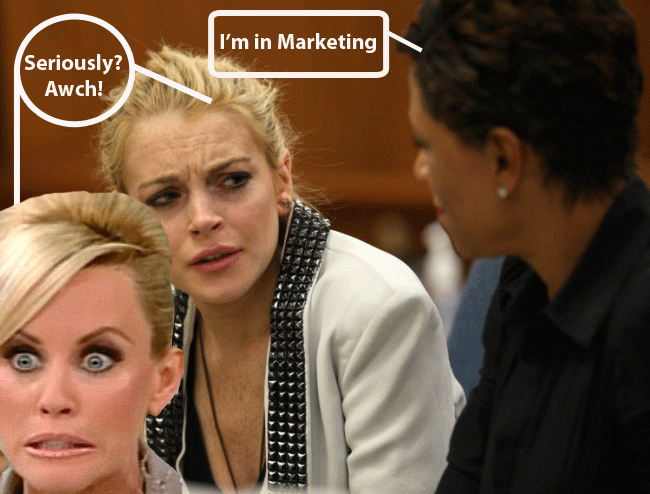
Today “I’m getting market”, as it turned out that most people react to “marketing” with a frown of their eye brows while producing a little – rather scary – noise in between their teeth. It looks like the images on the left.

Agreed, I’m a marketer. My professional activities are about “getting market”.

I’m a marketer. And I can’t help it. It’s not a well-planned career path. It’s more something that I, as a sociologist, accidentally stumbled into. Nevertheless, it proves to bring me self-fulfillment. I’m happy with what I do, Trying to “get market”, like in marketing, like in “market getting”, not like in “pushing markets”.

Guess the whole frowning and bad-noise-making reactions on “being in marketing” has to deal with to the old-school conception of “what it is to be a marketer” or “what it is to push markets”.
Or: how old-school actually means old-scream.

What is marketing? The old-school vision: SCREAM : OLD MARKETING

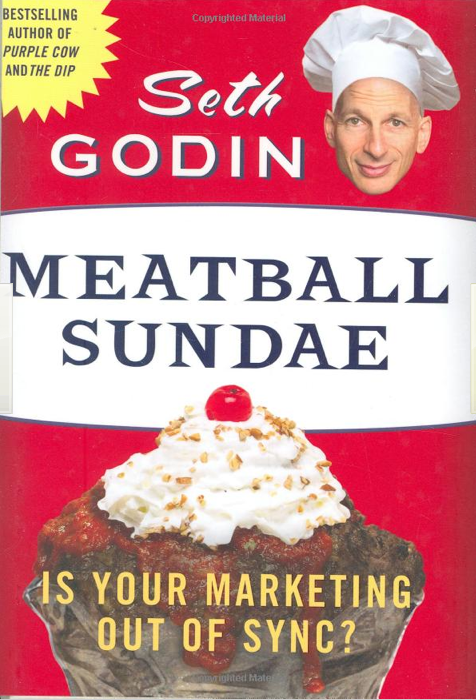
Allow me to refer to Seth Godin’s book “Meatball Sundae – Is your marketing out of sync?” to explain the difference between “old marketing” and “new marketing”. After all the first part of the book makes a great analysis of how new consumer needs and the internet made old marketing (think: P&G, TV and mass production) less effective. The book continues by underpinning this difference with broader sociological phenomena that are re-shaping the world…
Yup, you’ve got to love it!

What is marketing? The new-school vision: Unleashing the Power of Marketing: WHISPER : NEW MARKETING

old vs new marketing: Meatball Sundae

old vs new marketing: Meatball Sundae

Within this respect Seth’s advice is to no longer interrupt people with spammy messages, to make innovation (in all its dimensions) your biggest cost and last – but certainly not least – craft marketing into your product(s).

This is what I would call new marketing. Don’t make crap, produce value and don’t push it. This is the only valid approach to take on marketing. It’s not about supporting short-term sales of crappy products. It’s not about advertising. Or as some put it: “commit acts, not ads”.

If you look at it like that, you quickly realize that marketing shouldn’t be perceived negatively. It can and should be used as a positive force to engage with your customer – whether to improve life (B2C) or business objectives (B2B).

But how can you unleash the power of your marketers?
Well, I believe the GE story is a great example.

How GE unleashed the power of Marketing

“When GE realized that its products would no longer sell themselves, it had to invent a formidable marketing function from scratch.” (Comstock, Gulati, Liguori)

Let’s say about 10 years ago, GE had no significant marketing. The company was quite confident in its technologies. It believed the technical superiority would get market for itself. People with the position of a marketer were assigned to sales support (lead generation, events, …) or to communications (advertising, PR). In the essential corporate strategy meetings, marketing wasn’t invited. Marketing was considered a support function – or even overhead. Things were about to change however …

GE - unleashed the power of marketing

GE - unleashed the power of marketing

The business was mature and GE could no longer win by simply launching increasingly advanced technologies or by taking existing technologies to new markets. Some of their best offerings were mere commodities.

The re-focus in GE’s strategy was accompanied with a note by the CEO who stated that: “marketing should be a vital operating function across GE and an engine for organic growth.”

How does one implement such a thing?

New Marketing is a culture, not a department, role or responsibility.

In short, one could say GE’s corporate culture changed. They gave Marketing the respect it deserved. It wasn’t just a sales support function for screaming messages at as many people as possible. As a result, marketing at GE is now an engine for growth. It paves the way for customer collaboration, new product opportunities and new markets.

Equally important however is that this new marketing is related to a new society. Let’s say Society 3.0 or the trends as described in Meatball Sundae. Did you know by the way that lots changed in society 3.0? Branding for instance. Your brand is about to be a reflection of your corporate culture, certainly in the long run.

New positions top-class marketers reflect New-school Marketing

I tend to see a compelling relation with the new positions by well-known marketing guru. Their new functions basically show this “unleashing the power of marketing and marketers idea”. Here’s a small overview of those top of my mind – feel free to suggest more:

Sincerely yours,

Mark Etting.

3 C’s of Social Media Marketing Automation. On Cool, Cute and Crap.

Twitter Status 6 achievement - empireavenue.com

Twitter Status 6 achievement - empireavenue.com

I recently received a “Twitter Status 6 achievement” on empireavenue.com.
It means I posted 750 tweets in my life. This merely indicates that I’ve been active on Twitter for a short period. During this short period however, I noticed a little annoying aspect of the social media phenomenon.

That little annoying aspect I want to talk about is what I call “the deployment of social media marketing automation tools” or even “twitter marketing automation”.

Social media has a human aspect

Social media doesn’t bear the word “social” in it just for fun. It’s all about engagement and connecting with people. As a result I recommend to listen before you define your social media strategy – and especially before you start automating. This will improve your overall social media campaign…

Oh wait! Stop thinking campaign-wise! It’s social, not campaigns. It’s people. It’s connecting. It’s engaging. It’s conversations. It’s for once and forever. It is marriage.

The Machine - painting as spotted in Museum of Modern Art Brussels.

The Machine - painting as spotted in Museum of Modern Art Brussels.

Social media’s machine aspect: automation

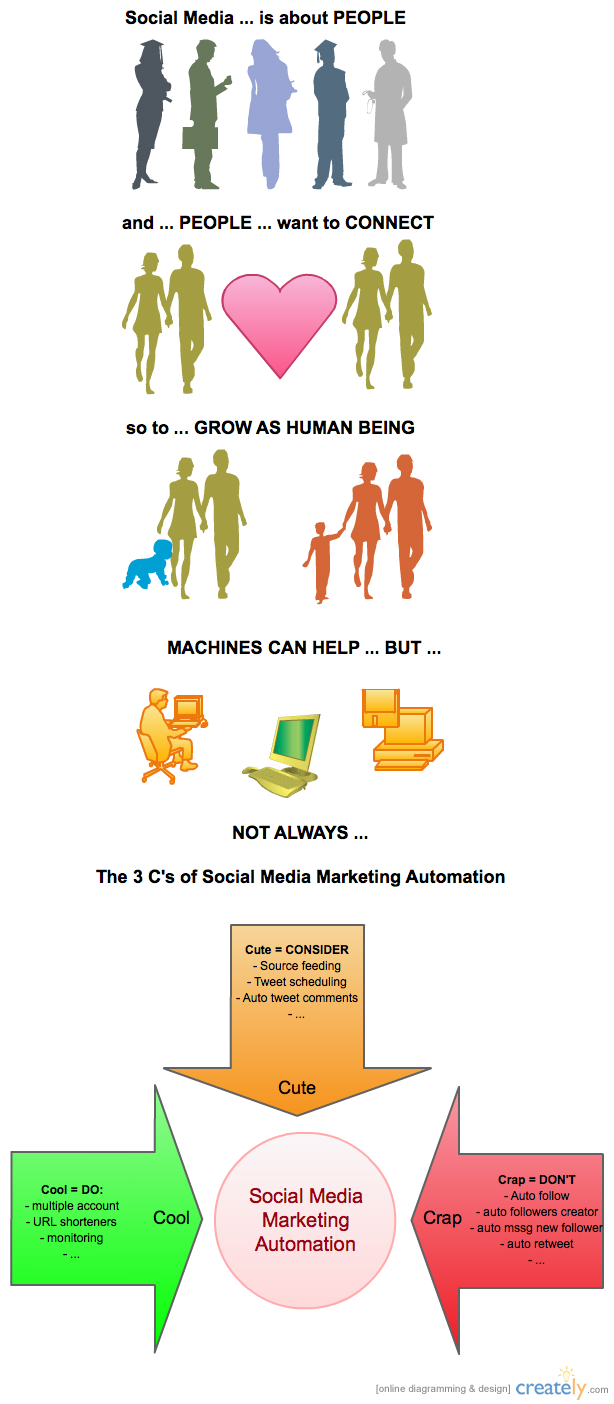
Let’s say social relates to human and let’s assume automation relates to machines. How can you then appropriately deploy automation within a social sphere? I believe the answer ought to be found in the 3 C’s of Social Media Marketing Automation.

The 3 C’s of Social Media Marketing Automation: Cool, Cute, Crap.

As I’ve been around and active in social media for about 750 tweets now, I’ve distilled some of the do’s and don’ts of social media automation.

It turned out however that it’s not that easy to define an automation aspect as “do” or “don’t”. Sometimes it can be used in a “good” way but it can easily glimpse into a “bad” one. That’s why I introduce a third class into this debate, the “consider wisely” category.

Bringing sexiness: category labels and infographics – Cool, Cute, Crap.

So to turn my entire theory / philosophy about social media marketing automation into a sex bomb, I’ve relabeled the categories into something more compelling (at least I believe, and please allow me to do so) and spice it up with an infographic.

The categories / labels are:

  • Cool (do): social media automation that’s recommended. A do. A Cool thing.
  • Cute (do with care): social media automation that might be beneficial. There’s the danger to glimpse into the don’t category.
  • Crap (don’t): absolute don’ts of social media marketing automation.

Cut the crap – what exactly is Cool, Cute or Crap?

Well, read the below overview or scroll down to the infographic below. Please realize that this is not an exact science and only a personal interpretation of what I’ve encountered. Of course, the list also doesn’t claim to be complete. I would highly appreciate your suggestions to include in this list – whether under Cool, Cute or Crap.

Infographic - 3 Cs

Infographic - 3Cs

  1. COOL
    • Multiple account management tools. If you need more than one account / profile / personality in the social realms, it might be cool to automate the management of the different personas. One could think of e.g. a professional and a private account or a consultant managing multiple company accounts, etc.
    • Multiple contributors to one account (professional environments).
    • Url shorteners. One of the key social aspects is to share things. Most of the time this includes sharing a link. It’s very cool to use Url shorteners. And it’s supercool to deploy personalized url shorteners…
    • Monitoring. It’s cool to monitor what people say about you or your themes. But please don’t push it.
  2. CRAP
    • Auto creation of users so to have a higher follower rate. There are tools who promise you a high amount of followers. In fact, the software creates fake people that follow you. Big fail.
    • Extensive retweet scheduling: automatically scream the same message over and over.
    • Bulk tweet sending. If you see a person able to tweet 10 messages in less than a minute than you know it’s automated, than you know it ain’t human.
    • Auto message to new followers “look forward to your tweets”. Yeah right, you follow over 20K people, as if you’re really interested in me.
    • Auto follow followers. It doesn’t make sense to follow somebody just merely because they follow you.
    • Picked keywords that are automatically (re)tweeted. This is very annoying. Yes it’s cool to monitor to stay informed but automatic re-spread of a message is crap.
    • Constant retweet of your marketing hero without any input. If I like those tweets, I will follow the source, your hero. After all it’s your hero who’s cool, not you.
    • Feed tweets from other sources that don’t have a 140 chars limit. Facebook has a 420 character limit, so if you push this to Twitter, your message is lost.
  3. CUTE:
    • Feed it from a different source. Linking your blog to other social networks is cool but tends to be cute when you don’t pay enough attention. It’s completely crap when you don’t pay any attention at all. Make sure you can modify your message for the different platforms’ characteristics.
    • Tweet scheduling can be very cute. Especially if you have a follower base in different time zones. But don’t spam it.
    • Automated tweeting when there’s a new comment on your blog is cute. But what about auto tweeting spammy a-like messages?
    • Social Media Monitoring and auto-follow anyone who mentions you without any interaction or further engagement. I personally had that experience with big brands as Adobe, Audi and RedBull. Of course I was flattered they followed me but without any engagement or interaction, it was only cute, not cool.

An infographic – that makes things sexy these days

Infographics are very hot these days. And yes, it makes facts and figures sexier to read. That’s probably why some even call it infoporn. OK, mine isn’t that sexy but it’ll be only by trying that I’ll make good once later, much later.

Infographic - 3 C's of Social Media Marketing Automation

Infographic - 3 C's of Social Media Marketing Automation