HTML5 & SEO impact.

SEO - Search Engine Optimization

SEO - Search Engine Optimization

I’m lucky. I managed to create a compelling info-sphere through Twitter. But compelling doesn’t always mean it guides towards striking insights. Sometimes the content I run up to is a bit blinkered – though useful. It should not come as a surprise then that I want to have my say from time to time on a specific topic. Just to put things in a perspective.

The info-sphere on HTML5 and its impact on SEO.

I struggled before with the questions arising around “web”, “internet”, “app” and “HTML5” – so I digged a little deeper into that. While doing so, the info-sphere pin-pointed an article that discussed the impact of “html5 on SEO”. Curiosity arouse. I clicked the link. Read the article. Frowned. Here’s why.

What is SEO?

SEO stands for Search Engine Optimization. It’s a term that describes a bunch of tactics by which your webpages rank well in search engines for a specific keyword. It results in visitors that are interested in your topic. After all, they looked for the content themselves, they were not pushed the messages on to them.

SEO tactics respond to the way search engine’s algorithms function. The only goal is to be easily found and to attract website visitors. Once those visitors are on your page, it’s not SEO that’ll turn them into a prospect or lead. SEO however is a start to get a “pool of convertible people”.

What is HTML5? Does it kill the “app economy”?

So what exactly is HTML5? What is its impact on the “world of the web”?

HTML5, as successor to previous HTML languages, adds many new syntactical features. These features are designed to make it easy to include and handle multimedia and graphical content on the web without having to resort to proprietary plugins and APIs. Other new elements are designed to enrich the semantic content of documents. New attributes have been introduced for the same purpose, while some elements and attributes have been removed. Some elements have been changed, redefined or standardised. The APIs and DOM are no longer afterthoughts, but are fundamental parts of the HTML5 specification.

The above makes clear there are some new “metadata” which can be used by SEO-marketers so to improve their find-ability in a new “era of the web”.

More important however from my point of view, is the fact that HTML5 is a markup language fitted for several OS. This basically means that iOS developers and Android developers don’t have to code a separate app for the different platforms. Develop your application in HTML5 and its ready to go to market in all OS. Just great, right? Yes, so why do people believe the “web” will be replaced by “apps” then?

HTML5

HTML5

As demonstrated, HTML5 is a great solution for your mobile web activities. It could save you a lot of money because you don’t need to develop for specific proprietary platforms (as Android, iOS, RIM, …).

Nevertheless, you want to be found on smartphones too. This takes us back to the mobile web and – of course – mobile SEO.

The Mobile Web: HTML5 vs Apps

So to answer the questions “what is mobile SEO”, one needs to first answer the question “what is the mobile web”. The mobile web is a collection of web pages that can be accessed through a smart phone. If we narrow this down a little, one could say: “the mobile web are pages optimized for viewing and interaction on a mobile phone”. Those pages typically get an URL that has the following format: m.website.com. If you visit these pages, you can be pretty sure they’ve done their best to optimize their web pages for the “mobile web”.

As we all know, we often make use of the mobile web through apps. These are in fact software functionalities to reach a specific goal. Let’s say you’re on the go (mobile) and you want to know which train to catch. You probably have an app for that. So you check that app and get the best train for your journey.

What’s truly at stake here, is that mobile people consult the web for a specific purpose. They know what they are after and need the information quickly. Today, OS-dependent apps are the best and fastest way to fulfill that need. HTML5 could also do the trick. So you basically don’t need to develop an app per se. I’m sorry, I know it’s trendy to build one.

What is mobile SEO?

Mobile Search

Mobile Search

Mobile Search is about “people on the go (mobile) in need and searching for specific information urgently”. As a result, I believe your mobile SEO content should address the following questions:

  • What information do people want to know when on the go?
  • Can they easily find that on our web?
  • Can they easily take on action once they found it?
  • What can we do to improve this? What traditional SEO tactics are valid?

It’s the principle. Not the technology.

Whispering Web – The Book.

I’ve made your life easier.

Well, I made it easier if you were to read everything ever posted on this blog. Consider how many clicks that’d take. At least a thousand, right?

Below is a book that collects all articles written in the first year of this blog. Reading all articles in this manner will take you about 70 clicks. I saved you just about 930 clicks. And I might argue that 930 clicks require at least 2 doctor visits because of a painful wrist. I’m not a doctor price specialist but I believe two visits quickly will cost you about 50 EUR or Dollars.

Hope you enjoy slide-reading through it.

3 C’s of Social Media Marketing Automation. On Cool, Cute and Crap.

Twitter Status 6 achievement - empireavenue.com

Twitter Status 6 achievement - empireavenue.com

I recently received a “Twitter Status 6 achievement” on empireavenue.com.
It means I posted 750 tweets in my life. This merely indicates that I’ve been active on Twitter for a short period. During this short period however, I noticed a little annoying aspect of the social media phenomenon.

That little annoying aspect I want to talk about is what I call “the deployment of social media marketing automation tools” or even “twitter marketing automation”.

Social media has a human aspect

Social media doesn’t bear the word “social” in it just for fun. It’s all about engagement and connecting with people. As a result I recommend to listen before you define your social media strategy – and especially before you start automating. This will improve your overall social media campaign…

Oh wait! Stop thinking campaign-wise! It’s social, not campaigns. It’s people. It’s connecting. It’s engaging. It’s conversations. It’s for once and forever. It is marriage.

The Machine - painting as spotted in Museum of Modern Art Brussels.

The Machine - painting as spotted in Museum of Modern Art Brussels.

Social media’s machine aspect: automation

Let’s say social relates to human and let’s assume automation relates to machines. How can you then appropriately deploy automation within a social sphere? I believe the answer ought to be found in the 3 C’s of Social Media Marketing Automation.

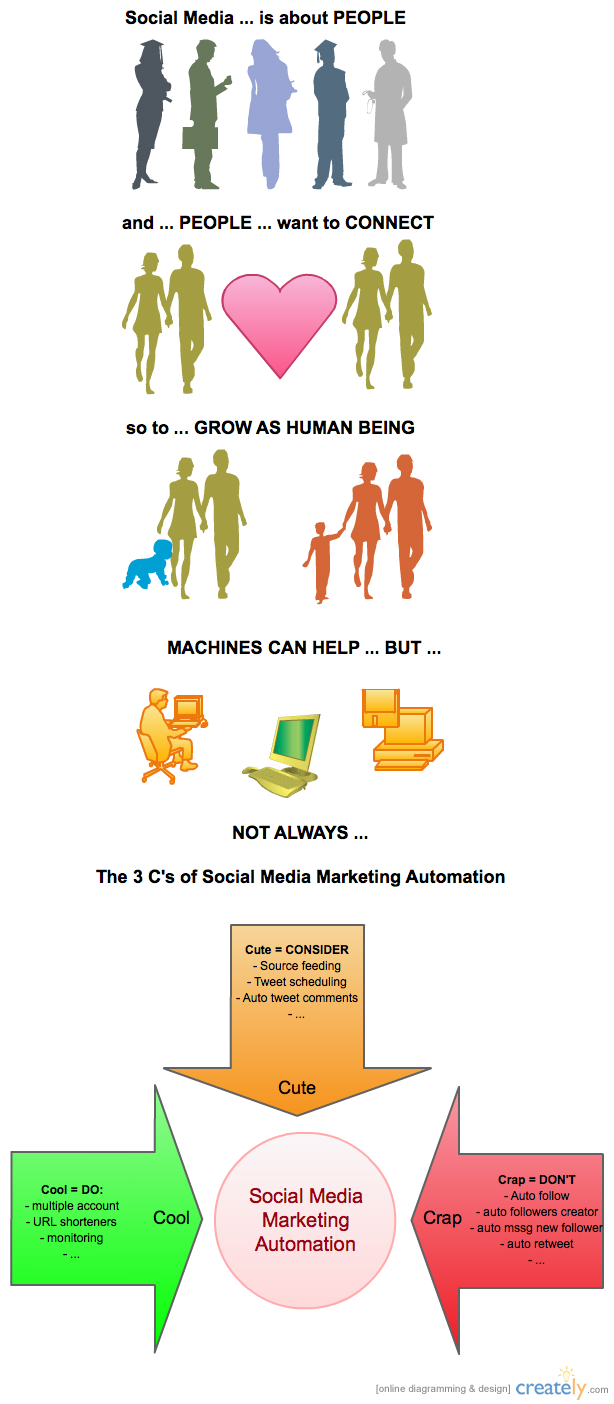
The 3 C’s of Social Media Marketing Automation: Cool, Cute, Crap.

As I’ve been around and active in social media for about 750 tweets now, I’ve distilled some of the do’s and don’ts of social media automation.

It turned out however that it’s not that easy to define an automation aspect as “do” or “don’t”. Sometimes it can be used in a “good” way but it can easily glimpse into a “bad” one. That’s why I introduce a third class into this debate, the “consider wisely” category.

Bringing sexiness: category labels and infographics – Cool, Cute, Crap.

So to turn my entire theory / philosophy about social media marketing automation into a sex bomb, I’ve relabeled the categories into something more compelling (at least I believe, and please allow me to do so) and spice it up with an infographic.

The categories / labels are:

  • Cool (do): social media automation that’s recommended. A do. A Cool thing.
  • Cute (do with care): social media automation that might be beneficial. There’s the danger to glimpse into the don’t category.
  • Crap (don’t): absolute don’ts of social media marketing automation.

Cut the crap – what exactly is Cool, Cute or Crap?

Well, read the below overview or scroll down to the infographic below. Please realize that this is not an exact science and only a personal interpretation of what I’ve encountered. Of course, the list also doesn’t claim to be complete. I would highly appreciate your suggestions to include in this list – whether under Cool, Cute or Crap.

Infographic - 3 Cs

Infographic - 3Cs

  1. COOL
    • Multiple account management tools. If you need more than one account / profile / personality in the social realms, it might be cool to automate the management of the different personas. One could think of e.g. a professional and a private account or a consultant managing multiple company accounts, etc.
    • Multiple contributors to one account (professional environments).
    • Url shorteners. One of the key social aspects is to share things. Most of the time this includes sharing a link. It’s very cool to use Url shorteners. And it’s supercool to deploy personalized url shorteners…
    • Monitoring. It’s cool to monitor what people say about you or your themes. But please don’t push it.
  2. CRAP
    • Auto creation of users so to have a higher follower rate. There are tools who promise you a high amount of followers. In fact, the software creates fake people that follow you. Big fail.
    • Extensive retweet scheduling: automatically scream the same message over and over.
    • Bulk tweet sending. If you see a person able to tweet 10 messages in less than a minute than you know it’s automated, than you know it ain’t human.
    • Auto message to new followers “look forward to your tweets”. Yeah right, you follow over 20K people, as if you’re really interested in me.
    • Auto follow followers. It doesn’t make sense to follow somebody just merely because they follow you.
    • Picked keywords that are automatically (re)tweeted. This is very annoying. Yes it’s cool to monitor to stay informed but automatic re-spread of a message is crap.
    • Constant retweet of your marketing hero without any input. If I like those tweets, I will follow the source, your hero. After all it’s your hero who’s cool, not you.
    • Feed tweets from other sources that don’t have a 140 chars limit. Facebook has a 420 character limit, so if you push this to Twitter, your message is lost.
  3. CUTE:
    • Feed it from a different source. Linking your blog to other social networks is cool but tends to be cute when you don’t pay enough attention. It’s completely crap when you don’t pay any attention at all. Make sure you can modify your message for the different platforms’ characteristics.
    • Tweet scheduling can be very cute. Especially if you have a follower base in different time zones. But don’t spam it.
    • Automated tweeting when there’s a new comment on your blog is cute. But what about auto tweeting spammy a-like messages?
    • Social Media Monitoring and auto-follow anyone who mentions you without any interaction or further engagement. I personally had that experience with big brands as Adobe, Audi and RedBull. Of course I was flattered they followed me but without any engagement or interaction, it was only cute, not cool.

An infographic – that makes things sexy these days

Infographics are very hot these days. And yes, it makes facts and figures sexier to read. That’s probably why some even call it infoporn. OK, mine isn’t that sexy but it’ll be only by trying that I’ll make good once later, much later.

Infographic - 3 C's of Social Media Marketing Automation

Infographic - 3 C's of Social Media Marketing Automation