The Open Source Economy: from software to restaurants…

open source

open source

Pretty much everyone is familiar with open source software. However, the concept is transcending into other industries. Hence, we label this trend ‘The Open Source Economy’, an economy where organizations don’t design to protect (patent) but rather to spread (share). The idea behind open source is that someone can take an idea or design and develop it further – which in turn can lead to better solutions.

Roots: Open source software – Drupal

Drupal is the most widely used open source web content management system. It is used as a back-end system for 1% of all websites worldwide. Drupal is behind complex websites such as whitehouse.gov; data.gov.uk and even Ebay. In addition companies deploy it for knowledge management and/or business collaboration. Telenet for instance, the largest provider of broadband cable services in Belgium, used Drupal to develop their knowledge base.

Open source in other industries?

  • Publishing – Open Source Magazine: The July and November issue of a South-African magazine “hip2b2” only consisted out of open source content licensed under a Creative Commons.
  • Fashion – Open Source Fashion Label: A label for green and fair fashion items is open: other designers and artists are invited to enrich the label with their own creations. The label ensures that the product is high-quality and sustainable.
  • Automotive – Open Source Eco-car: An open source project that aims to design the car of the future. More than 800 people collaborated on the car’s blueprints. Those blueprints are publicly available under an open source license. The new car is open for modification by others as long as any derived works are shared with the public as well.
  • Food / Lifestyle / Leisure – Open Source Restaurant: At a restaurant in Amsterdam, everything starts with a web-based documentation platform. The web app allows people to share their with others and the restaurant deploys it for crowdsourcing basically for anything. What’s more, the instructions for creating a similar restaurant yourself are available online.

How to “open source” your business?

Open source seems a sustainable recipe for success. We’re not saying you have to comply with this trend but why not consider it at least? Is it also applicable to your activities? If you were to transform into an open source business, how would that affect your current workflow (a.k.a. cost structure)? What market advantages would you get from it? Would it result in a unique position that positively impacts your bottom line?

Need ideas? Generate them with us.

Just contact us, leave a comment, follow on twitter, etc.

Citizen journalism & Citizen service: Twitter-interview Belgian Minister.

A couple of days ago, a Minister from the Kingdom of Belgium organized a Twitter-interview. The “event” was organized in cooperation with a newspaper. As a result, a lot of Q-A occurred between the Minister and officially registered journalists of a publishing group. We do understand this of course. However, the “Twitter-interview-experiment” could have meant the start of “Citizen Journalism” and “Citizen Service”. The first being a form of journalism that enables anyone to take part in the news-making process. The latter being an informative, collaborative and conversation platform for governmental organizations.

Citizen journalism: Twitter-interview with Minister of Belgium

Citizen journalism: Twitter-interview with Minister of Belgium

The rise of the internet and the advent of Citizen journalism

With the rise of the internet, journalism gradually changed. Anyone could create articles through blogs. Everybody could be a journalist. They just had to start a blog and write articles. Today, there’s something even more interesting: Twitter.

Twitter-interview Belgian Minister

The interview on December 9 demonstrated that in fact anyone with a Twitter-account could have interviewed the Minister. Anyone was able to ask questions. Everybody was an interviewer.

Citizen service: Twitter as a tool for governments?

The event did not guarantee your question to be answered. Should there be a dedicated governmental service to make sure all citizen questions are answered?

Can Twitter be a useful medium for this? Can governments deploy it to further bridge the gap with their citizens? Is it useful to inform citizens about new laws via a twitter feed? Would it be beneficial to build up conversations about essential social themes over Twitter? Could Twitter bring the government closer to the people? Could this result in happier citizens and an improved quality of life?

Understanding Dutch? Read the Twitter-interview here.

Spatial planning strategies struggle to meet demands network society?

During one of our “search sessions” on random topics on google scholar, we stumbled upon an interesting article written by Healey, P.: “Network Complexity and the Imaginative Power of Strategic Spatial Planning.”

Not being an expert in both matters it was interesting to see how a discipline struggles to comply with knowledge from another science. As suggested by the article, spatial planning is still theoretically struggling to give answers to the characteristics of the network society.

Debate: the network society and implications for spatial planning?

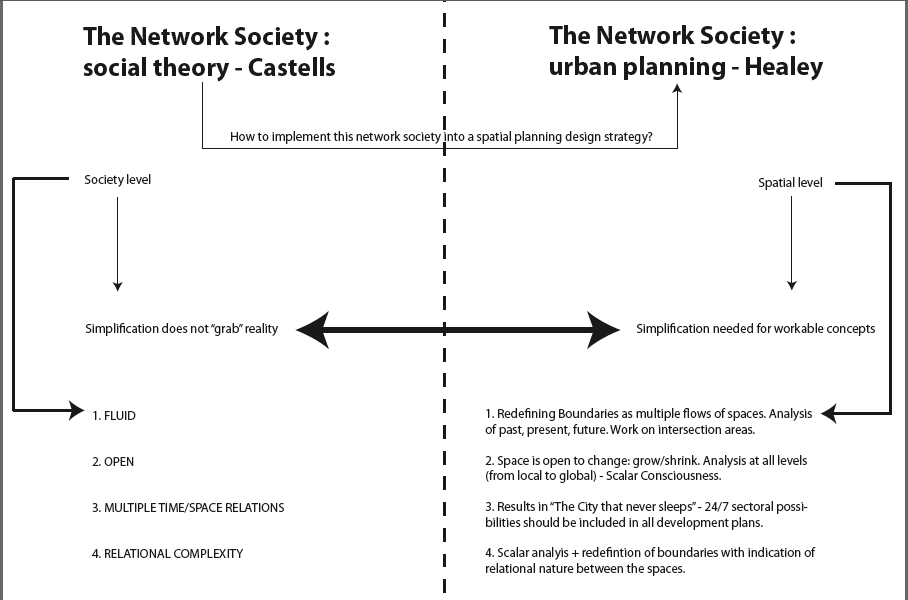
The world has changed. Societies have changed. Concepts for spatial planning remained untouched. In order to know how planning could adapt to the challenges of the network society, one needs to define the specifics of this society. The article argues that a network society is fluid, open, complex and experiences multiple time-space relations.

How to answer the challenges?

Healey critiques the determinism resulting from the usage of architectural concepts for spatial organization. She suggests to find answers in sociological theory and/or geography studies. Once again a call for a multidisciplinary approach. Below is an attempt to translate the theoretical concepts into design strategies.

We apologize for this extremely theoretical post. Some like that however.

Spatial planning strategic challenges to comply with network society

Spatial planning strategic challenges to comply with network society - free, based on Healeys publication mentioned in the article