The power of ecosystems? On Google+

Google Plus

Google Plus

Do you still remember the day Google launched Google+? This much awaited and highly anticipated social networking platform was launched about a half a year ago. “Social media gurus” immediately announced the death of Facebook. At that point, I was convinced those people understood the phenomenon wrong. So to put things in perspective, I wrote a blog post called “Why Facebook wins the Social Network Battle. On Flirting, Sex, Porn and Mr Rogers.” As from last week, I believe we entered a new stage in this debate. After all, Google plans to implement an updated version of its search algorithms that will change how the web works. This time it was up to the “SEO gurus” to have their say on Google+.

I don’t know what type of guru I am – I believe none at all – but it felt like time for my take on Google Plus. And let’s start with the hottest topic these days: SEO and Google+.

Google’s announcement on G+ integration

Regardless of the fact that Google Plus looked like “a Facebook” at launch, Google always insisted that it concerned a “project of bigger scale”. How big that scale is became clear with the announcement made by Google at the beginning of January 2012.

Simply stated: Google plans to integrate information from Google Plus to personalize search results. For SEO gurus it was a signal to jump into action. Suddenly SEO drastically changed: it’s no longer about how to get sites ranked high in search results but about having content on Google Plus. This not rarely resulted in advice similar to “you need to be on Google Plus.” As a result, brand pages flourished like mushrooms.

Of course, I cannot have anything against enterprises and brands being on Plus, but I can object the proposed tactic by the gurus. I believe the “New SEO” is more about getting real people post information about a business or brand on Google+. That’s something completely different from merely broadcasting marketing messages through a brand page, no?

However, there’s more at stake than just the impact on search. As one observer cleverly noted: “Google has a lot of other products that contain personally relevant information. Google Docs has documents, Gmail has contacts and calendar entries, Google Music has playlist information, and so on.”

Google as an integrated online collaboration platform. Google+ as social layer.

Google as an integrated online collaboration platform. Google+ as social layer.

Google+: social layer on top of collaborative cloud ecosystem by Google

Have you ever looked at Google’s navigation bar in detail? You should. I believe it’s not a coincidence that Google Plus is integrated into this bar. Google Plus is a part of a wider ecosystem. That ecosystem is neatly designed through a navigation bar. It contains multiple collaborative cloud solutions, amongst:

Google's collaborative cloud solutions as an ecosystem

Google's collaborative cloud solutions as an ecosystem

  • Gmail
  • Docs
  • Translate
  • Calendar
  • Search

I have a feeling this ecosystem will pay off. Not in the way that it’ll outperform Facebook or whatever other social network but in an unprecedented position within the organizations of the future it might take.

The organization of the future: fluid networks of interconnected freelance workers

Based upon a study by SD Worx on “the Future of Work”, I’ve deducted 3 core principles about the organization of the future:

  • Organization based upon strength individuals
  • Individuals work autonomous
  • Collaboration between individual people is more than the sum of all individual co-workers

The above means that organizations will form themselves organically between engaged people who connect. This connection can occur online and offline. However, as the strength of the individual becomes key to an organization, they’ll look for the best individuals. During this search process they won’t take geographic borders into account. In order for those talented people to collaborate effectively in a remote manner, they need collaborative tools that are available 24/7. And what exactly is available 24/7? Right: the worldwide web.

There we are: the Google web tools listed above are a great solution for future organizations. A lot of people will work through the Google Docs platform, use Gmail, translate through Google Translate, etc. Added to that is a tool that allows you to easily message, share, video call,…: Google Plus.
What else do you need to effectively execute your job as a knowledge worker? Almost nothing?

Google Plus a social layer for the future enterprise, not a Facebook killer.

Do you see the power of ecosystems at work?
Do you know other products designed with an ecosystem in mind apart from Apple’s app store?

Why Facebook wins the Social Network Battle. On Flirting, Sex, Porn and Mr Rogers.

Facebook social network

Facebook social network

Earlier this week I came across an interesting study on social media around the world. The presentation is packed with social media data but if you go through the slideshow, you note that the researchers basically conclude the following:

  • There’s one big Network: Facebook.
  • It’s flanked by a few smaller nonetheless successful players: Twitter, LinkedIn.
  • We must keep an eye on smaller, locally succesful players like Vkontakte in Russia and Eastern Europe or Hyves in the Netherlands.
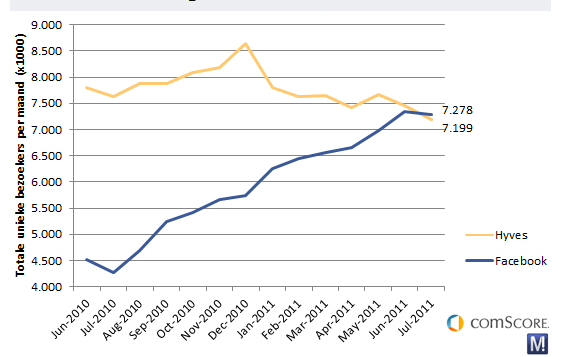
  • In addition to the researchers findings, we want to point out that locally succesful social networks might be thriving these days, but the chances are high that they are to be beaten by Facebook – as happened in the Netherlands with Hyves. The below image shows the decline for Hyves in favor of the Facebook growth.
Facebook bigger than Hyves in the Netherlands.

Facebook bigger than Hyves in the Netherlands.

The research report makes a similar observation: “The Big will get bigger – The small will become smaller”. This doesn’t have to surprise you that much. It’s like with people: the rich get richer while the poor become more poor every day.

Big to be bigger, small to become even smaller.

The value of a social network can be determined by the size of that very network (user base). Now, as the study points out, Facebook is the only one that has an adoption rate higher than 25%. If we think about the mainstream social network battle, this theory suggestst there will be only one mainstream social network: Facebook. I’m so sorry for Google’s tremendous efforts.

Google intelligently trying to give you a hint about it social network Google Plus

Google intelligently trying to give you a hint about it social network Google Plus

Facebook & LinkedIn: why are they ‘big’?

When you’re dealing with the adoption of innovation, one needs to realize that adoption is a human personality trait. Some are early adopters, others are laggards – lacking behind in adoption for every single technological novelty. According to Mr Rogers innovations always diffuse according to this model.

Speaks for itself that this diffusion is boosted when the innovation is actually making life more comfortable, taking away a pain or getting things done faster. Ideally the innovation continues on the path paved by older media so to boost the adoption. Actually, those new media internalize the content of the old medium. This can be seen for instance in radio being “spoken news”; film being “theatrical”; websites being a “digital brochure or businesscard”; etc.

The question is: what pain does Facebook take away? Have we been on this planet for ages with a tremendous pain that is now suddenly being solved through Facebook? How were we able to life before? What pain does LinkedIn take away? How did we do business before?

Facebook and LinkedIn have clear goals

In the case of LinkedIn there’s the obvious advantage of being a functional, B2B platform. And yes, it takes a way some pains related to networking, human resources, etc. It’s a great addition to business.

However, when looking at Facebook, what things did it make easier? I agree, sharing videos, pictures and status updates is very easy to stay in touch with your globally dispersed friends. However, there are other platforms that offer the same function. So why did exactly Facebook win and no other social network allowing to fulfill the same need?

Well, I believe the answer is in the very fact that Facebook was build for the Flirt!

Flirting is the act of demonstrating playfulness, romanticism or sexual overture by one person to another so to subtly indicate an interest in a deeper relationship with that other person. If you have a closer look at the very origin, growth and current usage of Facebook, you might notice that almost everything might come down to facilitating flirts.

The Digital Flirt = Facebook’s Killer App.

Facebook was founded to find and connect with people based on their “face picture”. Facebook made it possible to see who your co-students are, what they are doing without actually engaging but deploy it to set up an offline flirt strategy or charm offensive. Furthermore, the evolution of the platform always favored this aspect. Private messages and IM are perfectly suited for the flirt. Just think about it.

Summarized: Facebook is build to support our natural drive to have sex, to flirt.

Twitter: a flirt challenger?

The report points out that Twitter is a growing challenger. However, it might never reach the popularity like Facebook. Having nothing but 140 chars (minus room for images, links, etc) makes it a lot harder to flirt. But it’s possible though.

But there are bigger opportunities with Twitter. Its difficulty though is that this social network requires the individual to define its own medium goal. Not every individual is able to do that. But for some the twitter goal is about flirting, for others it’s free texting, for others it’s a personal teacher, etc.

Why did I ramble on about that? Well, flirting is a precursor to sex (if you are lucky).
Sex is a rather important social driver.
And sex is closely linked to porn. And porn is important to frame innovations.
And the softie in me believes flirting could be as valid as porn to frame tech-human innovations.
But You should always keep an eye on porn when discussing innovative technology.

iPhone innovative technology diffusion without porn

iPhone innovative technology diffusion without porn

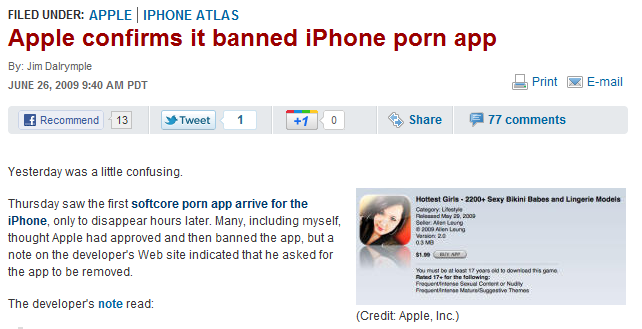
History has proven that porn and sex are often the key social driver behind the diffusion of innovation. Yes, it’s pretty strange that the iPhone was adopted so fast without supporting porn. But then again, the iPhone was adopted through a range of “taking pain away apps” to be easily installed through the app store. In the iPhone case, it’s not about the hardware but more the software ecosystem Apple cleverly set up. As might be clear, it’s not always about porn. But often enough it is.

Mr Rogers & The Adoption of Innovation

When we are talking about new communication technologies we often tend to focus on the technological aspects. It’s true that without the technology at stake, things wouldn’t be possible. But technology by itself doesn’t do a single thing as well.

To frame innovations, one needs to look at the social factors that determine whether a technology shall reach mainstream or not. Next to that, there’s always the economic reality check. Having an idea and a technology is one thing; to turn that into a viable business is a whole different story.

Specialist often point to so-called “Killer Applications” to explain the break-through. Well, in fact a killer application is an application of the technology that has social relevance. In the case of Facebook the social relevance is flirting. In the case of LinkedIn the social relevance is business networking. In the case of the VCR, it was porn.
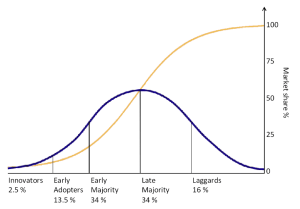
Rogers Diffusion of Innovation

Rogers Diffusion of Innovation

The importance of porn in the VCR battle

The diffusion of the VCR was related to 2 phenomenons, to know TV viewing and Film. Especially the latter is important to understand why VHS tapes won the battle – even if they were in a technological sense a lot less powerful than their competitors at Betamax or V-2000.

  • First application: time-shift in TV watching: new medium takes content of the old. This boost adoption since people are used to the content.
  • Second application: Film. And here’s where porn comes into play. The Film Industry (A-movies, blockbusters) were not very willing to offer their movies through VCR tapes. On the other hand the “secundary” Film Industry (porn) were very willing to spread their videos via the new technology. As a result video rent stores popped up and mainly had videos with porn. Most of those were VHS (65%), then Betamax (25%) and finally V-2000 (10%). So this VHS technology concquerred the market while clearly not being the best technology. Porn won!
  • Flirting wins! That’s people, that’s mankind, that’s a monkey brain.

Who’ll beat Facebook?

In short term: nobody. Most people basically hate change. It seems mankind is born with a love for status quo. So why on earth would they want to change their social network? It has been a big thing already to just get on it. But the opportunities for the digital flirt eventually got everyone on board. Now that we’re all on it, who’s going to swop? Most of us aren’t. Most of us love status quo. Most of us hate change.

People don't like change in general.


People don't like change in general.

Crises, Rebels, Journalists & Bloggers. On labels & labeling.

TV News

TV News

I’m not that different from any human being on this planet. I also watch TV news bulletins almost everyday. Yes, it offers me a window to the world. It shows me what’s going on. However, I came to realize the news is a heavy filter. Time to pull up the shutters, it’s noon.

On Labels & Labeling.

Labeling is describing someone or something in a word or phrase. That specific word or phrase is consequently a “label”. Without going into details of labeling theory, it’s important to realize that the very act of labelling is necessary for communication. You have to give something a “name” (aka label) so to communicate about it right?

It’s logic that journalists deploy labels and labeling techniques. After all, they are all human beings. However, they are human beings with a dramatic impact on society. Their act of labeling impacts how most people on the globe think about and frame certain events, evolutions, etc.

Let’s demonstrate “labels and labeling” with 3 real-life examples.

Example 1: multiple labels for 1 phenomenon

Mortgage crisis, credit crunch, debt crisis, economic crisis, etc.

I guess you’re quite familiar with the above “labels” today, as they have been largely present since a couple of years in the news. What’s remarkably striking however is that these terms have been deployed consecutively, one by one, the one after the other. In this manner it seems as if we’re hit by multiple different crises. I believe this is not the fact. All labels in fact point to one deeper phenomenon: rectification of global power values.

Global Power Value Rectification

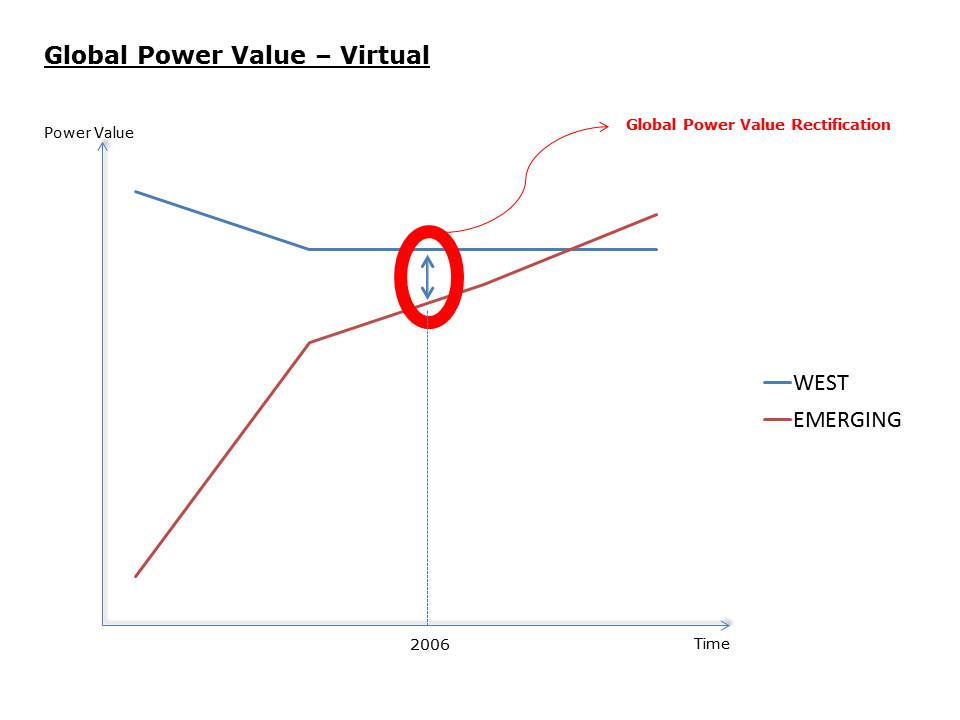
The concept of Global Power Value Rectification is not that easy to understand. Maybe that’s why journalists don’t use it to frame the crisis story. However, as a non-journalist, you have more time for interpretation and analysis. So why not try to explain this concept and consequently understand the framing of the different crises. I hope the below definition and graphics make clear what I label “Power Value Rectification”.

Global Power Value Rectification is:
a rectification process by which
a discrepancy between the Value in Reality and the Virtual Value
is manoeuvred away through crises.

Global powers - a reality check?

Global powers - a reality check?

Global Power - the virtual situation not aligned to reality?
Global Power Value Rectification as underlying phenomenon to frame the crisises.

Global Power Value Rectification as underlying phenomenon to frame the crisises.

Well, that should be about it for the first example of “journalistic labeling”.

What I’m trying to prove here is that all crisises are related and have a deeper reason: the change in global power. The crises are the process that rectify the difference between real and virtual value. There’s only a new name (label) to it because it happens at different structural levels that construct society. Once all structures have gone through their crisis, the deeper reason – rectify global power – is gone and consequently all crises, up until a new rectification is required.

This was a rather difficult example of journalistic labels, I know. But it was the starting point in my thinking on labels, so it’s a well-deserved first place. The next case should be easier to understand: the labeling of freedom fighters as “rebels” during the Arab Revolution.

Rebels Journalistic Framing - HLN.be (rebellen = rebels in Dutch)

Rebels Journalistic Framing - HLN.be (rebellen = rebels in Dutch)

Example 2: The label “Rebels” in Arab Revolution

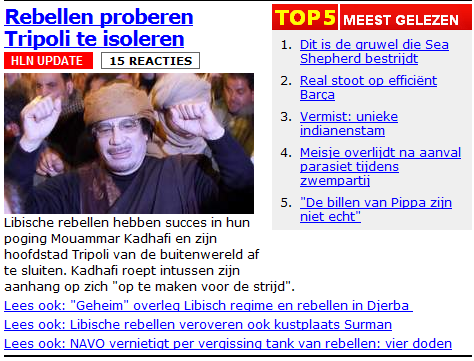
You often hear about the “Rebels” fighting the Arab Revolution. Quite frankly, this is a pretty strange label. After all, these people are actually fighting for freedom. Labelling them freedom-fighters would make a difference. Why do you call them rebels? I happen to associate the label rebel with negative and bad feelings, while freedom-fighter suggests they are “rebelling for a cause”. What about you?

Example 3: The label “Journalist” and the label “Blogger”

Overlooking what’s being said above, one can state that journalists are still important to provide us a window to the world but that we should always keep in mind that they are also humans who use labels so to interpret, understand and communicate about the world. I believe there might be a role for additional interpretation from bloggers around the globe.

It might be note-worthy in this respect to relate this to the “blogger vs journalist debate”. A journalist is formally employed at a professional media organization whereas a blogger is a more ad-hoc individual initiative. As a result the blogger has more freedom, time, less pressure and is able to frame stories more in-depth. Or am I just completely wrong on this whole labeling issue?