Sustainable Business Strategies for SMEs in a "dying industry"?

Business strategies for a dying industry

Business strategies for a dying industry

Print: a dying industry?

I often encounter the phrase “Print is dead”. Of course, print is not dead. First of all, it’s not a living organism – so technically unable to die because it never actually lived. Second, I still meet printed collateral on a daily basis. Third: history demonstrates that some people always tend to state that new emerging media “kill” existing ones. Concerning this third issue, allow me to have a small digression by referring to the panic for the medium radio with the rise of commercial television.

Commercial television would kill “the radio”. In fact, radio still exists. What happened is a re-allocation of the time spent for a specific medium. People tend to watch more tv and listen to the radio less. But radio is still alive and kicking. People just use it in a different way. The radio went from a “primetime” medium to a “drive time” medium – which means that people mainly use radio while driving a car. So: did video kill the radio star? No, it did not. It just resulted in a new way of allocating resources for specific media.

How to understand the phrase “print is dead”?

So one needs to pay attention what exactly is meant and how the above phrase should be understood. First of all, we have explained in the above paragraphs that media do not die. However, having a look at the phrase “print is dead”, there seems to occur another problem. What is the “printing industry”?

The printing industry is a rather general description of business activities related to printing. The argument that print is dead doesn’t hold much water past books, newspapers and magazine – which aren’t even dead also by the way. The printing industry has multiple subsections, so one cannot simplify that easily.

To start with: every single item made and sold in this world comes with packaging, even if ordered over the internet. So package printing won’t die. However, in times of economic downfall people consume less, which results in less shipments of goods (with printed packages). This also counts for commercial printing – which most of the time people denote when saying the phrase “print is dead”.

Is commercial printing dead?

Commercial printing is about the creation of leaflets, brochures, catalogues, etc. Yes, it still exists and it’s often quite important to have those “sales support documents” next to a powerful website. What is a fact is that more and more corporations are re-allocating their budgets from print to other media (internet, mobile, tv, …). But it is not dead. Nevertheless, the decrease in volume of printed marketing collateral has been an undeniable trend for years now.

Companies that have been in the industry for years are increasingly looking to survive. What business strategies have proven to be effective in surviving this turmoil?

Sustainable business strategies for commercial printers?
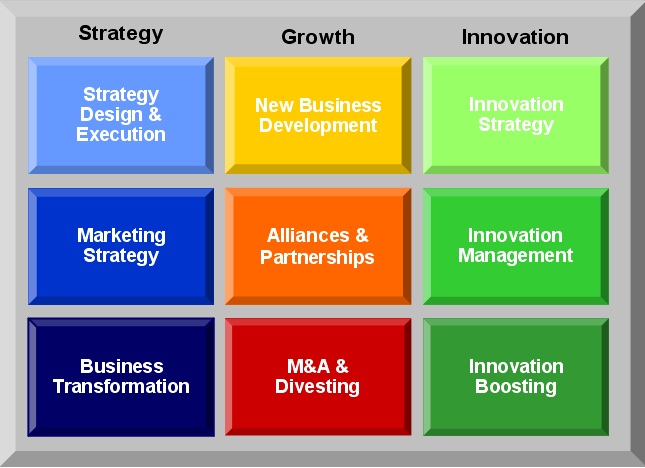
Business strategies and innovation are closely linked together

Business strategies and innovation are closely linked together

We don’t want to put an in-depth (theoretical) analysis here about business strategies for growth and innovation. But apparently they are closely linked to one another. The image on the left should do the trick for now. We believe it’s more fruitful to draw a real-life business case.

Sustainable business strategies for SMEs in commercial printing?

The graphics / printing industry has been going down for years now. The economic slowdown and the credit crunch only empower the trend. Loads of SME printers went bankrupt or at least had to shrink down the number of employees.

As a reaction, the industry’s major players reached out to a well-known strategy for growth: “M&A” (mergers and acquisitions). A financially strong company within the sector buys out less powerful players and consequently integrates them into the new structure. The sustainability and growth of the business is hence secured (it might be a short-term…).

As a result of the concentration process, the number of printers within the industry decreased. SMEs reacted by expanding into multi-media production services or by integrating into larger corporations. However more creative initiatives have seen the light as well. And those initiatives don’t even mean the loss of SME commercial printers. The initiative “Pinca” of the Pica Media Partners Group is one of those creative initiatives to counter-fight the negative spiral of the industry.

The Pica Media Partners case

Pica Media Partners is an independent network that contains more than 30 graphic communication corporations within it. The network covers the entire area of The Netherlands. By gathering the strengths of each entity in a network, the group has additional forces for marketing, sales and purchase. By uniting forces, the SME companies within the network can benefit from the state-of-the-art tools as if they were a big player.

In today’s printing industry it’s important to make the transition from a “printer” who sells products into a “media service provider” who sells services. An important element to successfully realize this transition is technology. Specific technologies support printers’ transformation into a service provider.

The network equally saw the importance of technology and jointly invested in an “online collaboration platform”. We are very keen to see how this technology will further prove how business model innovation can act as a strategy for growth. And I have to say: it looks quite promising. The deployment of the technology resulted in an innovative business model within the graphic production industry. In fact, BMI or business model innovation could well be the theme for my next blog post since I started to feel a particular interest in related subjects.

Share

Google Adsense: why should you consider it?

Google Inc.

If I ask people to “just name a brand”, then I often get the answer “Google”. Yes, Google is a powerful brand these days. Nevertheless, people often know nothing more about Google then it being a search engine. Of course, Google is much more than a search engine. Just think about the apps “Google Earth”, “Google Maps”, “Google Video” “Google Docs”, “Google Calendar” and last but not least “Gmail”.

It’s clear that Google isn’t just a search engine. But how do they generate revenue then? Google introduced an innovative business model – AdWords – and the pay-per-click (SEA) concept. The new business model proved to work because today AdWords is still the main source of revenues of Google Inc.

Google and its highly targeted advertising options

The powerful element in the Google business model is the fact that advertisers are ensured their ad appears only when people are interested. A search engine ad only appears for relevant keywords (in the case of the pay-per-click model). People only enter keywords when they are explicitly interested in a subject. An Adsense ad only appears in between relevant content. This means the ad is advertising the same good or service as the page it is on. Bottom line: advertising via a Google platform is cost-effective since it only reaches people who are interested. Compared to “mass advertising media” such as television, this way is much more effective.

Example: Google Adsense on this blog

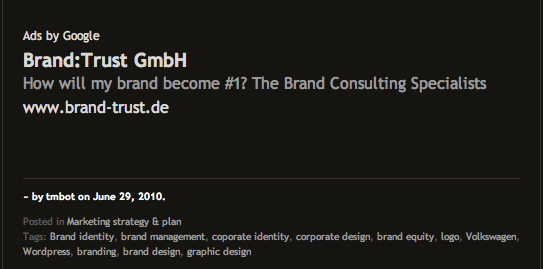
Have a look at the below screenshot of this website. It’s an Adsense ad that was placed next to an article on “brand management”. For a company specializing in brand management, appearing next to an article like that is very useful since the reader of the article is already interested in the advertiser’s core business.

Google Adsense for "brandtrust" on this blog

Google Adsense for "brandtrust" on this blog

Benefits Google Adsense

  • The most robust targeting of any ad network
  • AdSense’s innovative targeting options allow advertisers to more precisely reach their desired audiences on a third-party website — resulting in more revenue for the third-party website owner as well as more sales for the advertiser.

  • Contextual targeting
  • AdSense ads are related to the content of the webpage. This is an advantage: your ad pops up there were it doesn’t interrupt. It fits in between the content on the website.

  • Placement targeting
  • An advertiser can target a site based on demographics, vertical, geographic location, or URL.

  • Interest–based advertising
  • An advertiser can show ads based on users’ interests and previous interactions with that advertiser.

  • New Media?
  • AdSense isn’t just for websites. Earn extra revenue by displaying ads on your:

  • Site search results
  • Mobile webpages
  • Feeds
  • Parked domains
  • Mobile applications
  • Videos
  • Online game
  • Share

    World cup advertisers reflect shift in economic powers

    Chinese characters appear in the fifa world cup stadium perimeter advertisements

    Chinese characters appear in the fifa world cup stadium perimeter advertisements

    Fifa world cup: global event, global brands

    The world cup football is almost at its end. A European country is about to win the tournament – that’s for sure.

    However, if one digs a little deeper into the entire phenomenon of the world cup – one could see that the “economic powers” from the past (let’s say USA, Western Europe) are loosing power.

    I’ve been a dedicated world cup watcher since the ‘Mundiale’ in Italy, 1990. Since that day I mainly see “Western brands”: brands from manufacturers in the classic economic powerzones – they were the only ones who could afford the investment.

    With today’s shift in economic and financial power, it should not be a surprise that we see non-western brands on the global advertising platform (which the world cup football definitely is)

    Fifa partners and their core market

    To demonstrate the reflection in powershift, one can start looking at the “general fifa sponsors”. These are well-known companies from the past with their headquarters in Western (industrial?) economies. Brands that match this example: adidas (Europe), coca-cola (US), visa (US), sony (Japan), hyundai(South Korea). One of the upcoming economic (financial) powers is the Middle-East. You shouldn’t be surprised then that the Dubai-based Emirates Group is an official sponsor nowadays…

    Stadium perimeter advertisers

    The driving factor in this analysis however came from looking at the stadium perimeter advertisements during the game. By seeing exotic alphabet (chinese) and an Indian inspired font next to the pitches, my attention was drawn.

    Here’s a list of non-western brands that I’ve noticed to be advertising on football pitches during the world cup. In my opinion, they reflect the shift in economic and financial powers.

      1. mahindra satyam > Mahindra Group; India
        Yingli Solar > China
        Seara > Brasil

    Proving the shift in powers

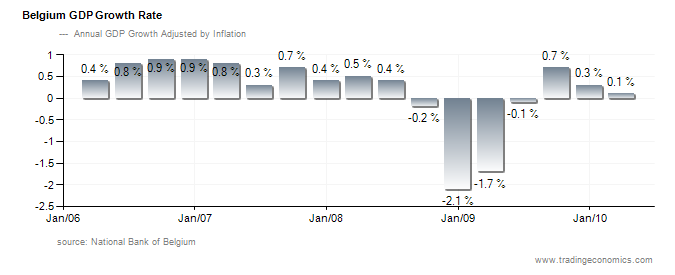
      1. Credit crunch : US ; Europe
        Economic slowdown: US, Europe
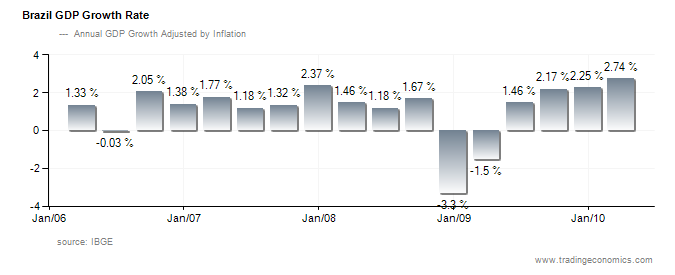
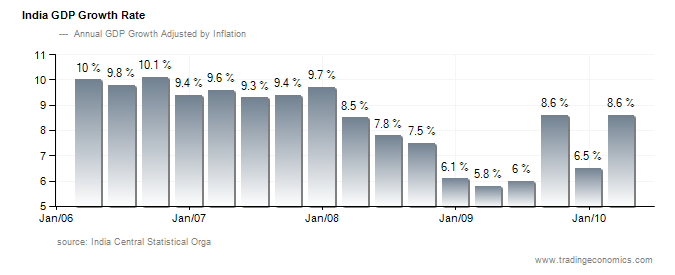
        New regions (India, China, Brazil): economic growth in 2010?
    • Belgium - economic growth rate ; 2010 Trading Economics. All Rights Reserved.

      Belgium - economic growth rate ; 2010 Trading Economics. All Rights Reserved.

      United-States economic growth rate 2010;  Trading Economics. All Rights Reserved.

      United-States economic growth rate 2010; Trading Economics. All Rights Reserved.

      Brazil economic growth rate;  Trading Economics. All Rights Reserved.

      Brazil economic growth rate; Trading Economics. All Rights Reserved.

      Indian economic growth rate;  Trading Economics. All Rights Reserved.

      Indian economic growth rate; Trading Economics. All Rights Reserved.

      China economic growth rate;  Trading Economics. All Rights Reserved.

      China economic growth rate; Trading Economics. All Rights Reserved.

    Share