Google Adsense: why should you consider it?

Google Inc.

If I ask people to “just name a brand”, then I often get the answer “Google”. Yes, Google is a powerful brand these days. Nevertheless, people often know nothing more about Google then it being a search engine. Of course, Google is much more than a search engine. Just think about the apps “Google Earth”, “Google Maps”, “Google Video” “Google Docs”, “Google Calendar” and last but not least “Gmail”.

It’s clear that Google isn’t just a search engine. But how do they generate revenue then? Google introduced an innovative business model – AdWords – and the pay-per-click (SEA) concept. The new business model proved to work because today AdWords is still the main source of revenues of Google Inc.

Google and its highly targeted advertising options

The powerful element in the Google business model is the fact that advertisers are ensured their ad appears only when people are interested. A search engine ad only appears for relevant keywords (in the case of the pay-per-click model). People only enter keywords when they are explicitly interested in a subject. An Adsense ad only appears in between relevant content. This means the ad is advertising the same good or service as the page it is on. Bottom line: advertising via a Google platform is cost-effective since it only reaches people who are interested. Compared to “mass advertising media” such as television, this way is much more effective.

Example: Google Adsense on this blog

Have a look at the below screenshot of this website. It’s an Adsense ad that was placed next to an article on “brand management”. For a company specializing in brand management, appearing next to an article like that is very useful since the reader of the article is already interested in the advertiser’s core business.
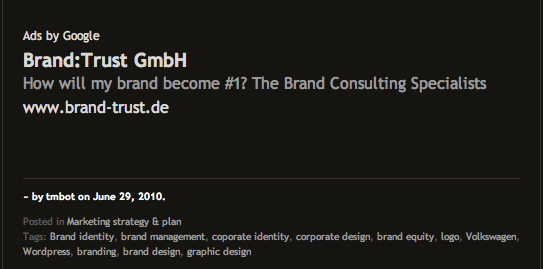
Google Adsense for "brandtrust" on this blog

Google Adsense for "brandtrust" on this blog

Benefits Google Adsense

  • The most robust targeting of any ad network
  • AdSense’s innovative targeting options allow advertisers to more precisely reach their desired audiences on a third-party website — resulting in more revenue for the third-party website owner as well as more sales for the advertiser.

  • Contextual targeting
  • AdSense ads are related to the content of the webpage. This is an advantage: your ad pops up there were it doesn’t interrupt. It fits in between the content on the website.

  • Placement targeting
  • An advertiser can target a site based on demographics, vertical, geographic location, or URL.

  • Interest–based advertising
  • An advertiser can show ads based on users’ interests and previous interactions with that advertiser.

  • New Media?
  • AdSense isn’t just for websites. Earn extra revenue by displaying ads on your:

  • Site search results
  • Mobile webpages
  • Feeds
  • Parked domains
  • Mobile applications
  • Videos
  • Online game
  • Share

    World cup advertisers reflect shift in economic powers

    Chinese characters appear in the fifa world cup stadium perimeter advertisements

    Chinese characters appear in the fifa world cup stadium perimeter advertisements

    Fifa world cup: global event, global brands

    The world cup football is almost at its end. A European country is about to win the tournament – that’s for sure.

    However, if one digs a little deeper into the entire phenomenon of the world cup – one could see that the “economic powers” from the past (let’s say USA, Western Europe) are loosing power.

    I’ve been a dedicated world cup watcher since the ‘Mundiale’ in Italy, 1990. Since that day I mainly see “Western brands”: brands from manufacturers in the classic economic powerzones – they were the only ones who could afford the investment.

    With today’s shift in economic and financial power, it should not be a surprise that we see non-western brands on the global advertising platform (which the world cup football definitely is)

    Fifa partners and their core market

    To demonstrate the reflection in powershift, one can start looking at the “general fifa sponsors”. These are well-known companies from the past with their headquarters in Western (industrial?) economies. Brands that match this example: adidas (Europe), coca-cola (US), visa (US), sony (Japan), hyundai(South Korea). One of the upcoming economic (financial) powers is the Middle-East. You shouldn’t be surprised then that the Dubai-based Emirates Group is an official sponsor nowadays…

    Stadium perimeter advertisers

    The driving factor in this analysis however came from looking at the stadium perimeter advertisements during the game. By seeing exotic alphabet (chinese) and an Indian inspired font next to the pitches, my attention was drawn.

    Here’s a list of non-western brands that I’ve noticed to be advertising on football pitches during the world cup. In my opinion, they reflect the shift in economic and financial powers.

      1. mahindra satyam > Mahindra Group; India
        Yingli Solar > China
        Seara > Brasil

    Proving the shift in powers

      1. Credit crunch : US ; Europe
        Economic slowdown: US, Europe
        New regions (India, China, Brazil): economic growth in 2010?
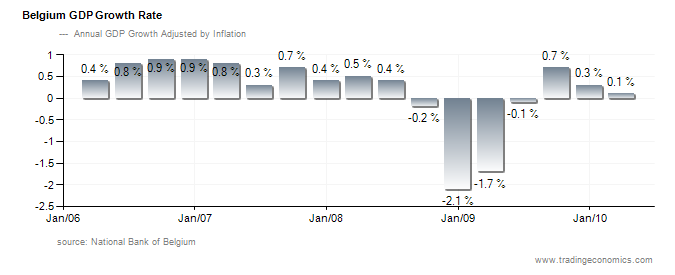
    • Belgium - economic growth rate ; 2010 Trading Economics. All Rights Reserved.

      Belgium - economic growth rate ; 2010 Trading Economics. All Rights Reserved.

      United-States economic growth rate 2010;  Trading Economics. All Rights Reserved.

      United-States economic growth rate 2010; Trading Economics. All Rights Reserved.

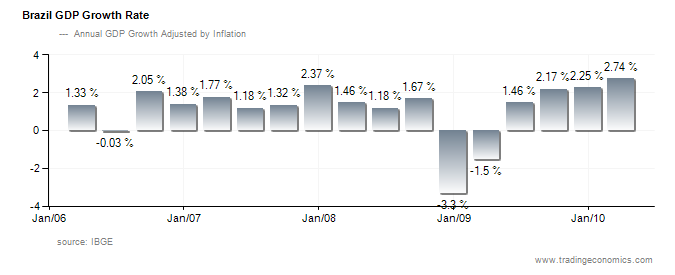
      Brazil economic growth rate;  Trading Economics. All Rights Reserved.

      Brazil economic growth rate; Trading Economics. All Rights Reserved.

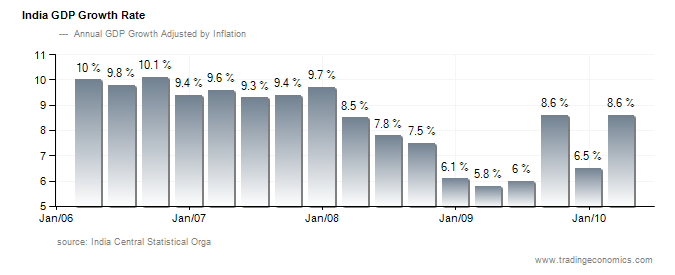
      Indian economic growth rate;  Trading Economics. All Rights Reserved.

      Indian economic growth rate; Trading Economics. All Rights Reserved.

      China economic growth rate;  Trading Economics. All Rights Reserved.

      China economic growth rate; Trading Economics. All Rights Reserved.

    Share