Everyone deserves 2 seconds of fame. Iphone App Messe Düsseldorf.
March 30, 2011 Leave a comment
Guess this Iphone App Ad were mine…watch the movie online at Digi:Media Trade Fair website.
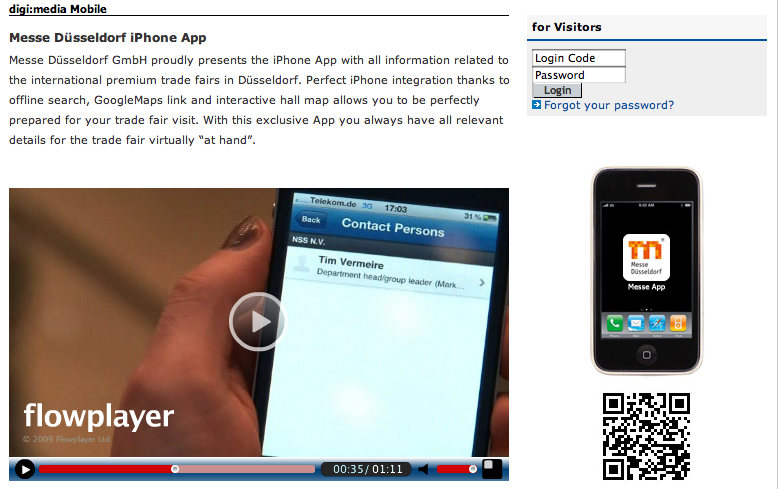
My 2 seconds of fame - marketing without a cost
Creative-Consulting concerning Content-Community-Commerce by @vermeiretim
March 30, 2011 Leave a comment
Guess this Iphone App Ad were mine…watch the movie online at Digi:Media Trade Fair website.
My 2 seconds of fame - marketing without a cost
March 28, 2011 8 Comments

arrival at the right spot: vermeiretim extension switch - photo: allnewsweb.com
Just arrived at this new destination: vermeiretim.wordpress.com.
“Hey, this has the same extension as my twitter account! And it feels the same as my previous blog.
I feel very at ease. Yes, think I should settle here. “
But you’re here already, so I better cut the crap and inform you that I was formerly whispering at tmbot.wordpress.com.
Moving content from a wordpress.com blog to another wordpress.com blog sort of works like this (or at least, that’s how I think you’re supposed to handle it):
make new domain, export xml old, import xml into new, wait 20 sec, site is there! But afterwards, you need to do organize your blog. Settings and things like widgets and themes are apparently not in the XML.
Annoying? Absolutely not.
Just modifying a name shouldn’t take that much time. I guess any non-technician will agree. But while going through this entire export/import/tweak-process, I noticed that the WordPress back-office has a “Polls” option. Hooray! Always wanted to poll. The question is below and if you’re into stories, elephants or brain concussions I think you should VOTE!*
What a stupid question! Haven’t you heard about Mobile HTML5 yet?
I have to say, I’m a bit tangled by the entire mobile market thing / marketing (phones, tablets).
If you want to “go mobile” for whatever business reason – don’t just do it because you can – what platform do you develop it for? As it seems a mobile app is OS-dependent and thus requires some different coding.
From what I’ve understood (mobile) HTML5 would overcome this issue. So as long is this language isn’t completely there yet, mobile marketing could be a big effort and a lot of money.
Guess best thing today’s marketers can do is to find out which mobile devices have the biggest market share within their customer base.
How to obtain that kind of knowledge? Well, I would say use your senses when you meet a customer. He’ll probably do something with his mobile device at some point. Or just look when one uploads an image to Facebook or something similar. Yfrog for instance shows the device that shot the picture. Another approach is to organize a poll. As I did with my poll on the battle for standards.
My poll is about the battle for standards
Don’t underestimate the battle for standards within high-tech industries. It can be an important factor for the adoption of innovation. It can also make or break a company.

battle for standards - video recorders
Dumbo is on but Samson is on too.
Easter holidays, rainy day. You’re not allowed to play outside. So is your friend living across the street. Good thing: big afternoon on the tele. Dumbo was aired. But Samson, which I was equally into, was on too. And at the same time. Bummer!
Me and my friend (read: their dads) decided to each tape a show, not realizing they couldn’t exchange the tapes because one of the dads had a betamax and the other had a VHS. Battle for standards, there you go!
Let’s play Dumbo. Hell yeah, I believe I can fly!
As a result me and my friend watched the Dumbo movie together and we didn’t watch Samson anymore. Rain stopped by the way. It was logic that we went out to play. We always did that. We often played football. Not that day.
We played dumbo that day, only that day that is. We took a bucket and a feather. Climbed on top of our red brick postboxes. I jumped believing I was about to fly, exactly in the same way as Dumbo does in the below video. Crashed on my head but scored the bucket though! Guess I didn’t fly because I miss the elephant ears.
Few hours later I woke up. Diagnosed with a brain concussion. Maybe that’s why I remember this entire story anyway?
Oh yes, VHS won and I love Samson more than Dumbo since then.
*It would be truly awesome if the site only showed the video after poll participation.
March 24, 2011 12 Comments

corporate pursuit of happiness
Earlier this week, I couldn’t access my blog Administration. WordPress kindly informed me about the issues. The message was something similar to “Whoops! There’s something wrong. Please check the knowledge base for any known issues and if none of this helps, drop us a note”.
So I did all of that but ended up dropping them that note. The issue got solved extremely quickly by Andrew. But I don’t want to talk about WordPress’s great support service today.
Today I want to talk about Andrew. Andrew is a Happiness Engineer at WordPress. Happiness Engineer? What on earth? Well, WordPress probably met Marketing professor Jennifer Aaker and her research on “Happiness”.
Jennifer Aaker’s study on the corporate pursuit of happiness
Jennifer Aaker is a well-known professor marketing. She studies psychology alongside marketing and spent the last several years studying the subject of “happiness”. How do people find happiness? How do they keep it? How do they manipulate it? How do they use it as a resource?

Jennifer L. Aaker, General Atlantic Professor of Marketing, Graduate School of Business Stanford University
The main finding of the study is that in fact a “meaningful experience” (e.g.: new skill) often makes people happier than moments of pure pleasure. This is what she and others call the “Paradox of Happiness”.
Next to that, she discovered happiness is age-dependent. Young people relate happiness to excitement whereas elderly link it with peacefulness. But what’s more important to me is that Aaker soon discovered that the above little nuances were key for marketing and business.
After all, she realized, brands are increasingly trying to appeal to consumer’s emotions to keep their sales going in these rough economic times.
So she set up her theory and easily convinced the academic world that she was on to something – resulting in a graduate-level class “Designing Happiness” in one of USA’s leading business schools. But in today’s post-recession economy, where morale is low, brand owners and marketers tend to see the appeal of promising happiness along with their products as well. They realized that they could deploy happiness as any other commodity to sell something.
Of course, the question is: how does one implement the ideas of Happiness into marketing and business? Let’s have a look at corporations that tried to integrate this entire “happiness idea”.
Aaker’s Happiness and some Big Guns
Benefits of “happiness-driven” marketing campaigns?
In fact nobody really knows for sure, as is often the case in social sciences. Aaker’s hypotheses is the following:
Marketing Happiness is one of the few ways businesses can still appeal to people in a manner that feels authentic. That’s important, because people have an aversion to anything that feels overly manufactured.
The concept of Marketing Happiness thus expands the idea of what it means to buy something. If you follow this theory, you believe that brands can provide greater meaning to the world for the consumer. One of those greater meanings could be things that enable happiness. Consequently the consumers want to share that happy moment and feeling as if the product is part of their lives and community (read: facebook likes, twitter mentions).
Happy Talk = Word-of-Mouth!
Case WordPress: bringing Happiness through a job title isn’t enough
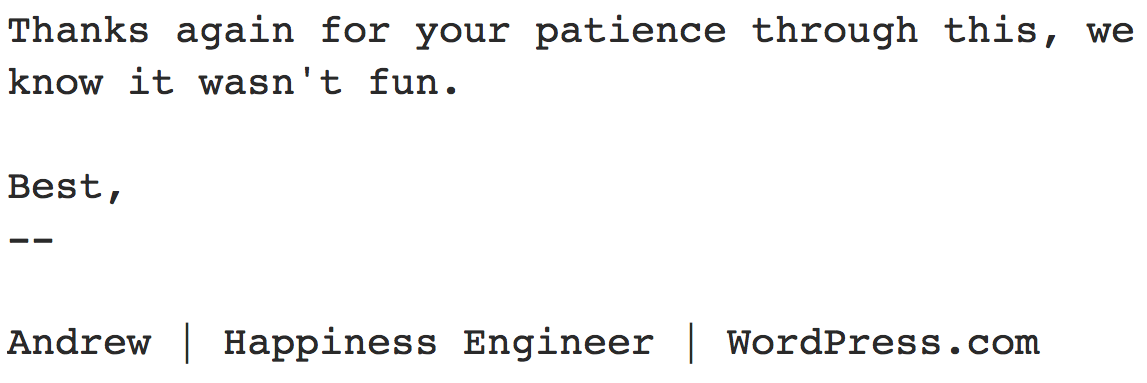
E-mail from the Happiness Engineer at WordPress
Best regards — Andrew — Happiness Engineer — WordPress.com
As I mentioned earlier in this article, I dropped WordPress a note to register my issue. Most compelling about the whole support was the job name of the guy helping me out. Andrew is a Happiness Engineer. Guess his job is to engineer people into a happy state of mind, right? Now how can he make people happy?
First, and this is what most people believe is sufficient, he can solve our technical problems as soon as possible.
Second, he can inform us what the error is about and educate us about the skill required to fix it. Maybe next time I can do it myself. This is what’s going to make me really happy, according to Aaker’s findings. And it will probably make Andrew happy too. His work-load will decrease. Andrew choose the first option by the way. He solved it himself. Not teaching me anything. Maybe Andrew already figured I couldn’t fix it anyway.
Aaker discovered that a meaningful experience (e.g.: new skill, volunteering, spending time with family) often makes people happier than moment of pure pleasure.
Andrew, are you authentic? Do you really exist?
Aaker believes marketing happiness could be one of the few ways business can still appeal to people in an authentic way.
I doubt the authenticity of Andrew. Would an authentic human being out of flesh and blood e-mail you six times? Would he send recurring e-mails that bring you exactly the same message? I wouldn’t for sure. It felt like spam. And I’m quite convinced that you’d experience too much e-mails as “manufactured” as well. Didn’t Aaker learned us that we actually don’t like that?
Aaker says that people have an aversion to anything that feels overly manufactured.
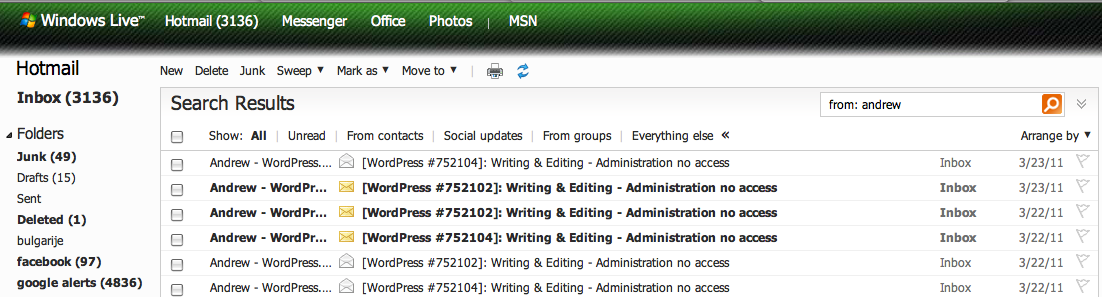
Andrew, WordPress's Hapiness Engineer send me 6 e-mails.
So, in the end I find myself asking: did WordPress ever had a lecture from Aaker? Or did WordPress just hear about the “Happiness Buzz” and came up with a title to put on automated e-mails? One would think so. After all they didn’t integrate two key findings of the study:
As they did:
Yours Truly — @vermeiretim — Awesomeness Developer — tmbot.wordpress.com
Notes:
 Keen on C