Have you ever experienced the web as a powerful tool for connecting people?
- Yes: continue reading.
- No, but I like the sound of that: continue reading.
- Not at all and I believe it’s bullshit: stop reading and go back to google.
Do you want to read a story about the web connecting people?
The New Trade - Book on Business Storytelling
I have experienced the power of the web. I felt how it can connect and engage people. And I want to share this story with you. Yes, I really want you to have a similar experience. Simply because it rocks!
linkedstories – connected people?
Below is the story of @vermeiretim connecting with @rafstevens with regards to his book project “The New Trade”.
If you like what’s being discussed in the below e-mail conversation, I suggest you read the book at some point. Highly recommended!
E-mail in: ROI of Business Storytelling: Story of Horse Bust.
Hi Tim, here it comes…
I would be honored to give you “a voice” in the book I am writing. The concept of the [book will be a mix of bizz-book-wrting, storytelling and blog-writing (with links to video, blogs, etc). I am in the final phase of finishing it. A draft should be ready within 4 weeks or so.
Here is my question to you: what is the ROI of storytelling to you?
To get you started on the topic I want to share this with you:
http://significantobjects.com/2010/10/08/horse-bust-beth-lisick-story/
Significantobjects is a project where a creative writer invents a story about an cheap second object to increase its value. In the test, invested with new significance by this fiction, the object is sold via eBay. It was a test of a group of people trying to prove that a good story sells, even if this story is false.
You can read more about the project/test here:
http://www.iddictive.com/2010/02/15/how-to-stand-out-by-telling-stories/
and here:
http://significantobjects.com/about/
This got me thinking about what Shawn Callahan of Anecdote calls “big S and small S storytelling:
The Uncanny Valley of Business Storytelling (http://www.anecdote.com.au/archives/2011/01/the_uncanny_val.html)
I quote him here: Big ‘S’ Storytellers understand plot structures, character development, scene design and a myriad of other storytelling principles and practices. At the other end of the spectrum is Small ‘s’ Storytelling where we find the stories we tell on a daily basis in conversations, anecdotes, recounts and examples.
Okay, here I go:
A part of my book is dedicated to storytelling as a “tool” to reveal what is happening in an organization. Here I’ll also be exploring how stories can drive internal communication to another level.
But another part of the book is dedicated to “how to use big ‘S’ stories to better connect to an audience.
So I repeat my question here:
What is the ROI of storytelling?
What is your view on what is going here with the test of significantobject? Does a good story always sell, no matter true or false.
The auction for this Significant Object, with story by Beth Lisick, has ended. Original price: 99 cents. Final price: $62.95.
Like to hear your view. And if it is okay with you I will curate your answer in the book. Ofcourse you can read the draft of the book and still than decide if you are okay with publishing it in it.
Thanks for considering this.
Best regards,
Raf Stevens
__________________________________
CORPORATE STORYTELLER
Vroonbaan 67 I 1880 Nieuwenrode I Belgium
M: +32 486 85 15 81
E: rafstevens@me.com
I: www.corporatestoryteller.be
E-mail out: RE: ROI of Business Storytelling: Story of Horse Bust.
Dear Raf,
as a result of your request to reflect on the “ROI of Business Storytelling”, I’m honored to bring you my story.
“What is the ROI of Business Storytelling?”
When I first read this question, I was puzzled. What at first sight seemed a simple question proved to be a genuine brain teaser.
In order to even boost that thinking, I figured it might prove beneficial to pose this question to my follower base on Twitter. After all, the real-time message service, had already proven to spark conversations. What’s even more, on top of those conversations, one can build true stories.
In what follows I will try to explain how my “Big Story about Storytelling” stems from “Little Stories Conversations” on Twitter.
Conversation: monetary value of Business Storytelling?
To reach beyond my grey brain cells, I fired “What is the ROI of Business Storytelling” at the crowd. And yes, there it was: @joachimschulz noticed the question and replied – quite convinced – $ale$.
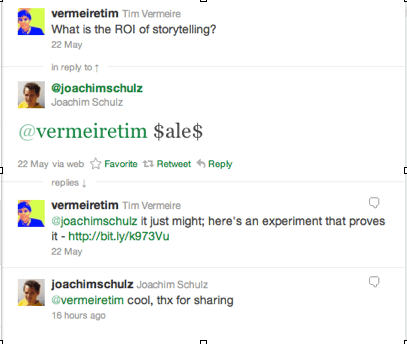
Twitter conversation with @joachimschulz about ROI of Storytelling
Significant Objects Experiment: story brings economic value
The Significant Objects experiment seems to prove that a good story behind an object (product) increases the value. The emotional value (story) can be monetized (economic value).
According to @joachimschulz and the Significant Object experiment that’s truly the case. A good story sells, always. I believe this isn’t 100% true.
Storytelling brings value, but not per se economic value.
Stories have business value. No doubt. For most businesses however they won’t bring immediate revenue or a higher margin. At least they won’t in the short run. They definitely will in the long run.
In the long run, all businesses need to evolve into a social, human business to stay in business. Stories support the transformation into a social business. Because social is human. And humans like stories – just as candy and sex. We simply can’t help it – it’s hard-wired into our brain.
That’s right, we still have that cavemen brain. And back in the cave days, stories were the manner to transmit information and knowledge in such a way that it was easy to notice, to remember and to share. The explanation speaks for itself: in an oral culture – where content is transmitted via speech – one needs a certain “angle” to find something compelling in order to receive attention, to be remembered and – especially – to be shared. And that’s where stories come into play.
Conversation: non-monetary values of storytelling?
Stories bring value. Period. But which values?
To tackle this question, I turned to my socially constructed professor again: Twitter. I teased the crowd with an – at first sight – simple question:
“Is it storytelling or storybuilding?”
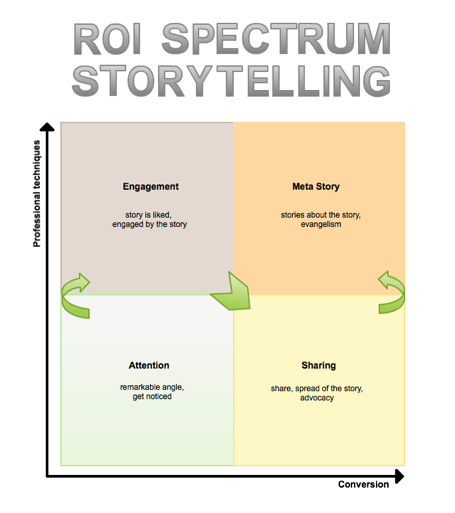
And hooray, scored again. The conversations lead to the ROI spectrum of storytelling.

Twitter conversation with @jukkaam about Business Storytelling
The ROI Spectrum of Business Storytelling
I’d love to thank @jukkaam for jumping into the question. He simply added “or storysharing or storyexperiencing #leadership” to the “Is it storytelling or storybuilding #justaksing” tweet – and by doing so co-created the ROI spectrum of Business Storytelling.
Yes, a spectrum. Because we later on realized we were actually having a wrong debate. We were not supposed to think in “or”. It was an “and” story.
We agreed to favor the Genius of the ‘and’ over the Tyranny of the ‘or’ (and we gave credits to @digitaltonto for this splendid quote). But in the meantime, we were talking about the ROI Spectrum of Storytelling.
The Return on Story Investment for Business is:
- Stories create attention – because of their angle, their framing, their intriguing aspect.
- Stories create engagement – because of the manner they grab the spectator.
- Stories are made for sharing – because of the experience the spectator had. He wants to share it with his peers.
- Stories are made to act on – people act on stories and even create stories about the stories.

ROI of Business Storytelling Spectrum
Business Storytelling is in conversion, not in conversation.
I tend to believe that the real value of this Storytelling is in conversion. Stories help people connect with you (and your brand). In an ideal world, conversion occurs via 4 stages: attention – like – share – act. Stories contribute to each stage.
Nevertheless, one needs to take the costs for creating stories into account as well.
The more professionally crafted, the higher the engagement odds for the audience. But that doesn’t necessarily count for the sharing odds (viral sensitivity?). On the contrary, grabbing attention with a remarkable angle or concept doesn’t necessarily require a big bag of money, right?
Hope you liked my story on ROI Business Storytelling Raf!
Yours truly,
Tim Vermeire





 Keen on C