Why my future business card is as it is. On Design thinking.

My future business card - final version

My future business card - final version

I recently got selected for the IBBT iBootcamp dating event. It’s a thing about innovative start-ups.
Some of the teams are still looking for people in marketing to empower their business idea. So I presented myself.
One week later. E-mail: “you’re selected”. Hooray! Wait a minute, maybe I need a personal business card for that? So I started thinking.

Design thinking is to come up with different scenarios and consequently select the best design

Design thinking is huge these days. Is it a buzz? I believe it’s more. It’s an essential way of getting the best result. Design Thinking isn’t just for car designers, interior designers or architects. No, even writing is design thinking.
You come up with a bunch of angles to frame your point in. You select the best angle, the one that appeals most to people. Design works in the same way: you choose that design which you expect will appeal most to people.

Maybe I do have design skills?

As I just figured out I was always using Design Thinking as a means to create an article, it came to me that maybe I could have got those design skills I’ve always dreamed of. Why not do the same but now with graphics?
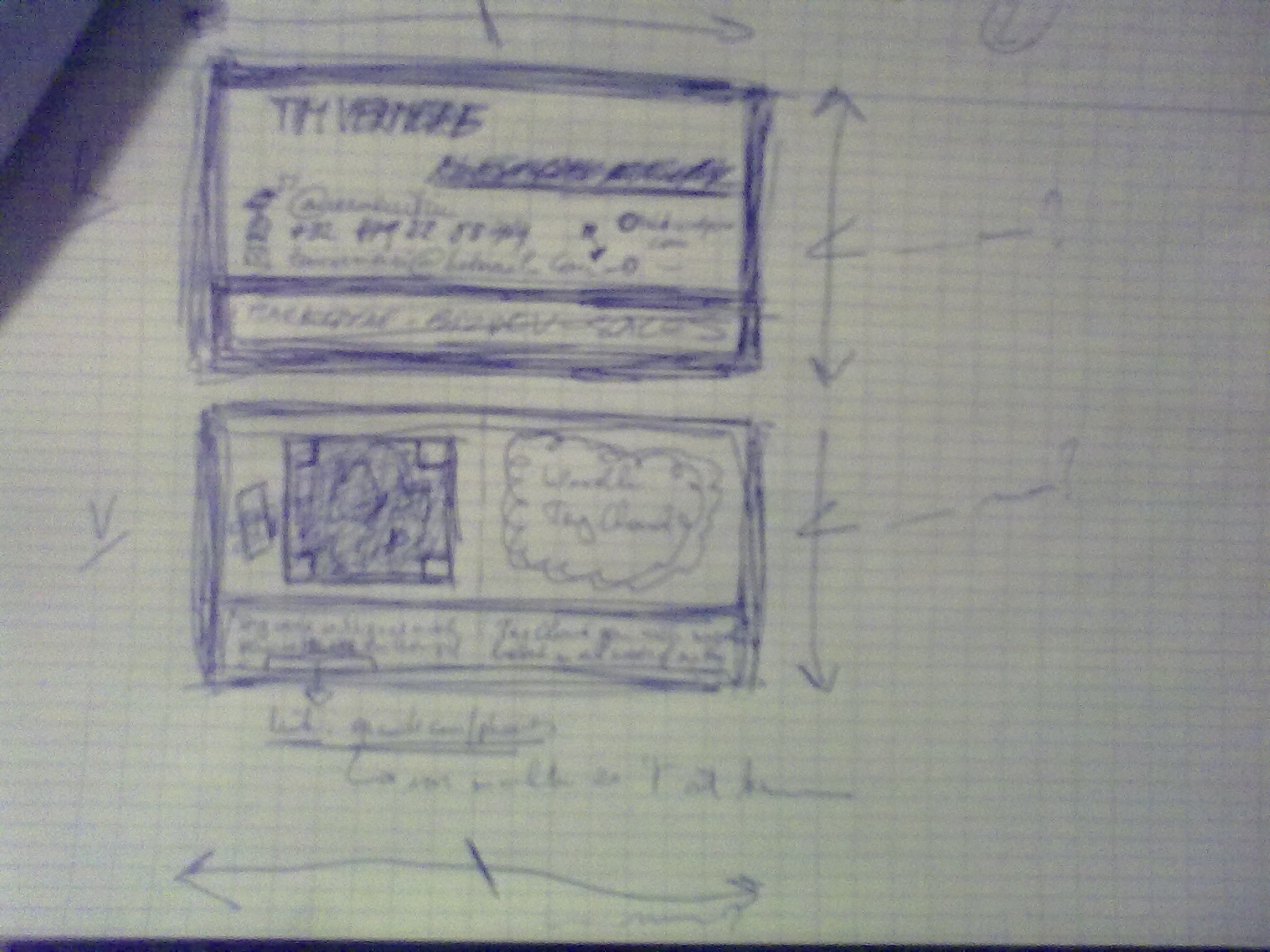
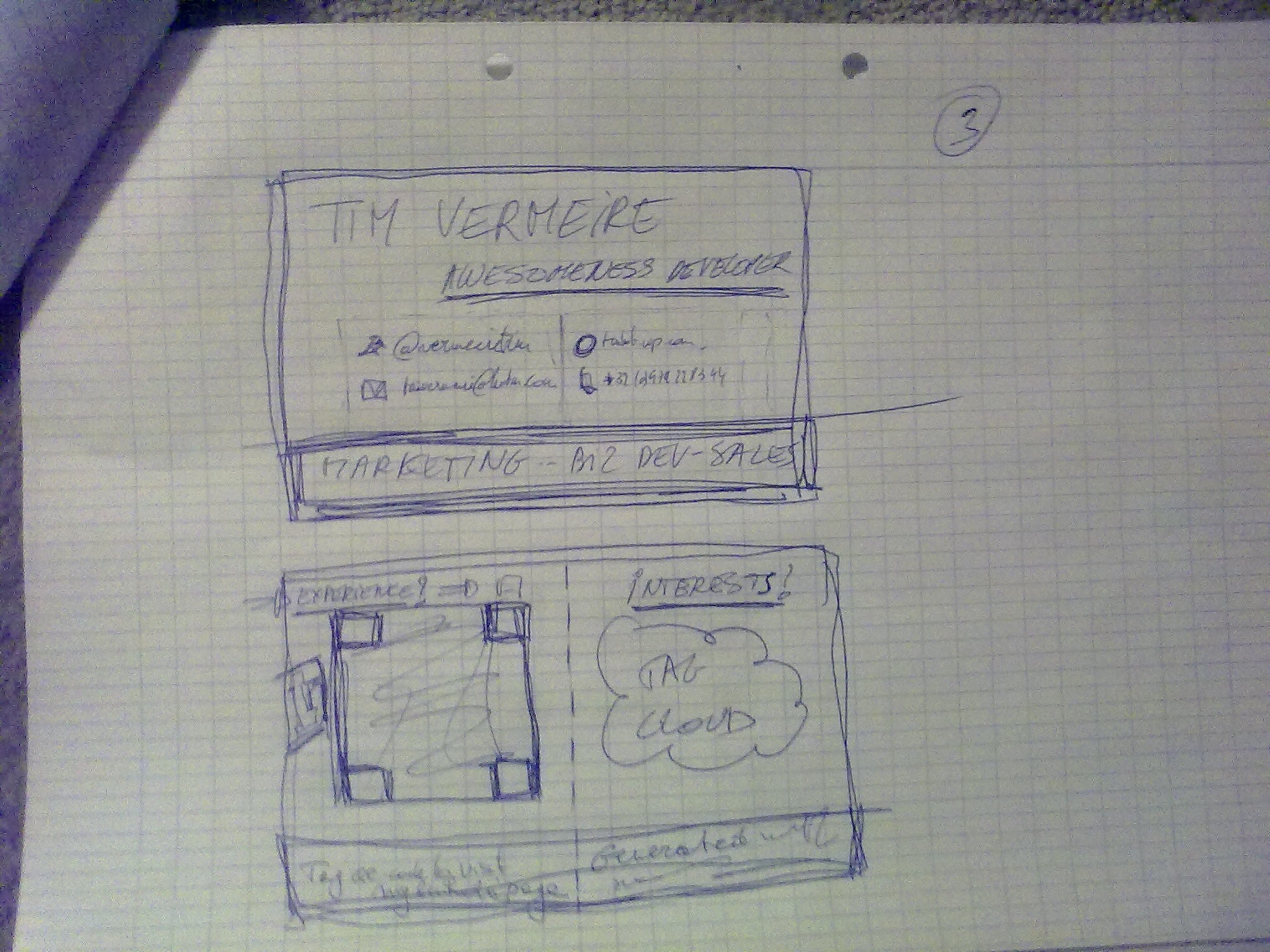
Below are some steps of the process. No need for words.

Oh, maybe just one more question: would it make sense to create this business card in A4 format?
Who wouldn’t remember such a big business card?

Business card - design phase 1

Business card - design phase 1

Business card - design phase 2

Business card - design phase 2

Business card - design phase 3

Business card - design phase 3

Business card - design phase 4

Business card - design phase 4

First digital version - design phase 5

Making it look beautiful

I’m currently trying to turn this into something sexy. I guess you’ll see the result when we meet, offline.

The rise of Happiness Engineer & The Corporate pursuit of Happiness.

corporate pursuit of happiness

corporate pursuit of happiness

After several months of bloglessness I finally got myself up-and-running again. Full of inspiration? Yes. And I still remember my password too. Great! But that’s only half-way there.

Earlier this week, I couldn’t access my blog Administration. WordPress kindly informed me about the issues. The message was something similar to “Whoops! There’s something wrong. Please check the knowledge base for any known issues and if none of this helps, drop us a note”.

So I did all of that but ended up dropping them that note. The issue got solved extremely quickly by Andrew. But I don’t want to talk about WordPress’s great support service today.

Today I want to talk about Andrew. Andrew is a Happiness Engineer at WordPress. Happiness Engineer? What on earth? Well, WordPress probably met Marketing professor Jennifer Aaker and her research on “Happiness”.

Jennifer Aaker’s study on the corporate pursuit of happiness

Jennifer Aaker is a well-known professor marketing. She studies psychology alongside marketing and spent the last several years studying the subject of “happiness”. How do people find happiness? How do they keep it? How do they manipulate it? How do they use it as a resource?

Jennifer L. Aaker, General Atlantic Professor of Marketing, Graduate School of Business Stanford University

Jennifer L. Aaker, General Atlantic Professor of Marketing, Graduate School of Business Stanford University

The main finding of the study is that in fact a “meaningful experience” (e.g.: new skill) often makes people happier than moments of pure pleasure. This is what she and others call the “Paradox of Happiness”.

Next to that, she discovered happiness is age-dependent. Young people relate happiness to excitement whereas elderly link it with peacefulness. But what’s more important to me is that Aaker soon discovered that the above little nuances were key for marketing and business.
After all, she realized, brands are increasingly trying to appeal to consumer’s emotions to keep their sales going in these rough economic times.

So she set up her theory and easily convinced the academic world that she was on to something – resulting in a graduate-level class “Designing Happiness” in one of USA’s leading business schools. But in today’s post-recession economy, where morale is low, brand owners and marketers tend to see the appeal of promising happiness along with their products as well. They realized that they could deploy happiness as any other commodity to sell something.

Of course, the question is: how does one implement the ideas of Happiness into marketing and business? Let’s have a look at corporations that tried to integrate this entire “happiness idea”.

Aaker’s Happiness and some Big Guns

  • Adobe:
    got lectured by Aaker on the liaison between happiness and meaningful moments. The ideas were implemented through the “Adobe Youth Voices” project. The project allows children and teenagers from poor environments to use the Adobe software freely in order to create their story.
  • Coke:
    experimented with the link between happiness and the brand. Just think about Coke’s “happiness machine” or the entire “open happiness” campaign.
  • AOL:
    sources claim they have received lectures from Prof. Aaker but I don’t have an idea whether they implemented it in one way or another.

Benefits of “happiness-driven” marketing campaigns?

In fact nobody really knows for sure, as is often the case in social sciences. Aaker’s hypotheses is the following:

Marketing Happiness is one of the few ways businesses can still appeal to people in a manner that feels authentic. That’s important, because people have an aversion to anything that feels overly manufactured.

The concept of Marketing Happiness thus expands the idea of what it means to buy something. If you follow this theory, you believe that brands can provide greater meaning to the world for the consumer. One of those greater meanings could be things that enable happiness. Consequently the consumers want to share that happy moment and feeling as if the product is part of their lives and community (read: facebook likes, twitter mentions).
Happy Talk = Word-of-Mouth!

Case WordPress: bringing Happiness through a job title isn’t enough

E-mail from the Happiness Engineer at WordPress

E-mail from the Happiness Engineer at WordPress

Best regards — Andrew — Happiness Engineer — WordPress.com

As I mentioned earlier in this article, I dropped WordPress a note to register my issue. Most compelling about the whole support was the job name of the guy helping me out. Andrew is a Happiness Engineer. Guess his job is to engineer people into a happy state of mind, right? Now how can he make people happy?

First, and this is what most people believe is sufficient, he can solve our technical problems as soon as possible.

Second, he can inform us what the error is about and educate us about the skill required to fix it. Maybe next time I can do it myself. This is what’s going to make me really happy, according to Aaker’s findings. And it will probably make Andrew happy too. His work-load will decrease. Andrew choose the first option by the way. He solved it himself. Not teaching me anything. Maybe Andrew already figured I couldn’t fix it anyway.

Aaker discovered that a meaningful experience (e.g.: new skill, volunteering, spending time with family) often makes people happier than moment of pure pleasure.

Andrew, are you authentic? Do you really exist?

Aaker believes marketing happiness could be one of the few ways business can still appeal to people in an authentic way.

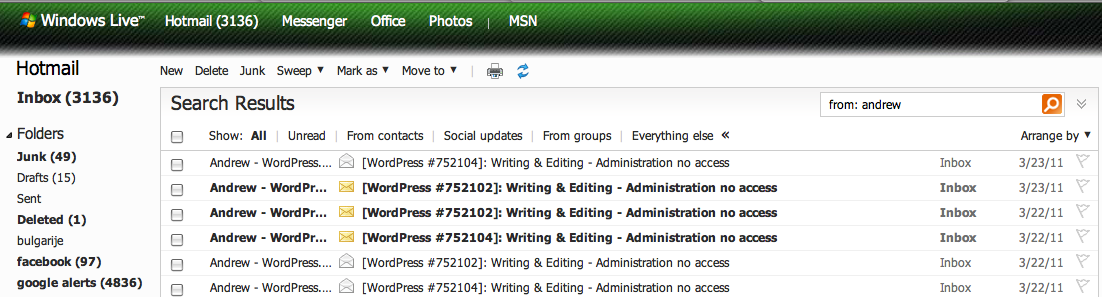
I doubt the authenticity of Andrew. Would an authentic human being out of flesh and blood e-mail you six times? Would he send recurring e-mails that bring you exactly the same message? I wouldn’t for sure. It felt like spam. And I’m quite convinced that you’d experience too much e-mails as “manufactured” as well. Didn’t Aaker learned us that we actually don’t like that?

Aaker says that people have an aversion to anything that feels overly manufactured.

Andrew, WordPress's Hapiness Engineer send me 6 e-mails.

Andrew, WordPress's Hapiness Engineer send me 6 e-mails.

WordPress and Aaker did they ever had a date?

So, in the end I find myself asking: did WordPress ever had a lecture from Aaker? Or did WordPress just hear about the “Happiness Buzz” and came up with a title to put on automated e-mails? One would think so. After all they didn’t integrate two key findings of the study:

  1. that happiness after a struggle is the most rewarding
  2. that bringing happiness requires authenticity

As they did:

  1. just solve my problem. OK, it was solved fast, so I’m quite happy with that.
  2. not show any authenticity to me. Yes, too much e-mails feel robotized and spammy.

Yours Truly — @vermeiretim — Awesomeness Developer — tmbot.wordpress.com


Notes:

  1. I’m still in love with WordPress. This is just storytelling.
  2. You can always frame a story like you want to. I could have written it completely different. Just consider me framing it from the perspective of me being happy because of writing this article as a result of my initial Back-office issue. If you look at it like that, Andrew truly engineered me to be happy. After all, the true struggle was writing this blog post. Now that’s finished, I’m happy.
    Or suppose I wrote this story with a focus on the opposite approach “fear appeals”?
  3. There used to be a theory/research about persuasive communication that stated that “fear” (as being the opposite of “happy”) was a very effective way to get attention and communicate a message: “fear appeals”. Here are some references from that “wave”:
    • Spence, H.E.; Moinpour, R. (1972). “Fear Appeals in Marketing. A Social Perspective”. Journal of Marketing 36 (3): 39.
    • Leventhal, H (1971). “Fear appeals and persuasion: the differentiation of a motivational construct”. American Journal of Public Health 61 (6): 1208.
    • Dillard, J.P., & Anderson, J.W. (2004). The role of fear in persuasion. Psychology & Marketing, 21, 909-926.
    • Witte, K. (1992). Putting the fear back into fear appeals: The extended parallel process model. Communication Monographs, 59, 329-349.
    • I’ve also encountered this philosophy in political sciences. Let’s think e.g. on Adorno’s theory of the “authoritarian personality” (1950).
    • Taken the above into account and from what I know from the “fear appeals” theory, one can hardly imagine that this could ever be an ethical way to promote your business value a.k.a. to organize your marketing around a.k.a. to use in your communications.

This Monkey is in for some Candy. And Stories.

Monkey brains want stories.

Monkey brains want stories.

Please Listen very carefully to what this monkey has to say. He shall say this only once!

It’s monday evening. You had another marvelous meal with your family. Children are to bed. You’re all set.
Couch? Check. Tele? Check. Wife half asleep under the blanket? Check. Game on? Check. Candies? Check.

Hold on, wait a minute!

Didn’t you just enjoy a great dinner with wife and kids? Do you really need that candy bar? I thought children were to bed? I can tell you one thing: you don’t want candy. So why are you eager for candy than?
Well, simply because you have a monkey brain!

You’re telling me I have the brain of a monkey?

No offense, but yes I do tell you that you have a monkey brain. Period. Let me explain. In fact, you still have that brain from back in the days people lived in caves. And it’s that caveman that is hard-wired deep inside of you that makes you want to have candy. You know back in the cave days, sugar was scarce. So we took every single chance we had to pump sugar into our body.

Nowadays, we still have that same brain. We still take every chance we have to eat candy. However, in today’s world sugar isn’t rare it all. It’s everywhere. But our brain doesn’t realize that. What our brain also doesn’t realize is that it simply loves stories.

Monkey brain loves stories.

Back in the cavemen days, stories were the manner to transmit information and knowledge in such a way that it was easy to remember and to share. The explanation speaks for itself: in an oral culture – where content is transmitted via speech – one needs a certain “angle” to find something compelling in order get attention, to be remembered and – especially to be shared. And that’s where stories come into play.

Stories create an angle. An angle makes something remarkable. Something that is remarkable enough to be noticed. Something that is that impressive that you might remember. Something that is that awesome that you need to share it with your peers.

Storytelling as a means to pass information - cavemen speak

Storytelling as a means to pass information - cavemen speak

Stories are told with moderate voice, or even whispered!

As stated before, in oral cultures, information was passed along through the usage of stories. As people were unable to transcend distance, only those at the right time and at the right place were able to hear the information. They were close enough to hear a story being told. A story brought to them via the medium ‘voice’ or ‘speech’.

The medium wasn’t disruptive and messages weren’t loudly screamed at participants. People who wanted to take part were pulled towards the storytelling circle, because of their interests, because of the fact they belonged to the community.

What we should realize here is that “stories” and “storytelling” are hard-wired into our cavemen brain – as is our love for sugar and thus candy. OK. Fact. But doesn’t the monkey brain brings along implications for today’s business, marketing and communication?

Not authentic? Sleep outside of the cave... not safe for mammoths!

Not authentic? Sleep outside of the cave... not safe for mammoths!

The monkey brain and your business, marketing and communication efforts

I didn’t tell the story above without a reason. I want to distill some essential characteristics of human communication and relate them to the world of business, marketing and communication.

The thing is, we are still cavemen, all of us. Our brain still favors elements that are compatible with a cavemen environment. We live in a modern world with a prehistoric brain. So here we go, what are the implications of the monkey brain for business, marketing and communication?

  • Don’t push it, Pull me. But pull me hard, Baby!
    The storytelling phenomenon from the cavemen clearly demonstrates that information or messages should not disrupt (push). Creators and distributors of information made their content that relevant that people were basically dragged towards them. In this manner, creators could whisper the story to the people in the circle. The circle is what we label today as a community.
    Today, with so-called social media, we have the chance to spread stories and make them easily accessible for anyone. Through conversations about the story, the community is build. No need for shouting. Whispering works just fine.
  • Connect people, Stupid!
    The whole point of the cavemen culture was to connect people by creating a “shared knowledge base” crafted through stories. Because of mankind’s evolution we altered from this and we started screaming our information. After all, screaming was the only way to reach people spread across the globe.
    Today, with the rise of social conversation digital media, we have the chance to act close to our monkey brain again. We can whisper messages to people in our storytelling circle slash community. To match the monkey brain, a whispering approach seems to work well. As a result we need to show ourselves in our authentic way, fully transparent.
  • No spinning please, those sleep outside of the cave.
    Social control was rather big in cavemen society. People that told stories that weren’t authentic or fully transparent weren’t appreciated. They were condemned to sleep outside of the cave. Pretty unsafe for mammoths!
    If you aren’t authentic and transparent today, you’re well on your way to loose all the monkey brain people – which is basically everybody! So you might want to consider…

Old marketing versus New marketing

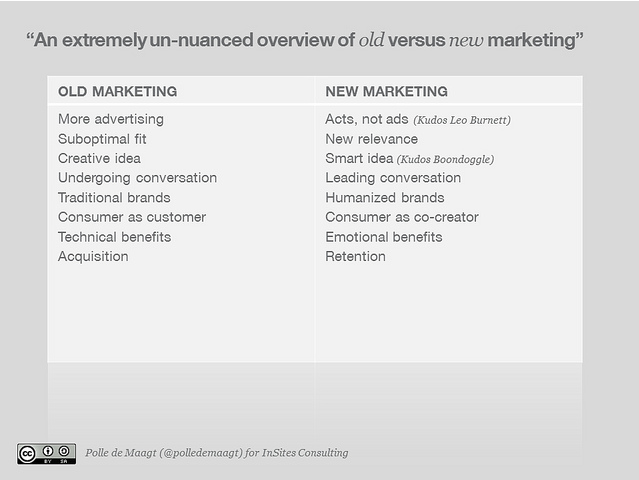
It seems as if the above reflections result in the same conclusion as made by market researchers. Here’s something I found through Twitter (yes, Twitter): a “bit of Polle Demaagt” from InSites Consulting. I believe at the end, we (try to) indicate the same thing. For those who rather have schemes than a story, I’m talking about the scheme below.
Old versus New Marketing - Insites Consulting / Bits of Polle Demaagt

Old versus New Marketing - Insites Consulting / Bits of Polle Demaagt

That’s why I Whisper through the Web in XL, Medium and Small

The above shows why I whisper through the web. Yes, I don’t wear a monkey suite. And yes, I do realize that the baseline “screaming is from the past” doesn’t completely fit. But I hope to have demonstrated that in the cavemen era people whispered in a community – they did not scream to people outside the community (who didn’t care about the information) and that we consequently altered from this, but that we now have the chance to go back to acting like our monkey brain loves most.

See which stories I whisper through the web? Hit the below links:

Oh, just one more thing.

The above is just my story, framed for a special purpose. I could have framed it completely different. But here’s why I did not.

Just one more thing - Steve Job sentence

Just one more thing - Steve Job sentence

The story of me ending up writing this story

Date is March 2010 or something like that. I decided to set-up this blog. Did get an average of 23 people a day. Hooray!

OK, it helped me to get rid of my writing anger. But clearly, it soon appeared that I wanted more. So I ended up thinking about adding some touchpoints for the blog: a twitter account, mention it on linkedin, tumblr account, etc. Options were numerous.

I decided to go for Twitter first. I think we were September 2010 by then and it’s one of the key drivers of writing this piece.

Twitter as a home-cooked private teacher

There you are. You have a twitter name. Congratulations! Now what? What to do with it?

I decided to consider Twitter as my private teacher as I figured a lot of interesting people had to be active on Twitter: MBA professors, Industry Thought Leaders, etc.

Twitter is full of crap

Twitter

Twitter - try to craft it into a first-class professor

Setting up an attempt like crafting Twitter into a first-class MBA professor is hard. Quite frankly, I’ve unfollowed loads of people that I followed at the start of my Twitter experience.

But one guy has been there almost from the very start. And I’ll probably never unfollow him: @rafstevens.

@rafstevens, my Storytelling teacher

I was intrigued by Raf’s project “The New Trade”, a crowd-funded and crowd-sourced book on Storytelling for business. So I asked Raf: “how does the collaboration process work?”. Raf kindly replied me “why not have a phone call about that” and provided his phone number. I promised to call him the day after. I didn’t. It slept my mind. My apologies.

However, I decided to take this “social error” (not calling as promised) into an advantage. After all it gave me the time to get more details and insights on the entire storytelling thing.

I used Twitter (and @rafstevens in particular) to obtain an MBA in storytelling. With Raf’s expressions and links to other world-class storytellers I started to realize what it’s all about. Or at least, I believe I do. I wonder if Raf thinks so too.